In September 2022, I was asked by Kathy Taddeo at the Webster Museum to assume the responsibility of writing the “Bit of Webster History” feature, which is published monthly in the Webster Herald and on the museum’s website.
I was happy to do it; these are very short and easy-to-write pieces, and the research they’ve required has led me to learn so much more about the fascinating history of our town and village.
I’ve made sure to post each of these features in my blog, but have also indexed them all here to facilitate easy access for those who are as interested in Webster history as am I.
Rules for teachers, circa 1972 (Sept. 2022)
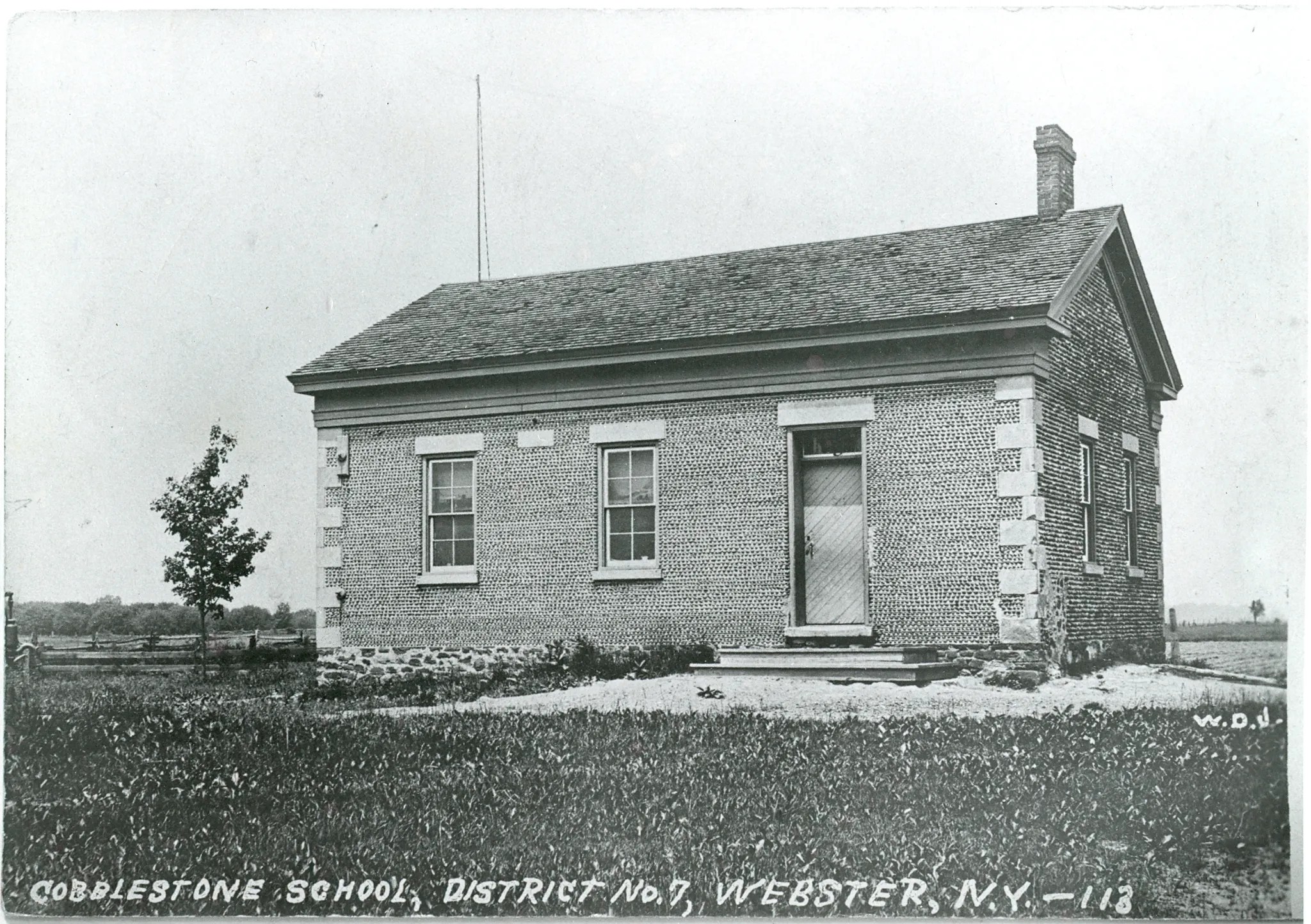
In honor of the first week of school and our hard-working teachers, this month’s History Bit takes us back to a time when school was held for all grades in one room heated by a wood stove, writing was done on slates, and the drinking fountain was a metal pail and cup.
The first school recorded within the township of Webster was a log cabin at the corner of Salt and State roads in 1813. In those days the school year was typically divided into summer and winter terms. Usually a woman would teach girls and young children in the summer, and a man would teach the older boys in the winter after they were released from farm work.
When is a house just half a house? (Oct. 2022)
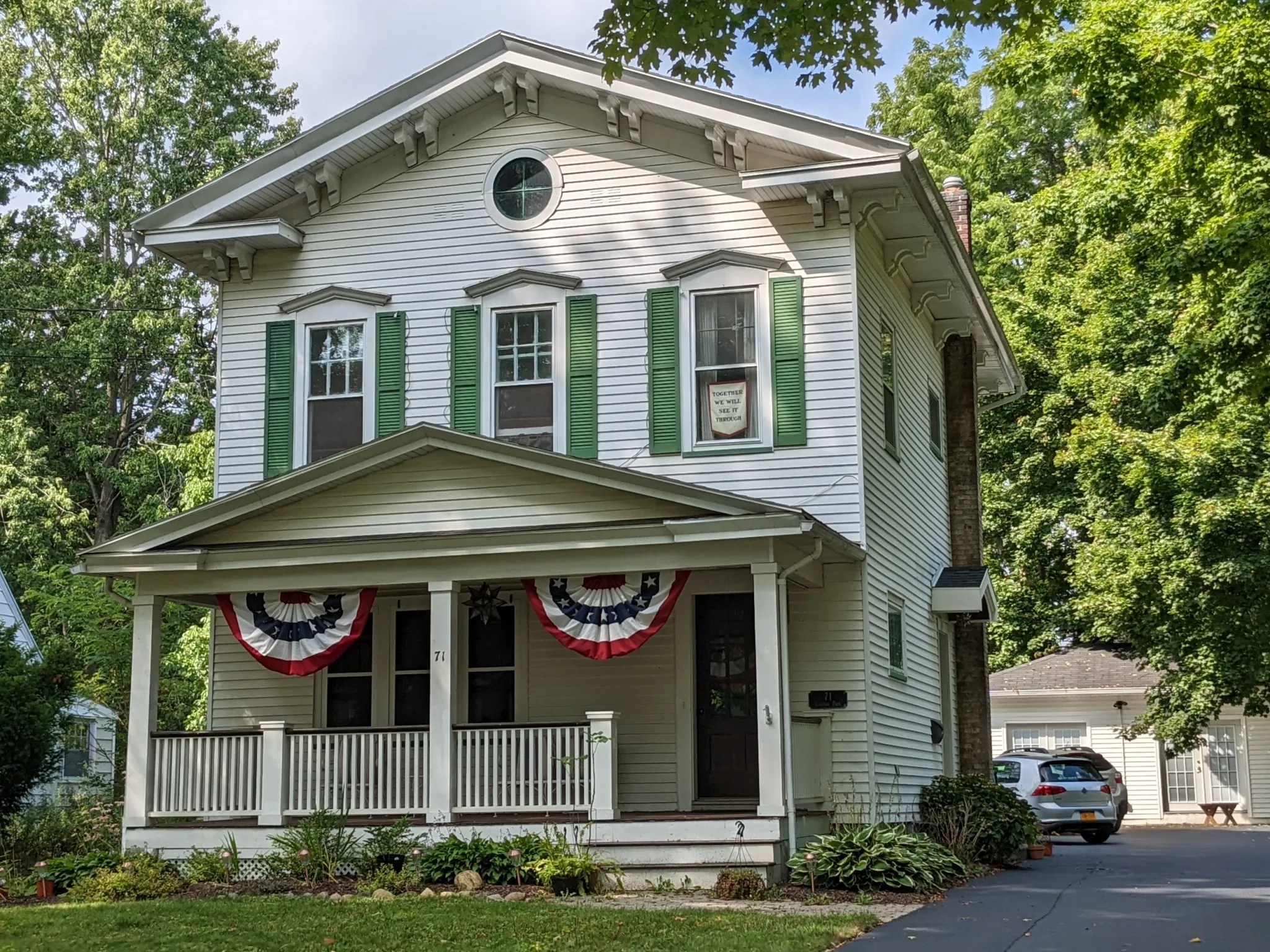
Anyone who’s ever walked or driven down Corning Park in the Village of Webster probably hasn’t noticed anything unusual about the houses on that peaceful little street. However, two of those houses, which stand across the street from one another, do have a curious history: in the early 1900s, they used to be one house.
(Click here to read more.)
What’s in that drawer? (Nov. 2022)
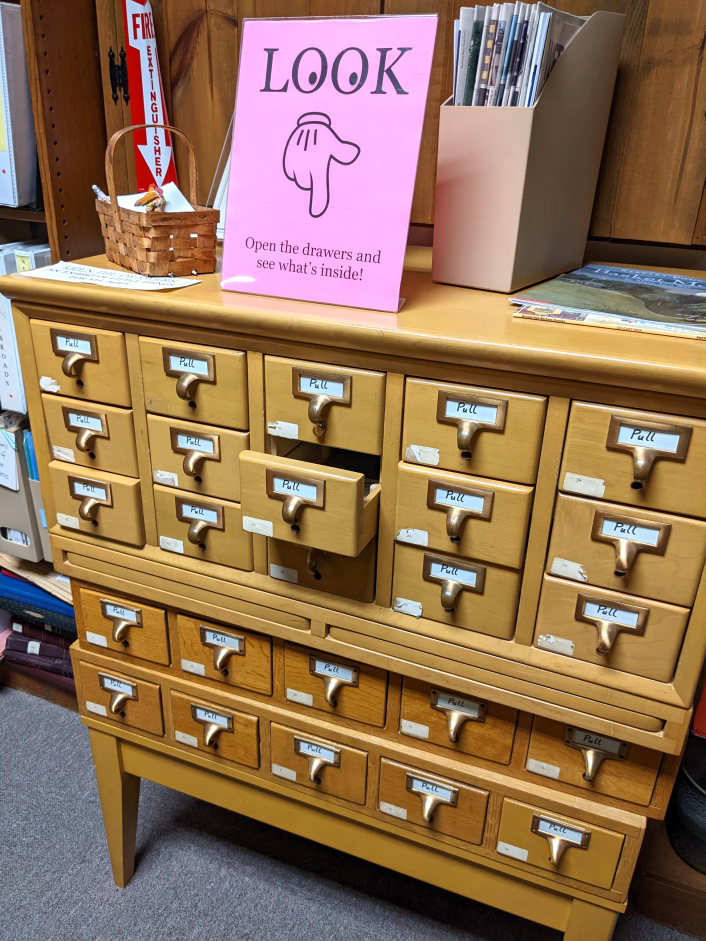
For this month’s Webster Museum History Bit, I introduce you to a piece of museum furniture that you might recognize from your school days.
Do you remember library card catalogs? Before the days of computers and electronic catalog records, these bulky wooden cabinets held individual cards for every book in the library’s collection. To find the book you wanted, you had to find the right drawer and flip through the cards.
(Click here to read more.)
Burkhardt family creche a holiday highlight at the museum (Dec. 2022)
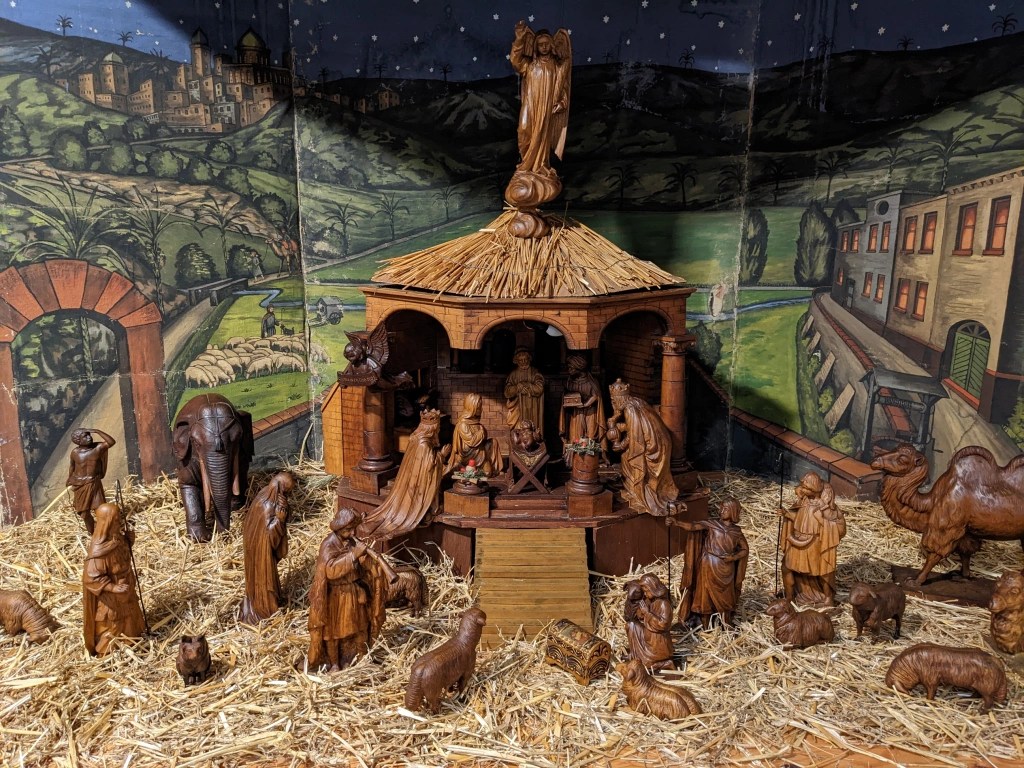
We can always count on the Webster Museum to be especially beautiful and sparkly this time of year, with holiday decorations and miniature Christmas trees sprinkled throughout the displays. But for more than 40 years, the real star of the show has been the Burkhardt Family Creche.
This beautiful, hand-carved creche, on display near the museum’s entrance, has a beautiful history all its own. This creche was made in Germany by C. Jess, a church architect. He made one piece a year between 1918 and 1944, each year giving the newly carved piece to his sister Freda in Frankfurt, Germany.
(Click here to read more.)
Check this out: the history of the Webster Public Library (Jan. 2023)
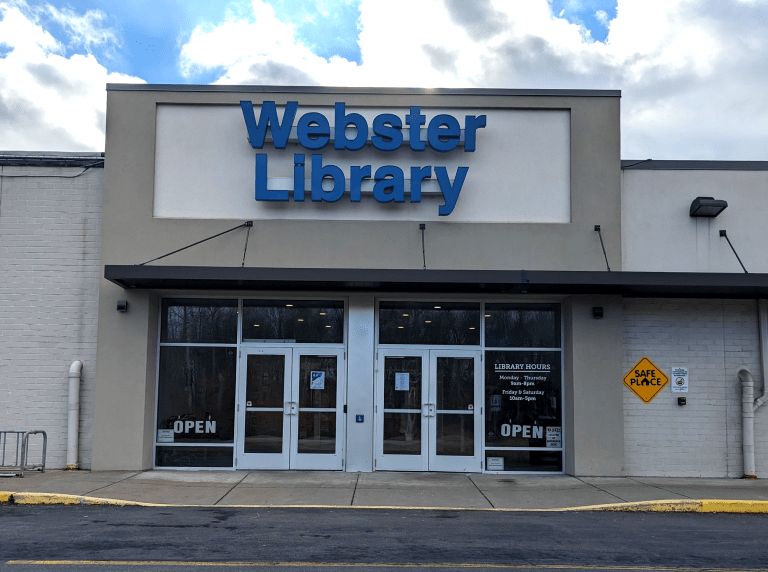
I don’t know about you, but I can’t imagine living in a town that does not have a public library. A public library is a vital part of any community, for all ages and for so many reasons. In particular, the services our Webster Public Library provides for our town can’t be overstated.
So it’s difficult to imagine a time when there wasn’t enough interest among the residents of our young town to support a public library. That fact alone led me to dig deeper into the history of our very own Webster Public Library for my January Webster History Bit. This is what I found out …
(Click here to read more.)
Meet “Nipper,” the Webster Museum’s mascot (Feb. 2023)
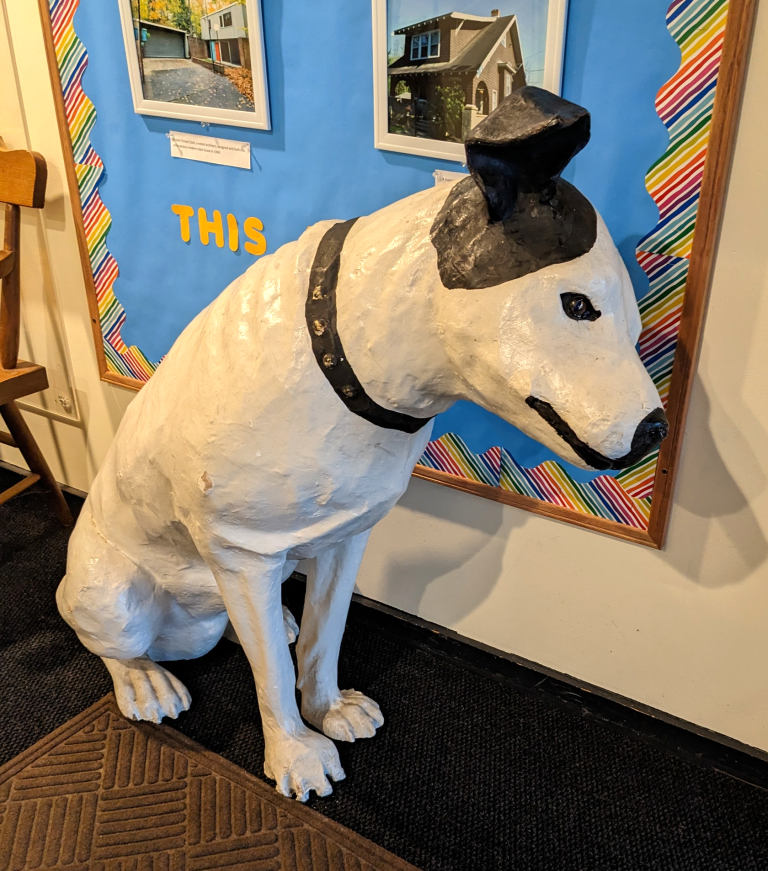
Just steps inside the front door of the Webster Museum sits one of the museum’s most faithful greeters, a life-sized white dog made from papier-mache. His head cocked slightly to one side, he seems to be patiently and carefully listening for when the front door opens and he can welcome the museum’s next visitor.
His name is “Nipper,” and if you’re of a certain age, you’ll recognize him as the mascot of RCA Victor, one of the most famous trademarks of the 20th century.
(Click here to read more.)
A little respect for the proud Irish potato (March 2023)

In honor of the month of March, when we celebrate all things Irish, here’s an amusing – and historical – look back at a vegetable that’s central to Irish heritage: the potato.
Back in the days when Webster was more a farming community than anything else, the Webster Herald would commonly publish reports on the bounty of the year’s harvest. But the following two items, pulled from a column called “Who Can Beat This?”, published on Oct. 23, 1942 at the height of WWII, focused specifically on two very unusual potatoes.
(Click here to read more)
History came alive at the Webster Public Library (April 2023)
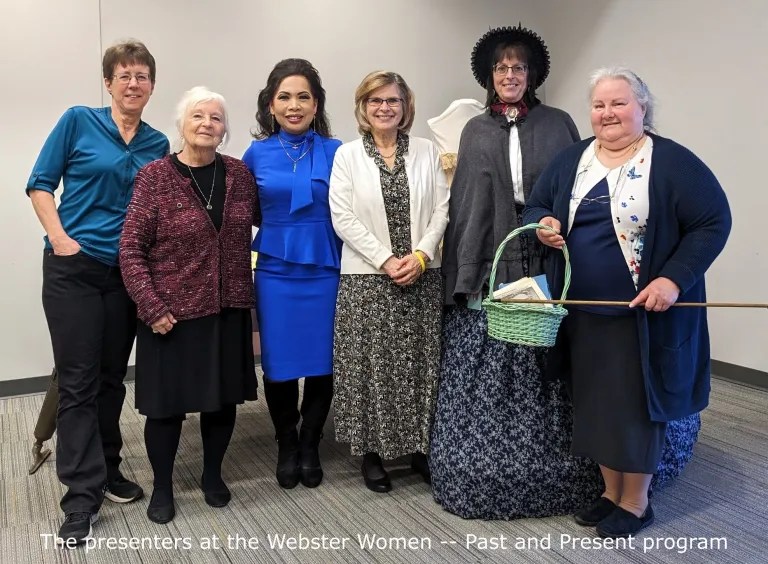
About 30 people gathered in the library’s Community Room Thursday afternoon to listen to six Webster women tell their stories of what was — or is — notable about their lives. I was honored to be included in that outstanding group of women, speaking for around five minutes mostly about how I began my Webster on the Web blog and how it’s become a valued resource in our community.
(Click here to read more.)
What’s in a name? (May 2023)
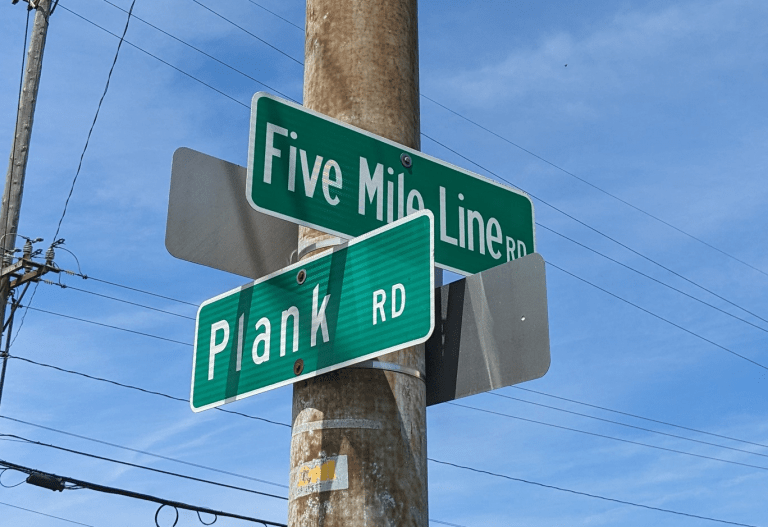
The names are all very familiar to us: Plank Rd., Salt Rd., Basket Rd., Five Mile Line Rd., Shoecraft Rd., Whiting Rd. But what might not be so familiar is exactly how these well-known roadways got their names.
Plank Rd. is pretty self-explanatory. It used to be covered in wooden planks. But how about the others? Their stories, recounted in Webster Through the Years by Esther Dunn, offer a glimpse into Webster’s history.
(Click here to read more.)
What’s in a name? (Part 2) (June 2023)
Last month’s Webster History Bit feature really struck a chord with many current and former Webster residents. Titled “What’s in a Name?”, it told the history behind several well-known Webster street names: Salt Rd., Basket Rd., Five Mile Line Rd., Shoecraft Rd. and Whiting Rd.
That little blog took took me about 15 minutes to write since I pulled pretty much all my information straight from a brochure published by the Webster Museum. Ironically, it drew more online comments, shares and “likes” than any other blog I have ever written. In many of the comments, readers wondered about the history behind other well-known road names. I made a list of all of the roads that people asked about, and I will try to address most of them here.
(Click here to read more.)
The Village of Webster’s very own pioneer cemetery (July 2023)
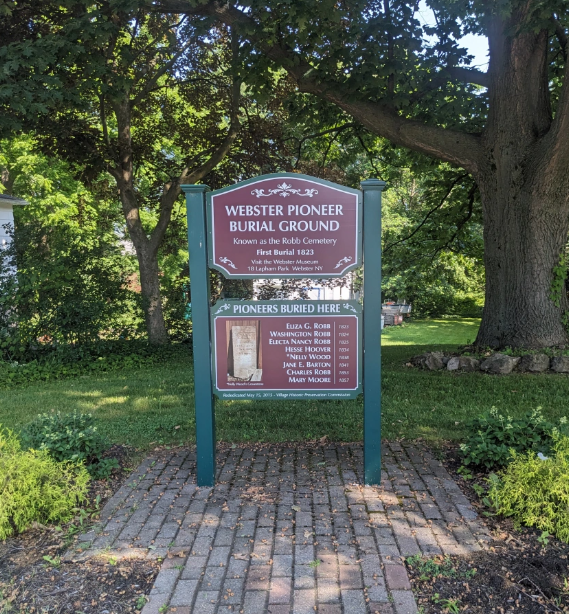
The Town of Webster has several beautiful cemeteries, most very familiar to us. But the smallest of our town’s cemeteries is often forgotten, even though many of us pass by it almost every day.
Robb Cemetery is an 8700-square foot parcel of land on East Main Street in the village of Webster, just west of Phillips Road. It is a true pioneer burial ground, with at least eight known burial sites dating back to 1823.
(Click here to read more.)
The town’s first “telephone” (August 2023)
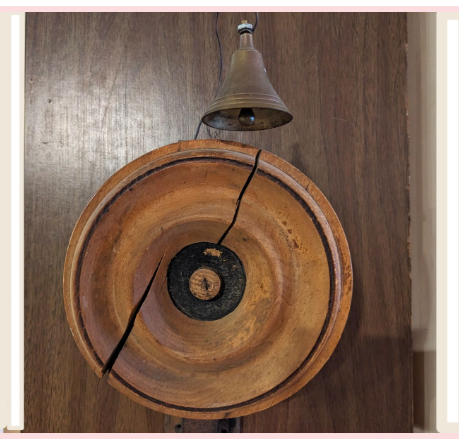
You never know what fascinating nugget of Webster history you’ll discover when you visit the Webster Museum.
For example, just inside the front door hangs one of Webster’s very first “telephones,” which was used from 1887 to 1901. It hung in what was most recently the Music Store on West Main St. in the village, when the old post office was located there. A second one was installed in the railroad station on North Ave.
The two instruments were connected by two wires strung across poles and roofs of houses along North Ave. They operated in much the same way as the old tin-can telephones we used to use when we were kids. Remember them? Stretch a string between two tin cans and you could talk back and forth just by keeping the string taut.
(Click here to read more.)
The Town of Webster’s official tree (September 2023)
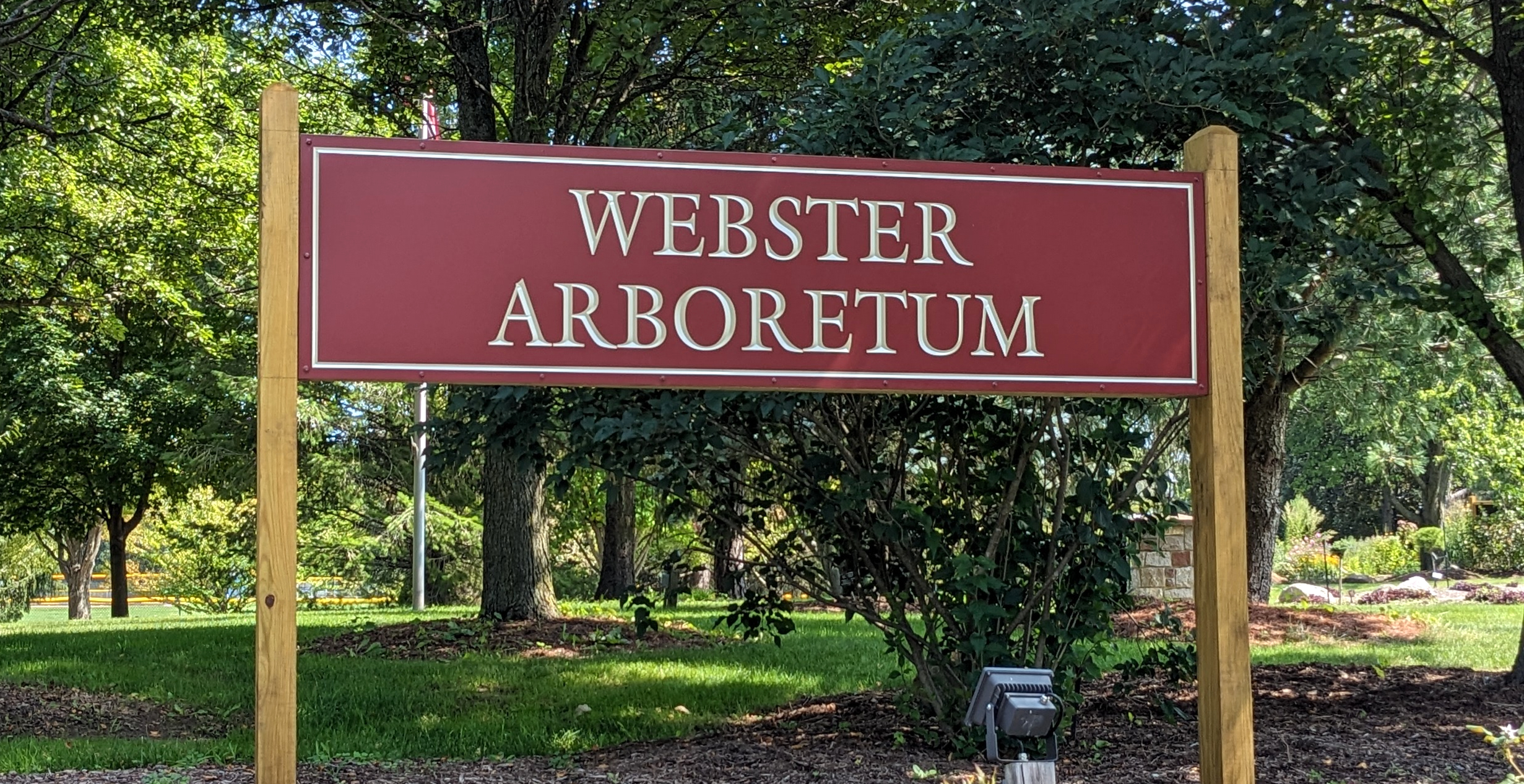
In this month’s History Bit, we shine a spotlight on the Webster Arboretum, and a beautiful little tree with the peevish name, the crabapple.
Most people probably don’t realize that the flowering crabapple is the Town of Webster’s official tree. According to the Webster Arboretum website, that designation can be traced back to Elizabeth Sykes, a member of the Webster Country Gardeners Garden Club. Back around 1970, she urged the Town to adopt the tree as the Town Tree. (No one seems to know why she chose the crabapple).
(Click here to read more.)
The James Carnevale Bike Route (October 2023)
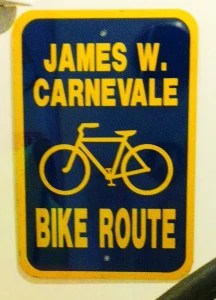
These beautiful first weeks of fall are a great time to go out for a bike ride. If you’re up for a 14-mile ride along some of Webster’s most beautiful roadways, you might want to explore the James W. Carnevale Bike Route.
The route was named in honor of James Carnevale, who lived on Old Farm Circle. He served in Korea as an Army Intelligence Officer, and was awarded a bronze star for photography. He served as Webster’s Recreation Commissioner for many years, and was an active member of the town’s Democratic Party. He passed away suddenly in 1977 at age 47 and is buried at Webster Union Cemetery.
(Click here to read more.)
Where did Webster’s slogan come from? (November 2023)
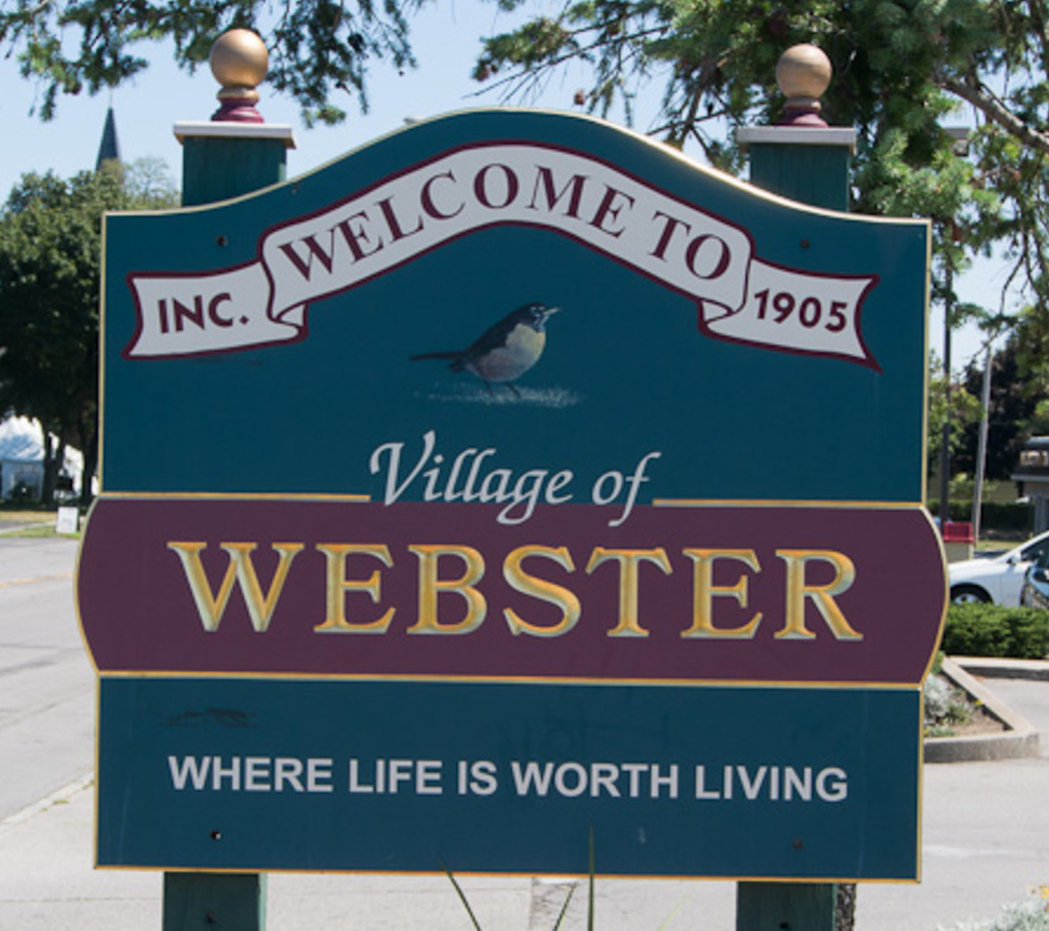
It’s a phrase most residents of the Town of Webster know well: Webster is “Where Life is Worth Living.” But have you ever wondered how and when that slogan came about?
Several years ago, Town Historian Lynn Barton looked into the question, and uncovered an excerpt from the 1926 Webster Union and High School Handbook for Students, Teachers and Parents, which attributes the slogan to “an enterprising Ad Club.”
(Click here to read more.)
The Burkardt Family Creche (December 2023)
This particular History Bit is a repeat from December 2022, mostly because I think it’s the perfect feature for this time of year (and I was a bit pressed for an idea).
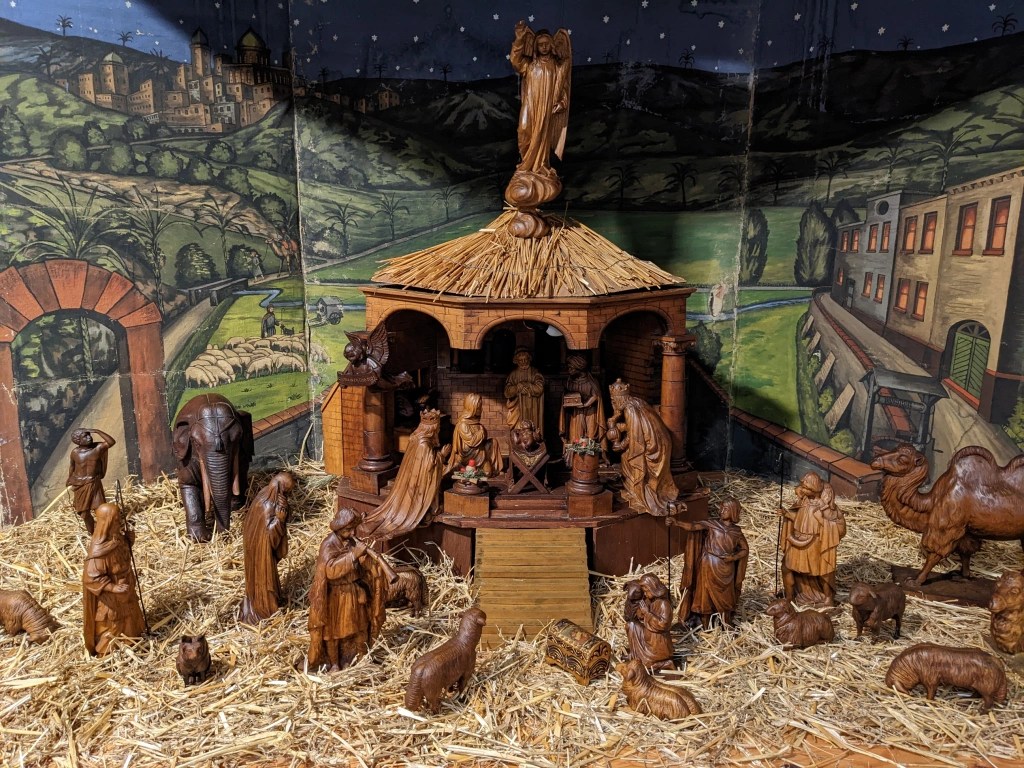
We can always count on the Webster Museum to be especially beautiful and sparkly this time of year, with holiday decorations and miniature Christmas trees sprinkled throughout the displays. But for more than 40 years, the real star of the show has been the Burkardt Family Creche.
This beautiful, hand-carved creche, on display near the museum’s entrance, has a fascinating history all its own. This creche was made in Germany by C. Jess, a church architect. He made one piece a year between 1918 and 1944, each year giving the newly carved piece to his sister Freda in Frankfurt, Germany.
(Click here to read more.)
Webster Carriage Blocks (January 2024)
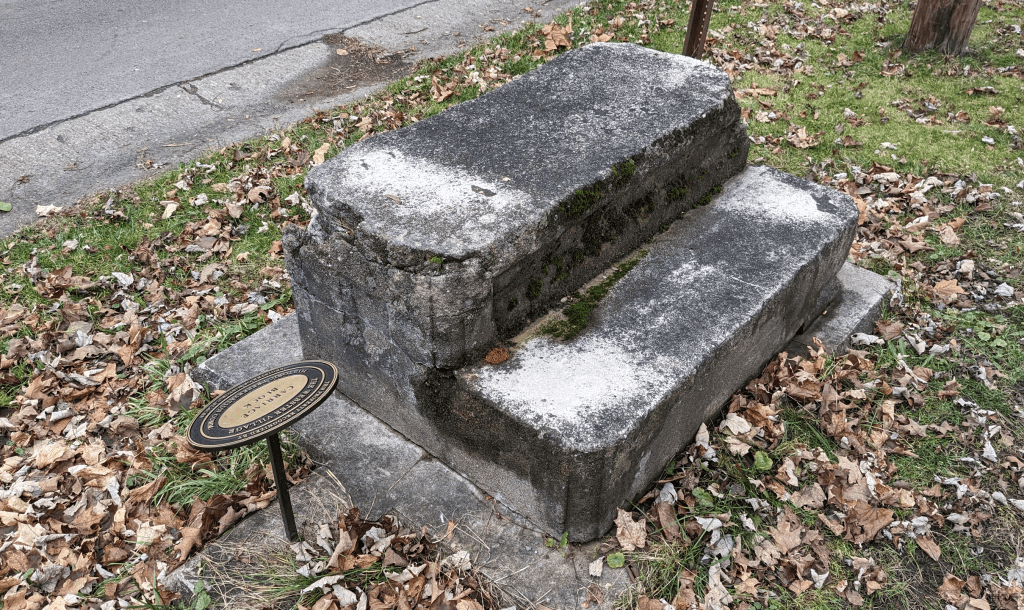
If you’ve ever walked or driven down Corning Park in the Village of Webster, you’ve passed by a little piece of history which you might not have noticed. It’s a carriage block, and it sits in front of the home at 34 Corning Park.
In the time when horses and buggies were the main forms of transportation, anyone other than very athletic riders and passengers faced some difficulty dismounting horses, stagecoaches or buggies, which rode several feet off the ground. The solution: a carriage block, also known as a horse block. Basically, they were step stools, bridging the large gap between ground and vehicles, making mounting and dismounting much easier.
(Click here to read more.)
Webster’s Camera, the Winpro (February 2024)
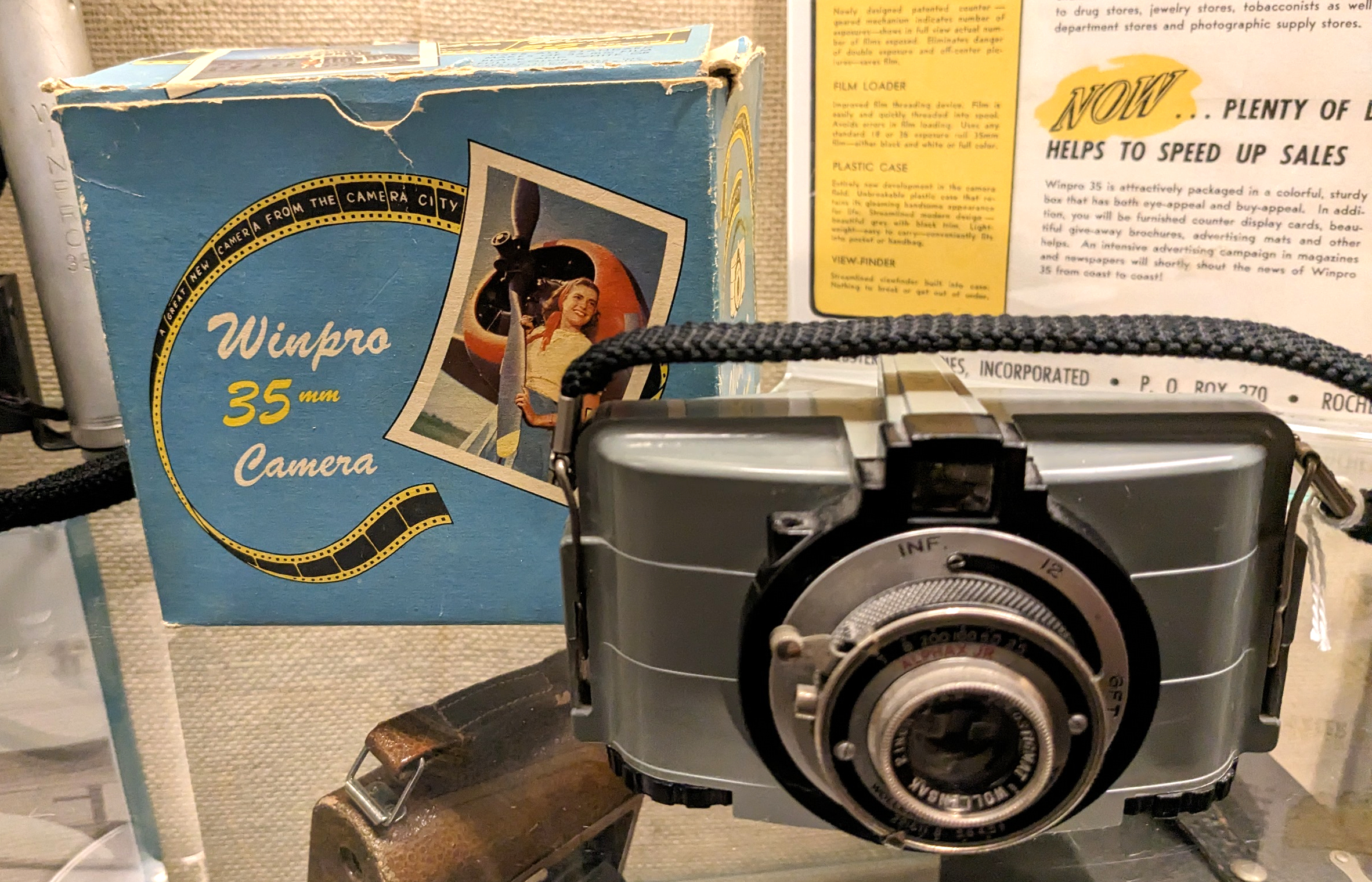
Most longtime Webster residents are already pretty familiar with the industries our town is best known for, like baskets, apple growing, and fruit evaporating. But how many realize that Webster also had a thriving camera-making business?
From 1948 to about 1954, Webster Industries, Inc. produced the only camera ever made in Webster. It was called the Winpro, and was the first point-and-shoot 35 mm camera made entirely of molded plastic. The factory was at 36-38 Commercial St., near where Response Care, Inc. is now located.
(Click here to read more.)
Happy Birthday Bay Bridge! (March 2024)
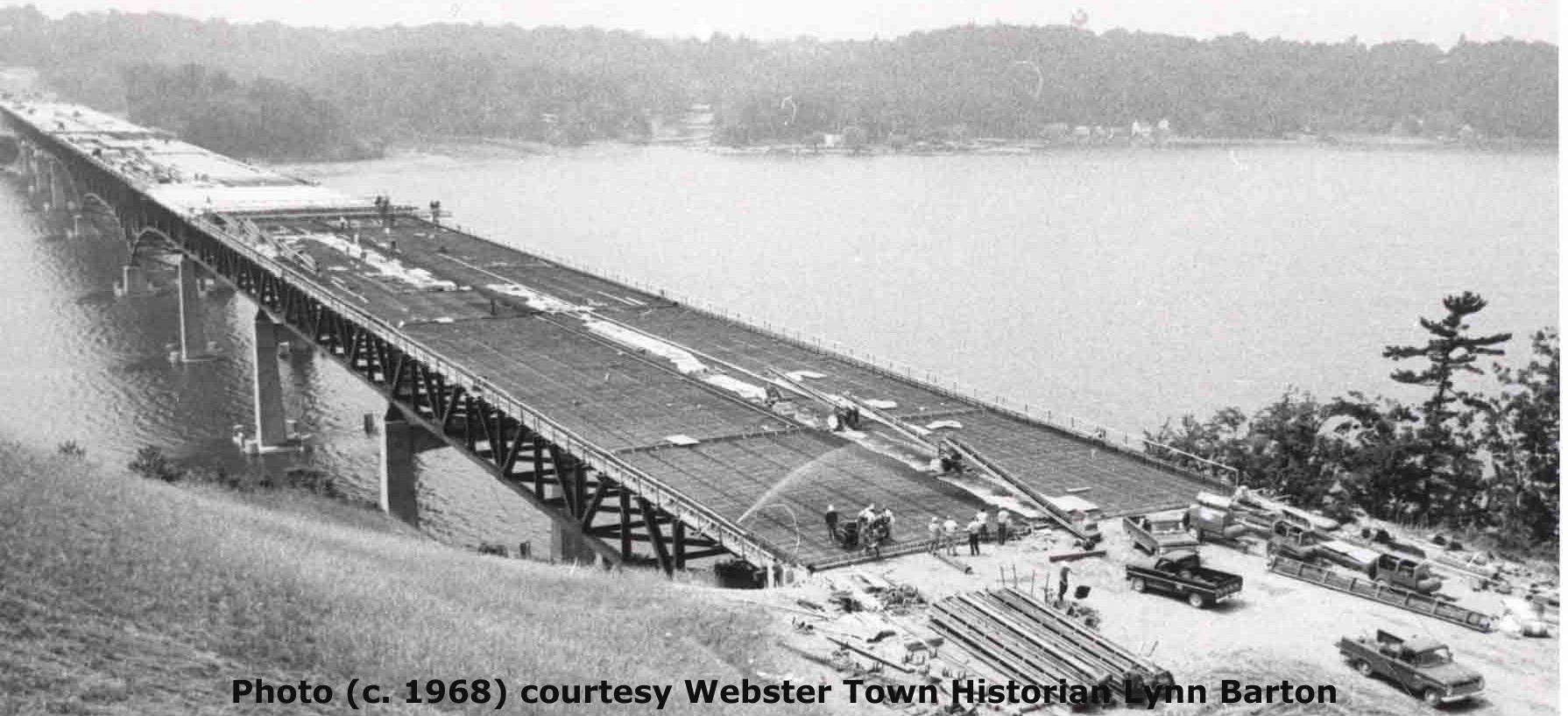
The Irondequoit Bay Bridge celebrated a birthday last month.
On Feb. 3, 2024, the Bay Bridge turned 54 years old. Stretching almost a half mile long, the bridge was christened on a snowy day in 1970, which was reportedly so cold that the celebratory wine froze in the glasses before it could be raised.
Seven months later, on a much sunnier and warmer late August day, the bridge was officially dedicated with not one, but three ribbon cutting ceremonies; one held at the Irondequoit end, a second in the middle and a third at the Webster end.
(Click here to read more.)
Cars Along the Creek (April 2024)
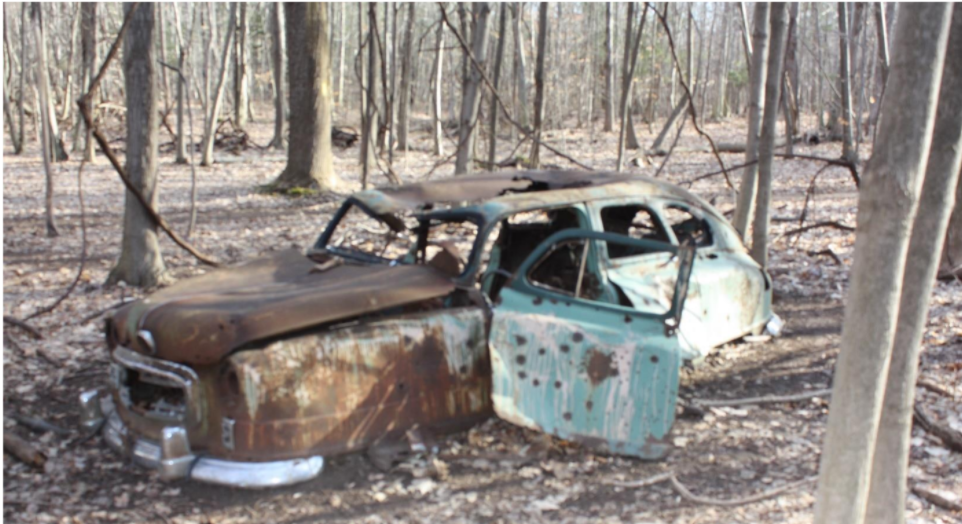
As spring slowly creeps back into town, and the flowers and trees start to bloom, it’s the perfect time to get out and take a hike on one (or several) of our outstanding Webster trails. Some of the most beautiful of those trails, and most interesting from a historical perspective, are the ones that wind through the Four Mile Creek Preserve at the corner of Lake and Phillips roads.
Scattered along the Four Mile Creek trails are seven rusted-out old cars, including a 1949 Nash Ambassador Custom Airflyte, a 1950 Chevrolet Deluxe Bel Air, a 1956 Nash Rambler and others. They tell of a day when the parkland was just farmers’ fields and kids would use the area for joyrides.
According to Dennis Kuhn, the Friends of Webster Trails’ resident Cars along the Creek expert,
The cars were driven onto the property from Lake Road across a bridge that accessed farmland where the cars were last driven. It seems that some local youths decided to create a racetrack somewhat off the beaten path to have some fun cavorting around the open fields that were available at the time. If you traverse the land as it is now, you’ll have to use your imagination to see a relatively treeless landscape that existed sometime in the nineteen fifties or early sixties.
Nevertheless, the youths of the day had a ton of fun going around in circles until they ran out of gas or had a flat tire or wrecked the transmission.
So take a hike one of these spring days along the trails at Four Mile Creek Preserve, and enjoy a fascinating walk back through Webster history. You can read more about these and all of Webster’s trails at the Friends of Webster Trails website, webstertrails.org.
The Harmony House (May 2024)
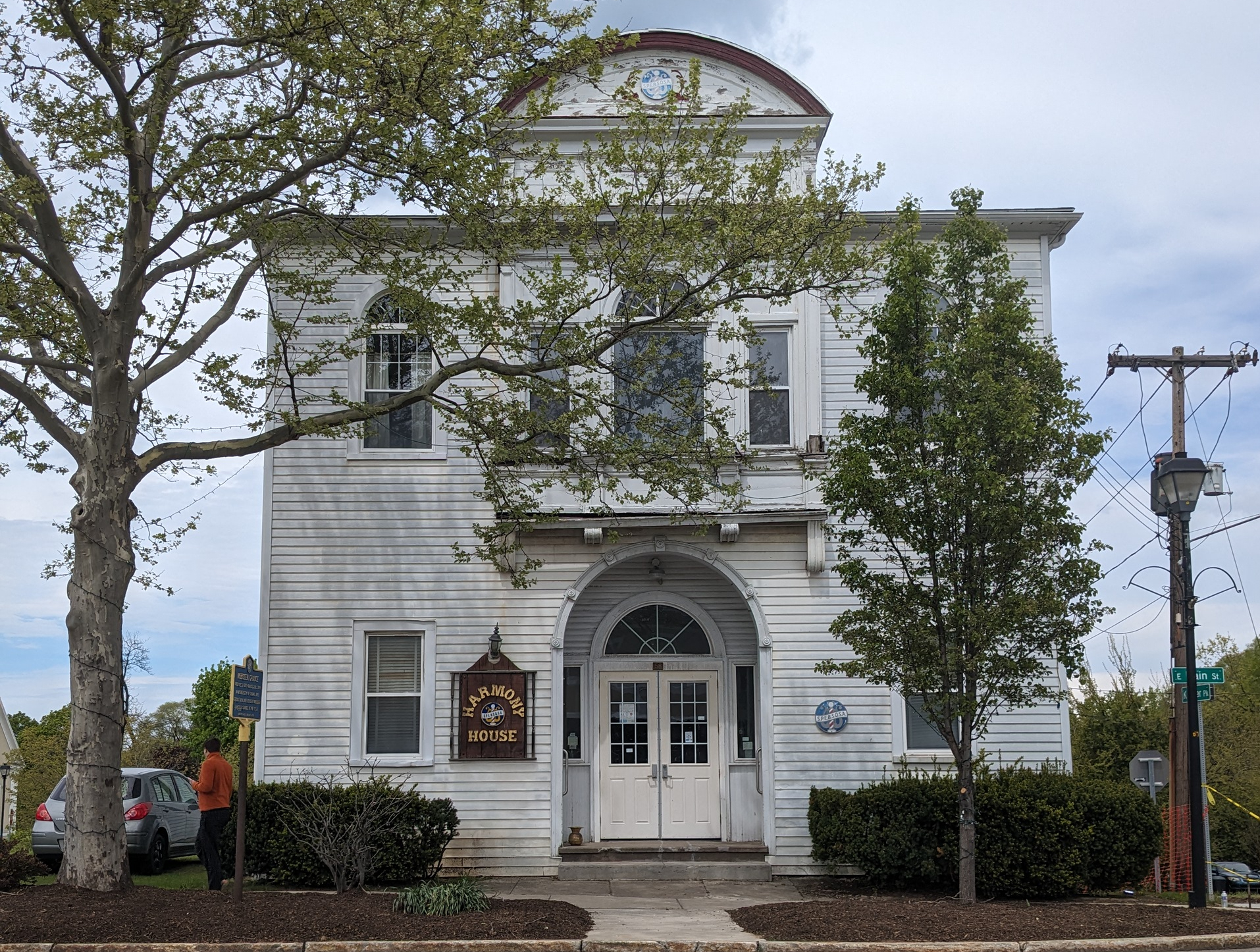
May is National Historic Preservation Month, so it’s only fitting that for this month’s History Bit, we take a closer look at one of the Village of Webster’s most historic and stately buildings: the Harmony House at 58 East Main St., which celebrates its 125th birthday this year.
The Harmony House earned its musical nickname from its best-known tenants, the Chorus of the Genesee. However, the building is officially known as the Webster Grange Hall, and was built in 1899 as a meeting place for Webster Grange #436. The lot was purchased for $450, chosen for its location near the heart of the business district, where it had direct access to the railroad via Kircher Park.
(Click here to read more.)
Webster Walkabout Adventure Lab (June 2024)
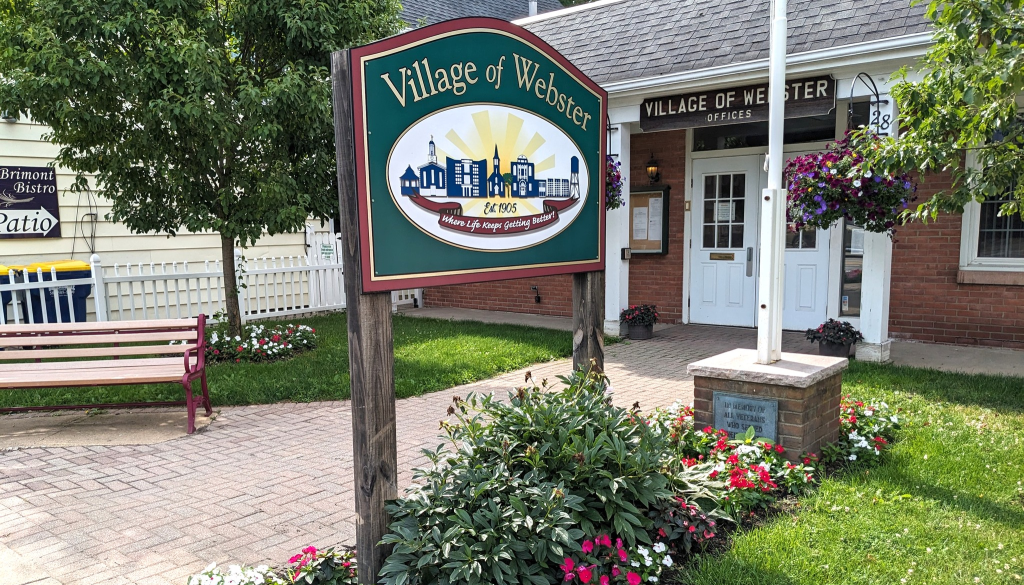
Summer is the perfect time to take a walking tour of the Village of Webster and explore its history. The Webster Museum has a fun and interesting way to do that: the Webster Walkabout Adventure Lab. It’s an activity for the whole family that gets everyone outside to learn a little history and get some exercise along the way.
The Webster Walkabout is based on geocaching, the very popular outdoor treasure-hunting activity that uses global positioning system (GPS) coordinates to hide and locate containers called geocaches.
Typically, the hidden geocaches are physical containers containing trinkets to reward the finder. The Webster Walkabout Adventure Lab is different; participants are led to a series of virtual caches; in this case, five sites of historical significance to the founding of the Village of Webster. At each stop, the game prompts you to answer a question by typing in a word that can be found on a sign or plaque nearby. The correct answer unlocks the clue to the next location. Some of the walkabout stops even include videos.
(Click here to read more.)
The Fireman’s Carnival (July 2024)
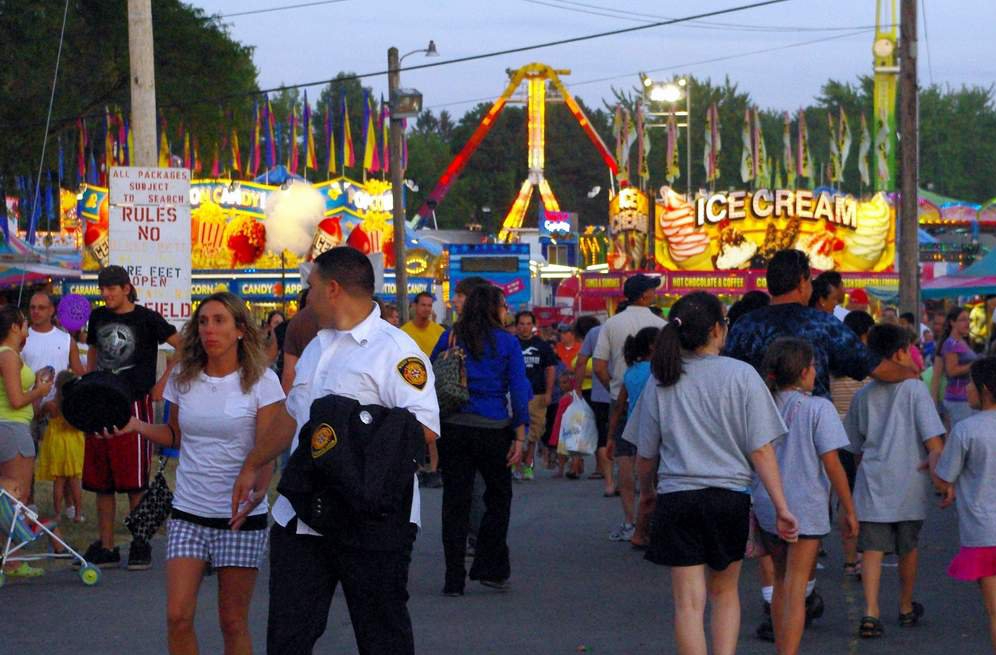
With the return of the Webster Fireman’s Carnival this week, it seems an appropriate time to take a look back at the history of this very popular and long-running summer event.
According to the Webster Volunteer Fire Department’s 100th anniversary history book, the Fireman’s Carnival turns 87 years old this year. The first carnival was held July 23 and 24, 1937 on Ridge Rd. just west of Corning Park, where Pierce St. is now. The first chairman, Russell B. Mason, reported a net profit of $514.63.
(Click here to read more.)
Webster Union Cemetery (August 2024)

Webster Union Cemetery, located at the corner of Rt. 250 and Woodhull Rd., is one of the richest historical sites in Webster.
Farmland was donated for the first known burial in 1817, when a Webster child needed a place to rest. It was originally called The Burial Ground, Lakeside, Union Cemetery of Webster. Since this caused some confusion between other areas near Webster, especially Union Hill Cemetery, the name was officially changed to Webster Union Cemetery in April 1954.
(Click here to read more.)
Going to school at the Webster Museum (September 2024)
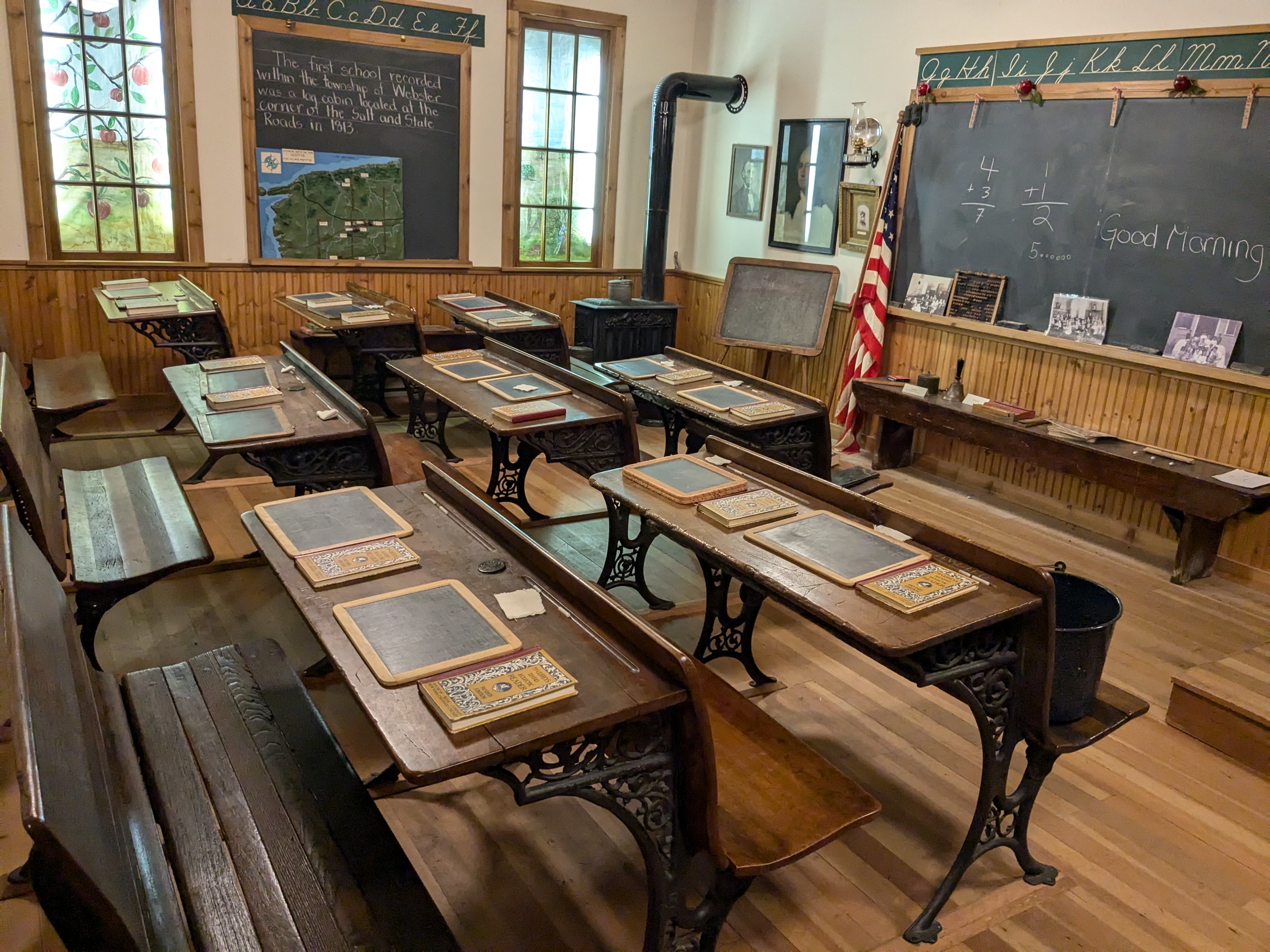
This month’s History Bit takes a closer look at a piece of Webster schoolhouse history, faithfully recreated at the Webster Museum.
It’s the museum’s very own one-room schoolhouse. Tucked at the far southern end of the museum’s exhibit space, the room represents a typical early-1900’s schoolroom. It seats 24 students at double desks and includes a schoolmaster’s desk, a collection of early textbooks, and early teaching aids.
The schoolroom is a very popular tour stop for the elementary school classes who visit the Webster Museum every year. As part their 75-minute tour through all of the museum’s exhibits, students take a 15 to 20-minute detour into the classroom and step back into a time when a wood stove provided the heat, lessons were completed on slates, and your older brother or sister might be sitting in a row behind you.
(Click here to read more.)
The Burning Ship of Nine Mile Point (Oct. 2024)
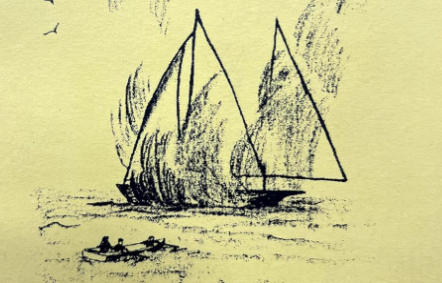
From the shores of Lake Ontario, I bring you a ghost story. It’s the legend of a long-lost ship whose spectral image (some say) can still occasionally be seen sailing under a blue moon.
The story hails from 1835, the heyday of lake-sailing cargo schooners. Nine-Mile Point was a natural stopping point for local shippers; the large sand bluff poked out into the lake and had a tree at the point’s end, making it easy to identify.
Angus McClone and Dirk VanWesterly were two tight-fisted farmers who had large farms near Nine Mile Point. Ship captains who docked there knew both farmers well, especially their penchant for haggling over shipping rates. Successful ship captains refused to deal with them, but there were always others who needed the money and had no choice but to agree to a bad deal.
(Click here to read more.)
What in the world is a penny-farthing? (Nov. 2024)
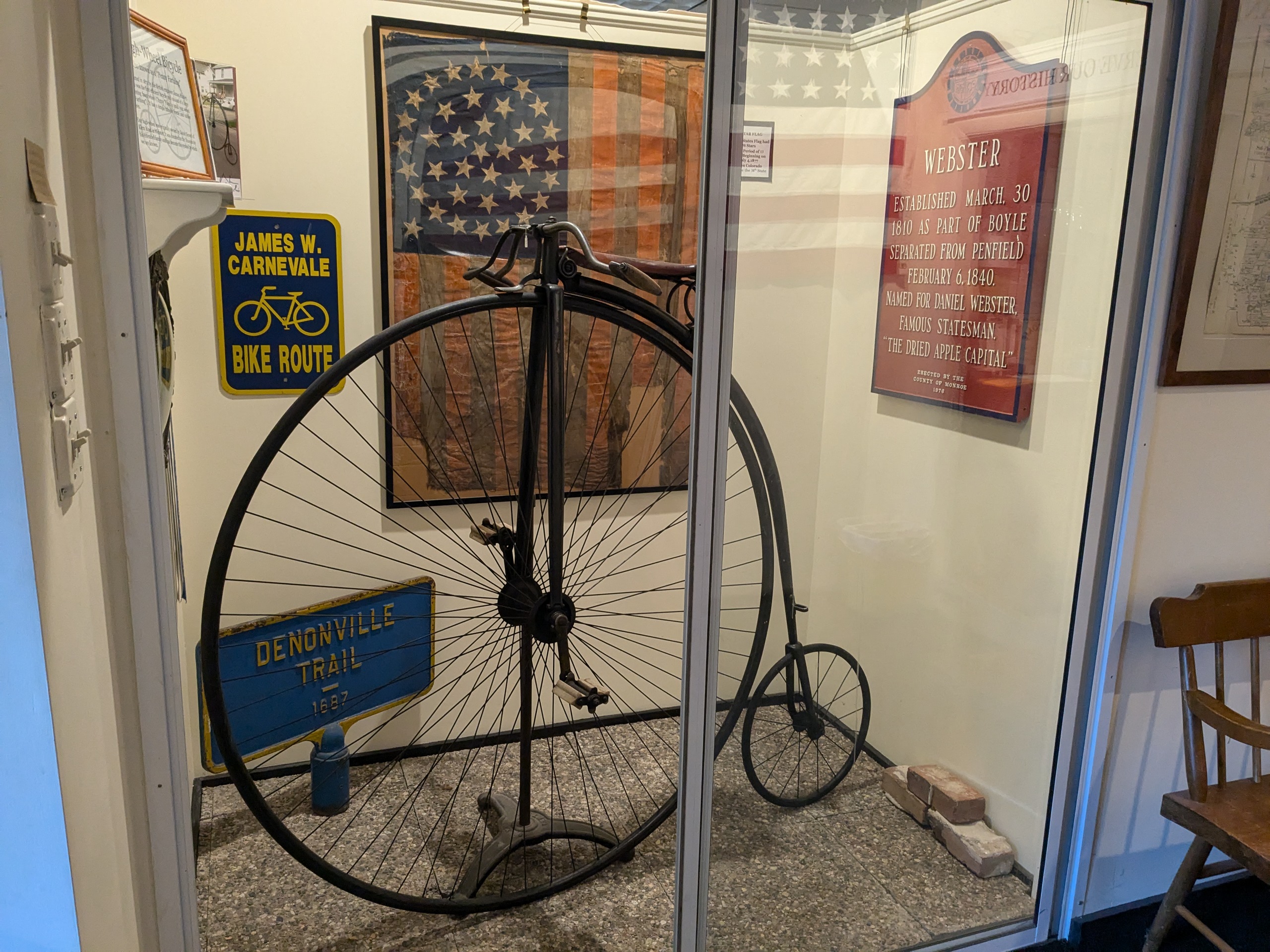
In this month’s History Bit, we honor the big bicycle with the funny name: the penny-farthing.
If you’ve ever visited the Webster Museum, chances are you’re already familiar with the penny-farthing. It’s that old-fashioned bicycle with the big front wheel and little back wheel that sits in a case just inside the museum’s front door.
It’s such an iconic piece of Webster history that many years ago it was chosen as the logo for the Webster Museum, and more recently, as the name for the museum’s new members and friends newsletter.
(Click here to read more.)
The day the American St. Nick visited Luxembourg (Dec. 2024)

Here’s a charming story about a very special Christmas gift delivered to the children of war-torn Luxembourg.
At the center of our story is former West Webster resident Richard Brookins, who in December 1944 was a corporal in the 28th Infantry Division. That fall, he and his unit were stationed in the small village of Wiltz, Luxembourg for a respite after a difficult battle in the Hürtgen Forest. Wiltz had recently been liberated after a four-year occupation by the Germans. It was a fairy-tale-beautiful village, but the residents had suffered under the German occupation.
Richard’s friend and fellow soldier Corporal Harry Stutz learned that during the occupation, the town had been unable to celebrate St. Nicholas Day. The holiday was fast approaching and the soldiers decided to throw a party for the children of Wiltz to celebrate. They sent out printed invitations and arranged for special treats including chocolates and candy from their rations.
Still, one thing was missing: St. Nicholas himself. Brookins agreed to do the honors.
(Click here to read more.)
Meet the Webster Museum (Part 1) (Jan. 2025)
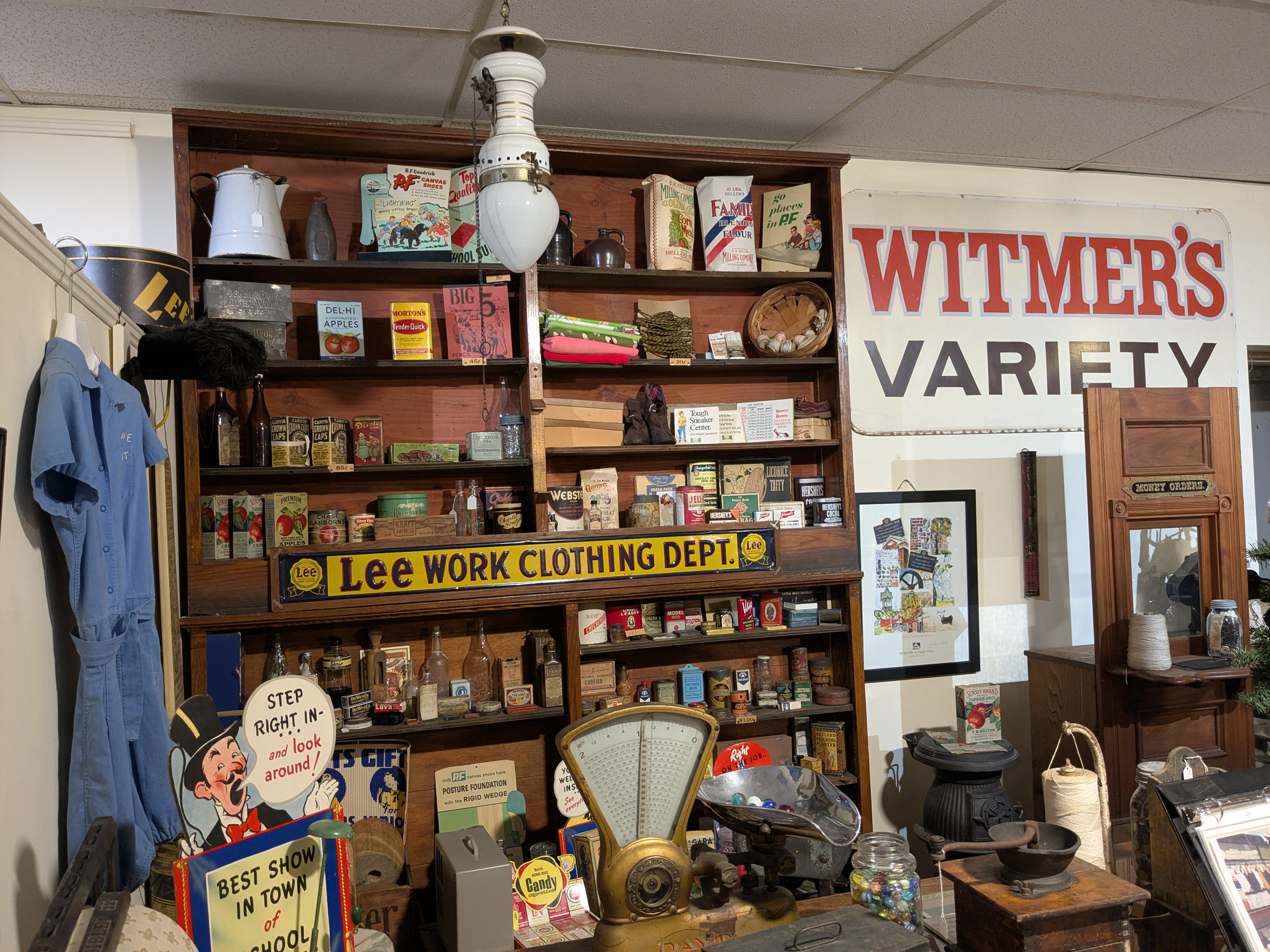
In today’s History Bit, we take a closer look at a place that I’ve written a lot about, but never really featured in any depth: the Webster Museum.
Located at 18 Lapham Park in the Village of Webster, the volunteers at the Webster Museum work tirelessly to keep the people, places, artifacts and stories from our town’s early days fresh in our minds. These nuggets of history made our town and village what they are today, and should never be forgotten.
Unfortunately, however, many people don’t even realize that our town has a history museum, let alone have visited it. So today, and several more times this year, these Bits of Webster History will focus on the permanent exhibits at the Webster Museum. For some, they may be reminders of things you already know about. For others, they’ll hopefully serve as an introduction to the valuable resource that is the Webster Museum, and will spark a visit to find out more.
Our first stop, just to the left inside the front door, is the Village of Webster’s Main Street. Here you see a recreation of Witmer’s Variety Store, which for many years was one of the village’s mainstay businesses, located in the east half of 1 East Main, where Jeff’s Computer Service used to be.
(Click here to read more.)
Happy birthday Village Hall (Feb. 2025)

Today’s Bit of Webster History celebrates a notable birthday. Last week, the current Webster Village Hall turned 60 years old.
The current Village Hall, located at 28 West Main St., was constructed in 1964 on the former site of Klem Chevrolet. In 1921, Walter Klem and his brother Frank took over the Johanson blacksmith shop, and eventually started selling Chevrolets. In 1963 the property was sold to the Village and Klem Chevrolet later moved to 740 Ridge Road.
The Klem building was demolished and construction of the new Village Hall began in 1964. Officials moved into the new building in the middle of January, 1965 and the first official function held there was a meeting of the Village Board.
(Click here to read more.)
Meet the Webster Museum (Part 2) (March 2025)
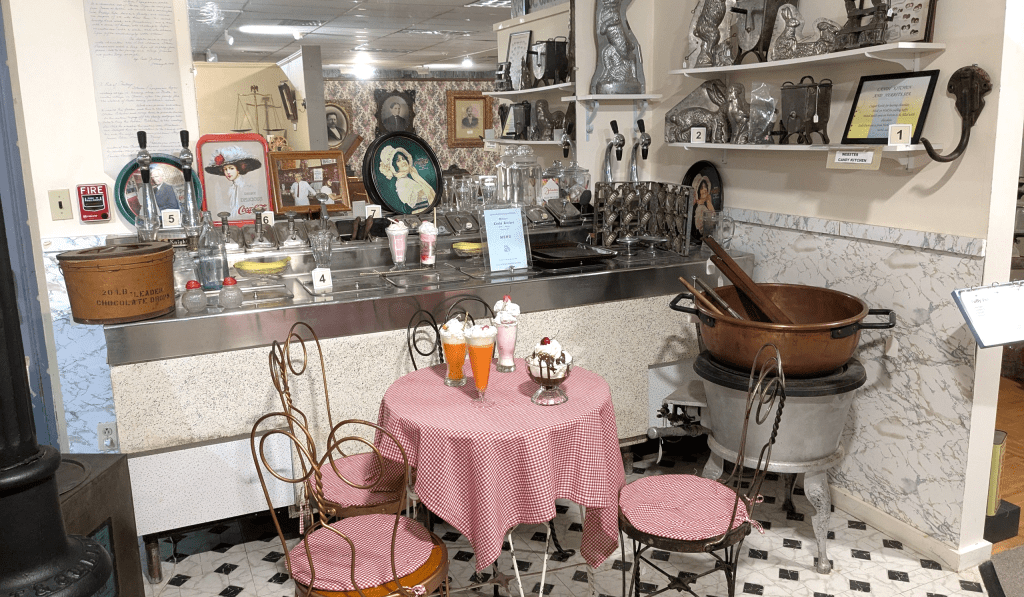
In Today’s History Bit, we take a closer look at another of the Webster Museum’s permanent exhibits, the Webster Candy Kitchen.
Located adjacent to the Witmer’s Variety exhibit, the Candy Kitchen is the second stop for museum visitors as they stroll down the Village of Webster’s recreated Main Street.
Founded in 1908 by Charles Papapanu, the Candy Kitchen was located at 14 East Main Street, and was a fixture in the village for 65 years. It was a popular teen hangout and beloved sweets shop, known for its dizzying selection of penny candies, including taffy, peanut brittle, nougats, ribbon candy, caramels and dozens more. It was especially known for its molded chocolate Easter bunnies, and every year the owners donated a huge chocolate rabbit for the annual Kiwanis Easter Egg hunt.
(Click here to read more.)
Willow Point Park (April 2025)

We all know Seabreeze Amusement Park in Irondequoit. It’s been around for almost 150 years, making happy summer memories for generations. Fewer, however, will remember Willow Point Park, Webster’s very own amusement park. It was in business for only three decades, but to this day it evokes very fond memories.
Willow Point Park was located on Bay Road (where Willow Point Rd. is now), a little more than a half mile north of the Empire/Bay Rd. intersection. It was a small, rather quaint amusement park, quite different from the sprawling parks that today’s kids know today. But its more intimate atmosphere was one of Willow Point’s biggest draws, especially for young families. It was also popular because, despite its moderate size, it featured many unusual attractions which were – and are – hard to find at the bigger amusement parks.
(Click here to read more.)
Meet the Webster Museum (Part 3) (May 2025)
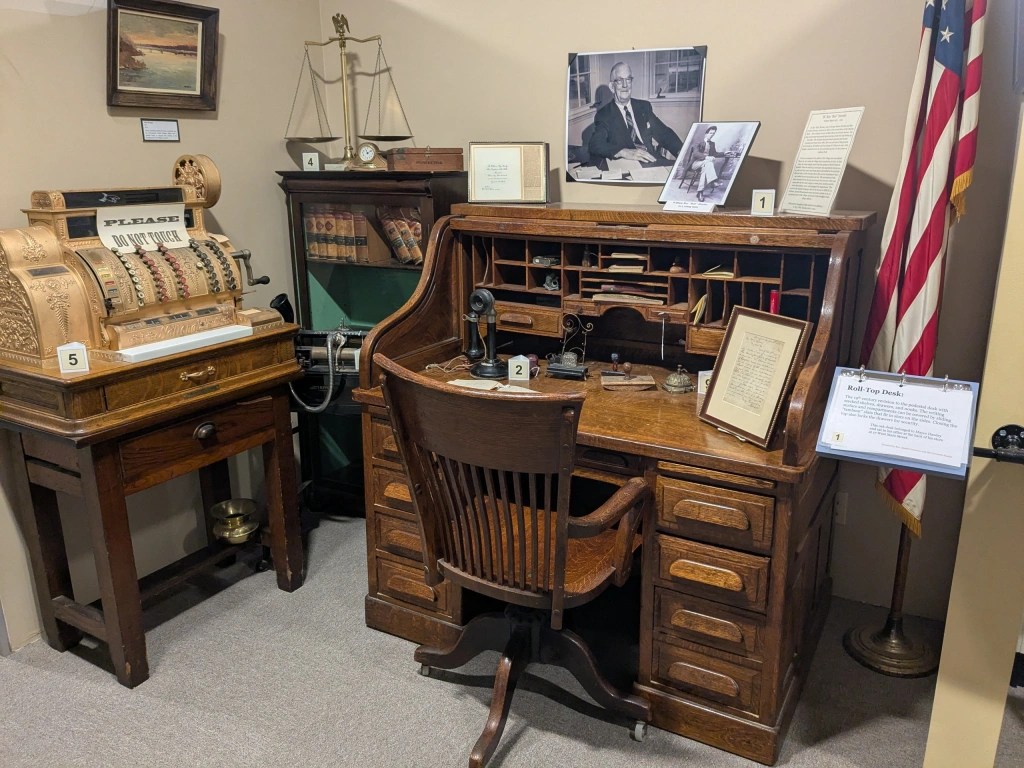
The next stop in our History Bits Tour of the Webster Museum’s permanent exhibits is the office of W. Roy “Bob” Hawley.
W.R. Hawley was born in 1881 to George Nelson Hawley and Mae Hawley, who owned a prosperous general store. He could have chosen to take that over when he grew up, but instead, in 1910 he opened Hawley’s Hardware Store at 17 West Main St., and later moved it to the corner of Lapham Park. When it closed more than 50 years later in 1965, it was the oldest retail business in the village or town of Webster.
(Click here to read more.)
Webster’s Kit Houses (June 2025)

In today’s wacky and overpriced housing market, it’s fun to remember a time back in the early to mid-1900s when you could purchase your new home from the Sears Catalog.
They were called “kit houses,” also known as pre-cut houses, ready-cut houses, mail order homes or catalog homes. Basically, they were delivered in pieces, which the homeowner would assemble. They came in many different styles ranging from simple bungalows to imposing colonials, and buyers were encouraged to personalize their order; walls, windows and doors could be moved, added or eliminated. Prices ranged from $3,000 to $10,000 depending on the style, which was a reasonable price even back then.
(Click here to read more.)
Meet the Webster Museum (Part 4) (July 2025)
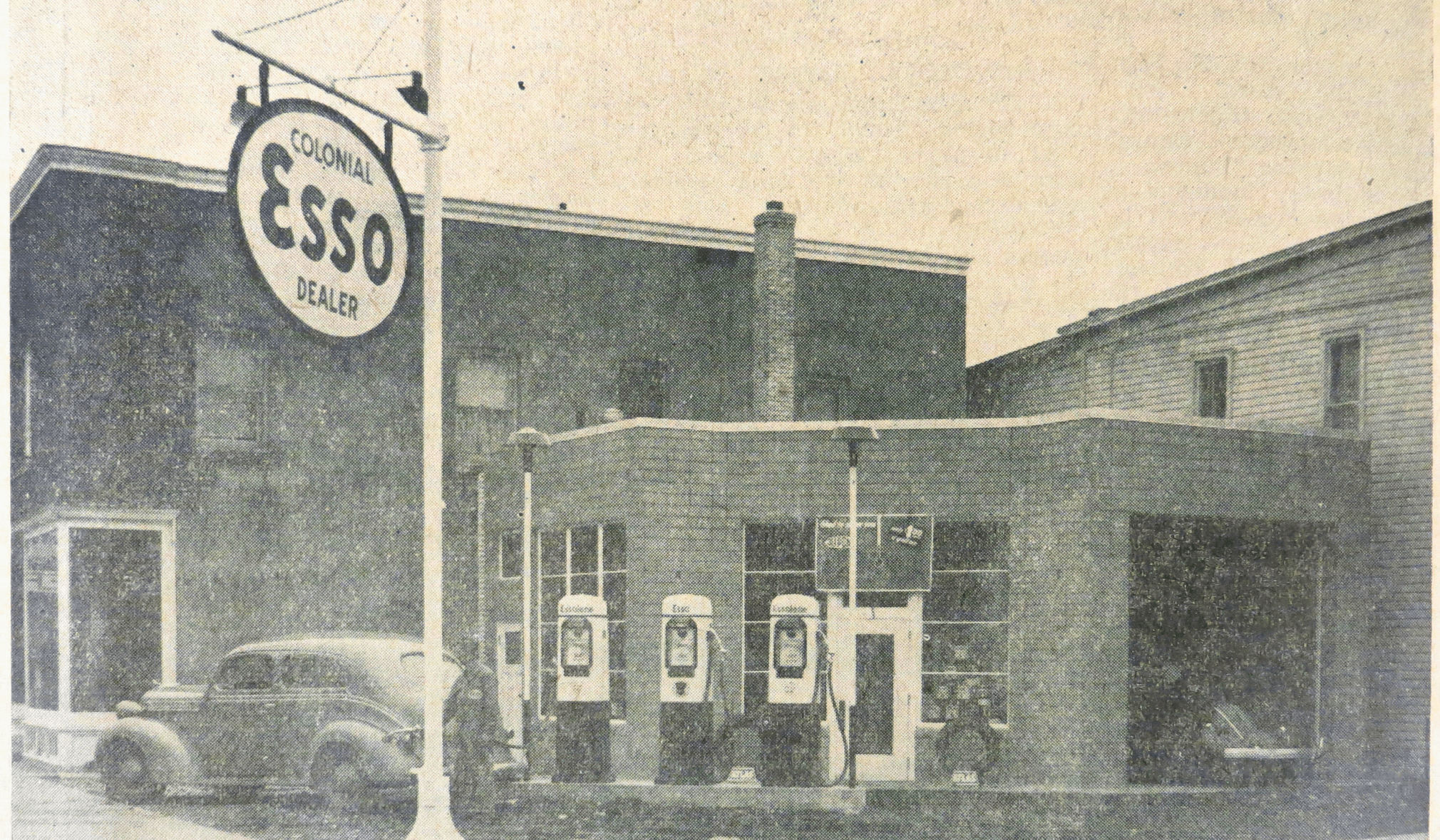
For today’s History Bit, we continue our stroll down Webster Museum’s recreated Main Street, passing Witmer’s, the Candy Kitchen and Mayor Hawley’s office, to discover nostalgic tribute to the service stations and dairies that once dotted our community.
At the heart of the exhibit is a colorful collection of vintage service station memorabilia, artifacts which pay homage to the many local garages and filling stations that kept Webster’s cars running smoothly for generations. Long before the days of self-service pumps and drive-through oil changes, town residents relied on friendly, full-service attendants at places like Furber’s Garage, Merz’s Sunoco and the Esso station at the village’s Four Corners. Mechanics knew their customers by name, and a quick stop for gas often turned into a neighborly chat. The exhibit also features photos and descriptions of many of the service stations.
(Click here to read more.)
The Forest Lawn Train Accident (Aug. 2025)
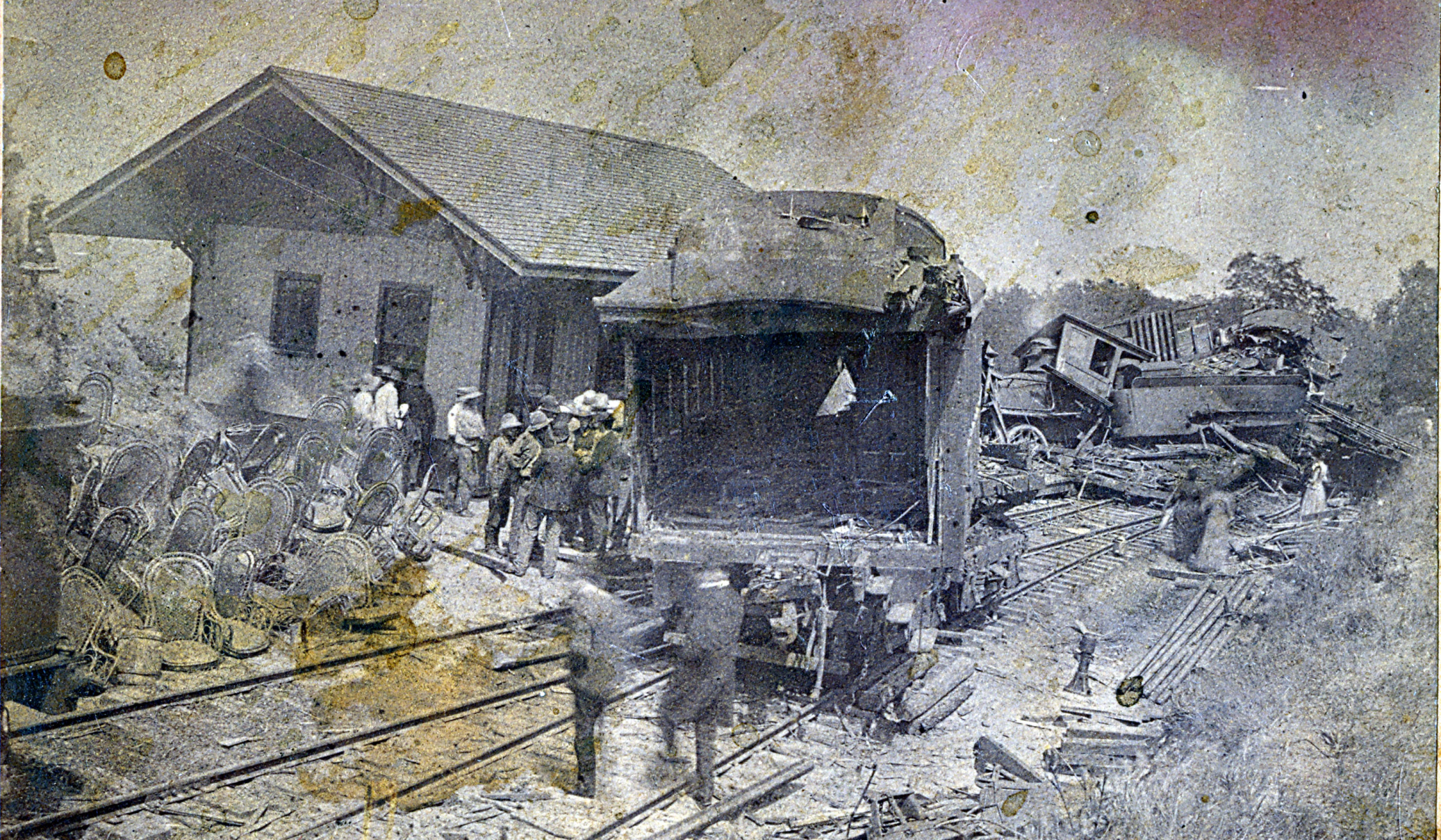
On a quiet summer morning 136 years ago this week, the peaceful community of Forest Lawn was jarred by a horrifying crash. A deadly train accident shattered the town’s calm, leaving twisted tracks, splintered cars, and a tragic story that would be remembered for generations.
August 10, 1889 was a normal day for the Rome, Watertown & Ogdensburg Railroad “stub train,” which ran from Windsor Beach to Forest Lawn every morning. It had pulled into the station at 7:50 a.m., as expected, and passengers were boarding.
Unfortunately, it was not a normal morning for the “Thousand Island” express train, which was running almost two hours late.
(Click here to read more.)
Spry turns 100 (Sept. 2025)
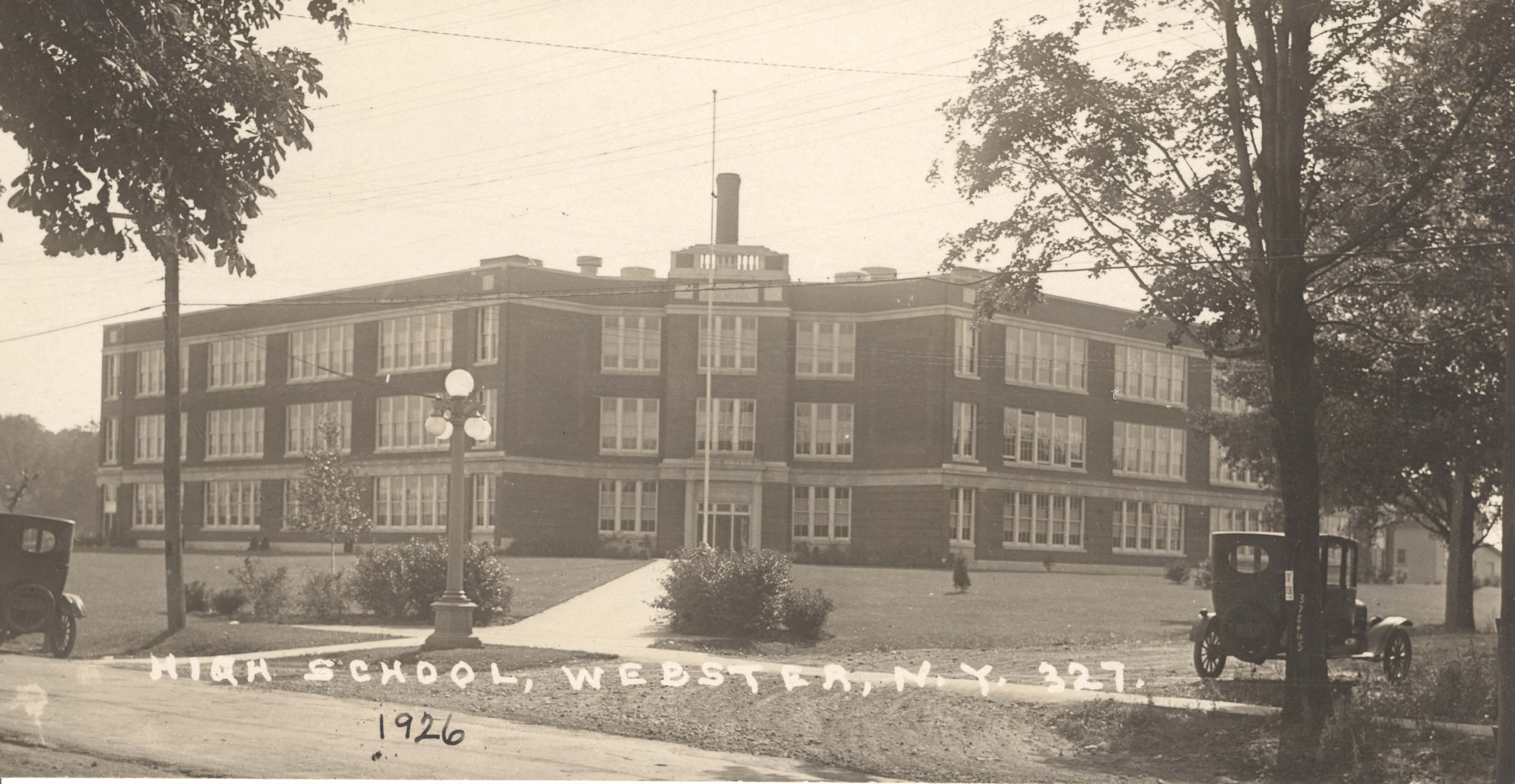
This month’s History Bit is perfectly timed for the start of the school year, highlighting the century-long educational legacy of the building now home to Spry Middle School.
The Spry Middle School building, located in the Village of Webster at the corner of South Ave. and Sanford St., turns 100 years old this week. It was built in 1925 to serve not as a middle school as it is now, but as the town’s high school, replacing the Webster Union Free School located just across the street. The new Webster High School welcomed its first students on September 17 of that year.
The building’s design was distinctive, shaped like the letter “W”. Despite recent additions and renovations, you can still get a sense of its original shape if you stretch your imagination.
(Click here to read more.)
Meet the Webster Museum (Part 5) (Oct. 2025)
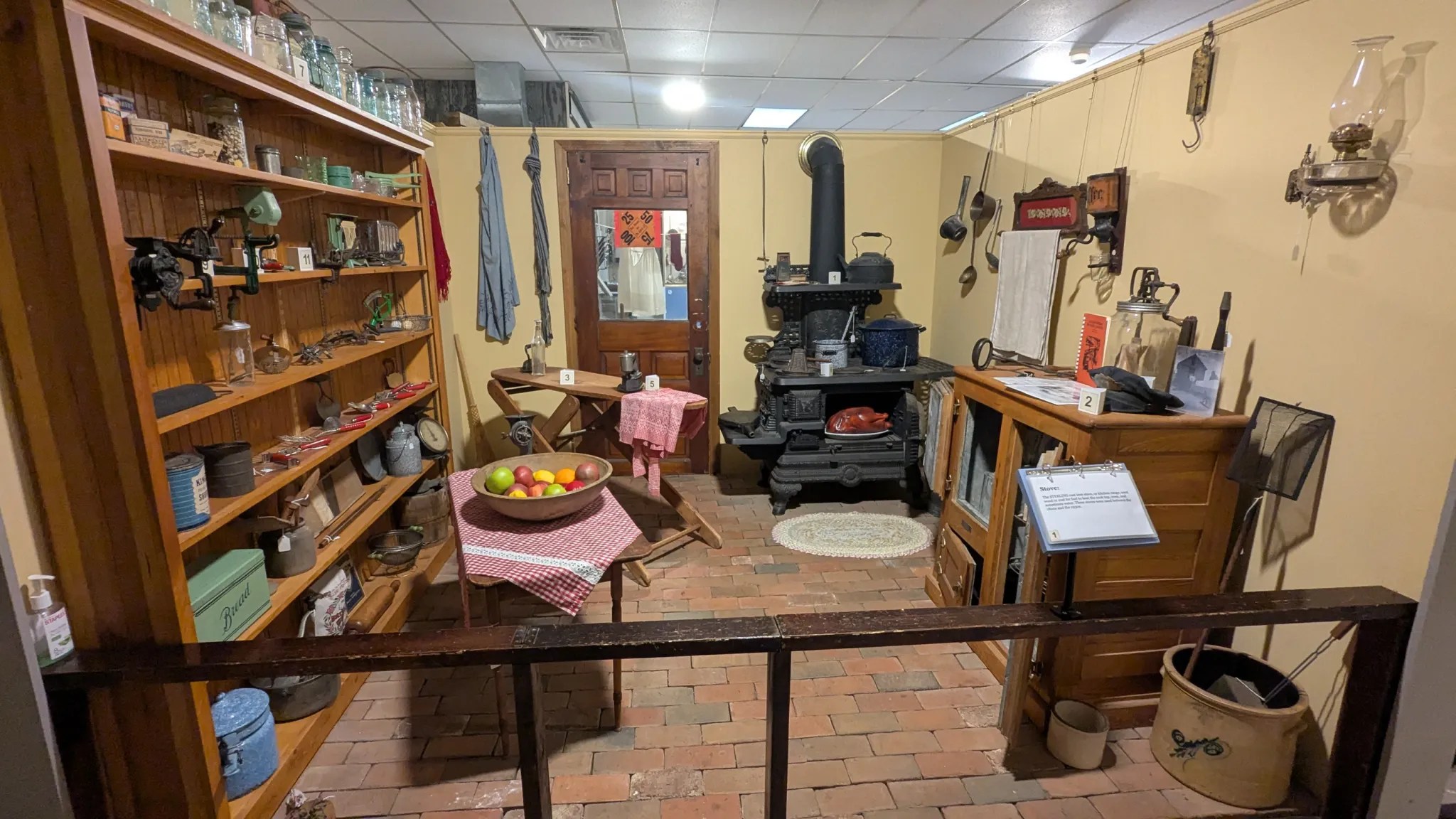
For today’s History Bit, we continue our museum tour of Webster, but step off of Main Street for a quick peek into some typical early-1900s homes.
At the back, easternmost end of the museum, are three period rooms – a parlor, bedroom and kitchen – which seem to have been frozen in history, plucked straight out of the early 20th century. Displayed within them are dozens of common household items which reflect what everyday life was like in the Town of Webster in those early days.
(Click here to read more.)
Outhouses (Nov. 2025)
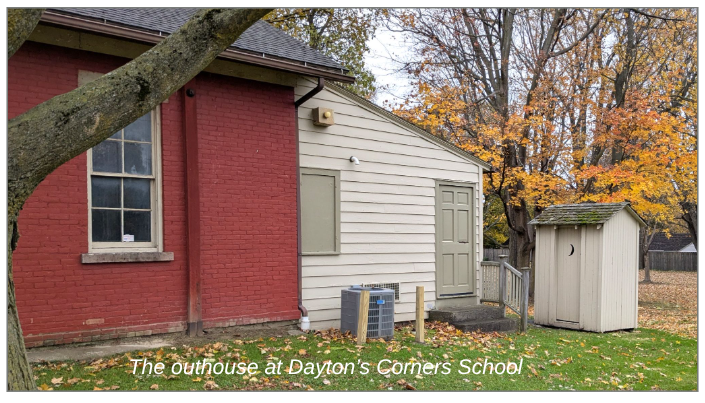
This month, we take a look at an uncomfortable, but necessary, facet of daily life for every Webster family in the days before plumbing and running water: outhouses.
Sometimes referred to as “the necessary,” outhouses weren’t too difficult to create; just dig a hole, build a little building over it and once in a while dump some chemicals in it or some dirt to cover it up. When it got full — which for a large family might have been once a year — making a new one was simply a matter of digging a new hole and moving the building.
Most outhouses actually sported more than one sit-spot, although both seats led to the same hole in the ground. They were also usually placed a distance away from the house, but not too far, balancing the issues of convenience and smell.
(Click here to read more.)
Meet the Webster Museum (Part 6) (Dec. 2025)
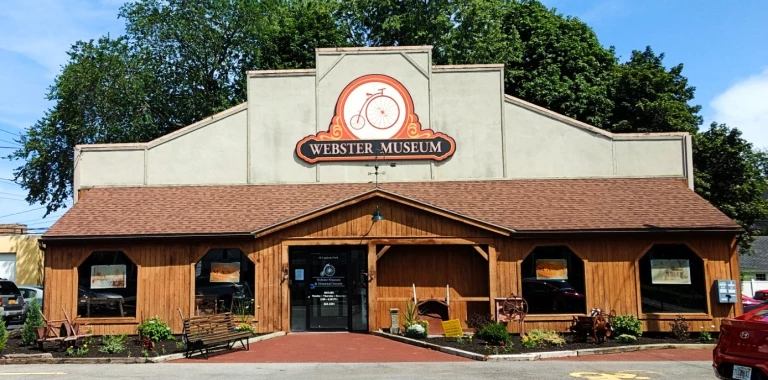
What do a pig ringer, a bull leader, a hog scraper, a hitching weight and a goose collar all have in common? Well, if you were a Webster farmer back in the 1800s, these items were all helpful tools of your trade. And while you’re not likely to find any of these gadgets on a farm these days, you can see them all at the Webster Museum.
Our “Meet the Webster Museum” tour makes our last stop in this month’s History Bit, ending on the right-hand side of the building as you enter the museum, where these farming implements are part of an eclectic collection of 19th-century tools and labor-saving appliances that offer a glimpse into life in early Webster.
(Click here to read more.)
What IS this thing? (Jan. 2026)
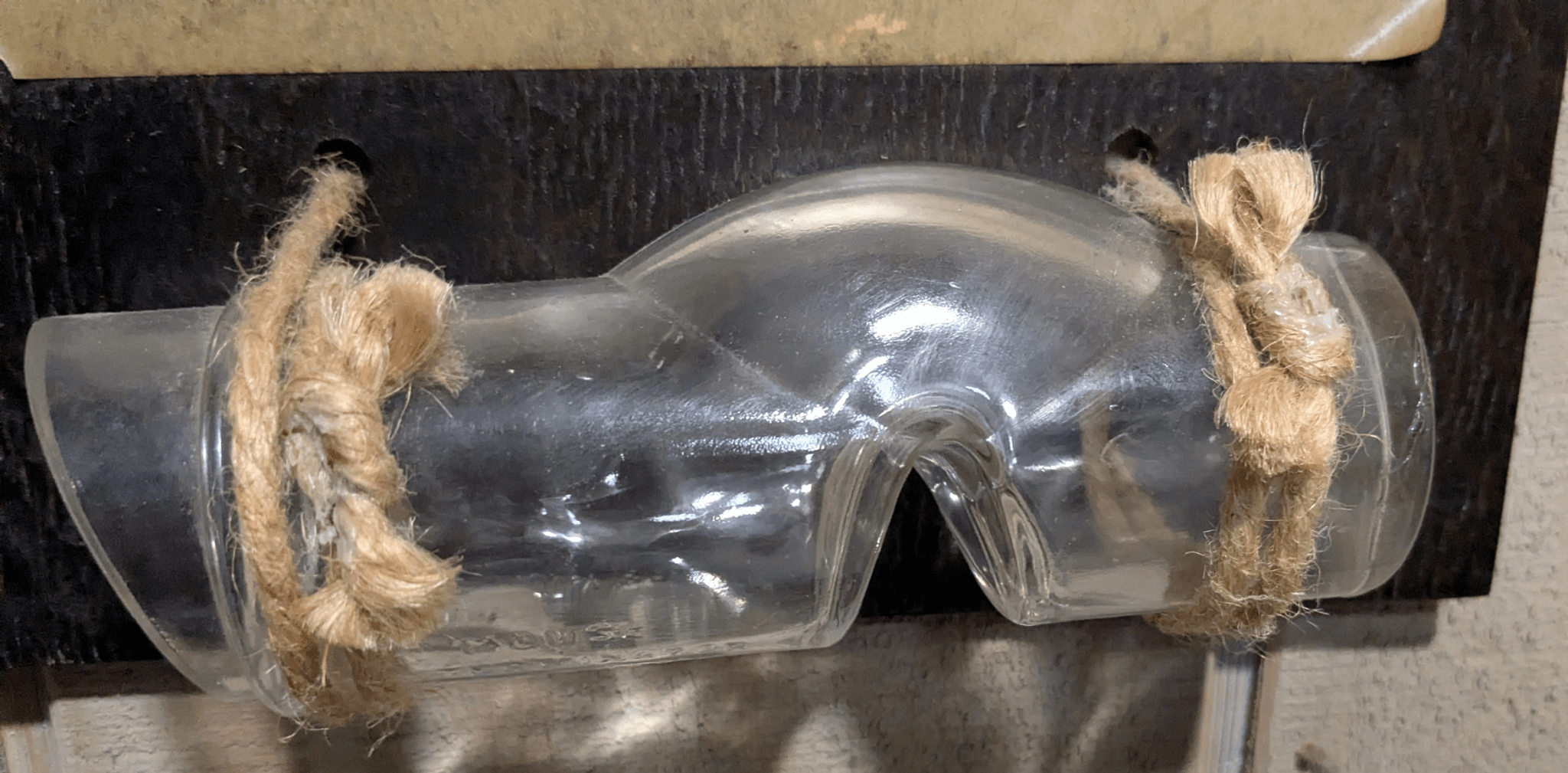
You never know what curious artifact you might discover when you wander through the Webster Museum. Case in point, this funny-looking, heavy glass, jar-like thing. Believe it or not, it’s actually a mouse trap, on display among many other farm and home gadgets that were instrumental to the lives of Webster residents a century ago.
The trap is about 6 inches long, with one open and one closed end. It has such an unusual shape and is so unlike anything we’re familiar with, that visitors are naturally drawn to examine it more closely and find out exactly what it’s all about. Fortunately, its history is thoroughly explained in a very helpful magazine article posted with the trap.
(Click here to read more.)
The Blue Line Trolley (Feb. 2026)
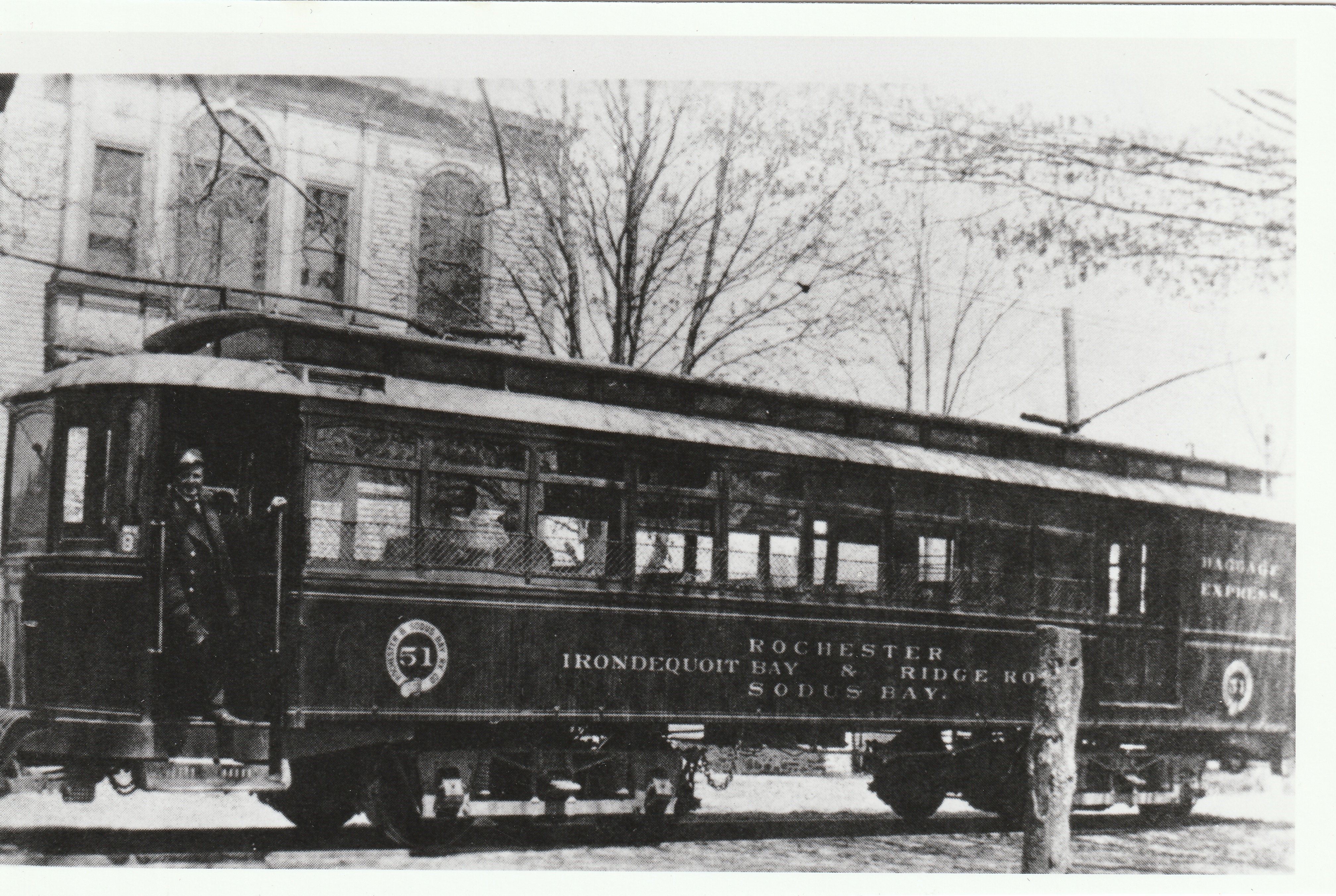
In the early 1900s, before automobiles became commonplace and horse-drawn wagons just weren’t considered fast enough anymore to travel long distances, Webster residents had another option: the “Blue Line” trolley.
The trolley was part of the Rochester and Sodus Bay Railroad Company, which was incorporated in August, 1898. It was nicknamed the “Blue Line” because the cars were all painted a deep, distinctive royal blue. The section that ran through Webster was built in 1900, taking passengers on a rather circuitous route through the town, especially where it climbed the east bank of Irondequoit Bay. When it reached the top of the hill, along what is now Rt. 104, it crossed the highway south of Dayton’s Corners and Plank Rd., continued to Creek St. and Bay Rd., then to Glen Edith. From there, the line headed east through West Webster, the Village of Webster, Union Hill, Fruitland, Ontario Center and beyond.
(Click here to read more.)


 webster on the web