Last March, I posted a blog about those big “WEBSTER” bushes adjacent to Rt.104 that welcome people to our town. In it, I told a bit about how they came about, and a little of their history, including the vandalism that almost completely destroyed them in 2010.
If you’re interested in even more and better information about that iconic landmark, read on. The most recent Penny Farthing newsletter published by the Webster Museum features a terrific article which goes even deeper into its history, and current efforts to update it:
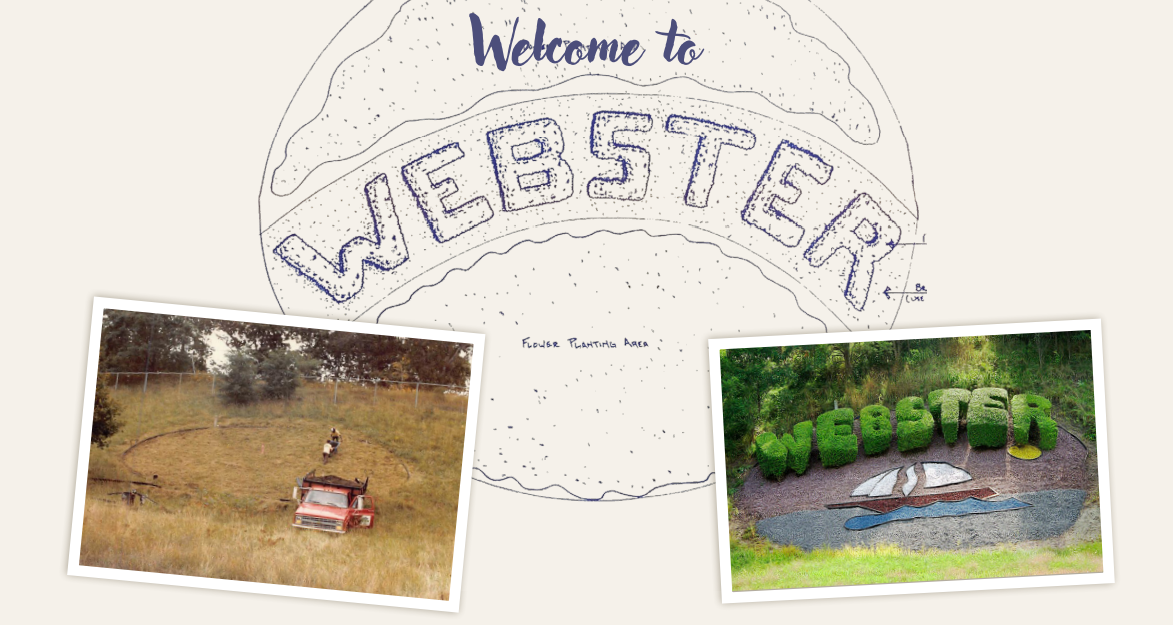
We’ve all seen the living sign along Rt. 104 near the Bay Bridge, welcoming all to Webster. The idea for this was the brainchild of the Webster Chamber of Commerce (WCC). Planning began in 1985 and ideas included an illuminated sign and a “HOLLYWOOD” styled sign. The committee settled on a landscaped area with a living sign – the word WEBSTER spelled out with privet bushes. An early design showed the bushes planted in an arc shape with brick chips filling in around the bushes and flowers planted at the top and bottom of the landscaped area.
A permit was issued by New York State in September 1986, granting permission for the WCC to create a decorative planting on state land. Bill Teamerson of Environmental Design planted the privet bushes in the fall of 1986 and construction began in 1987. The initial project cost was approximately $2000.
By the fall of 1987, it became obvious that the privet was not adapting well and the decision was made to replace the privet with 60 yew bushes in the spring of 1988.
After six years, the flower beds were requiring too much upkeep and, in 1993, were replaced with low-maintenance decorative stone. Dick Thomas designed the sailboat and water mosaic that we see today, using red sandstone from New Jersey and bluestone from Kentucky. The ten tons of stone were carried by hand in five-gallon buckets up the hill to the site.
In the spring of 2010, disaster struck. Vandals destroyed the W bush. Replacing the bushes in the W shape was not an acceptable choice. It would take too long for the new bushes to grow and match the appearance of the other letters. Replacing all of the bushes was discussed, but the cost was prohibitive – just over $5000. The WCC placed a survey on their website asking the question – should we replace the living sign with a wood sign, or replace the bushes and repair the living sign? Overwhelmingly, responders voted to replace the bushes, repairing the living bush sign. Local radio personality Tony Infantino held an on-air “radio-thon” with WCC president Barry Howard asking for donations. Callers donated $3500 to offset the cost. The WCC donated funds and Dick Thomas donated the balance of the money needed to replace the bushes and the labor to remove the old yew bushes and replant with privet bushes. Privet was chosen this time because it was found to be more deer resistant than the yew, and the new bushes did not wither as the original privet plantings did.
Now, at the beginning of summer 2025, the WCC is working with Thomas Landscape to again update and modernize the stone mosaic. They hope to have the project completed in the summer of 2026.
Our living sign is still standing – a warm and welcoming site as we cross the bridge coming home.
If you haven’t subscribed to the Penny Farthing newsletter yet, consider doing so. It’s an incredibly interesting peek into Webster history, packed with historical photos and stories, event notices, and information about the museum. If you’d like to be added to the distribution list, just email WebsterMuseum@gmail.com. And if you’d like to see this most recent edition, click here.
* * *
email me at missyblog@gmail.com. “Like” this blog on Facebook and follow me on Instagram and Threads (@missyblog)
You can also get email notifications every time I post a new blog by using the “Subscribe” link on the right side of this page (or all the way at the bottom of the page if you’re on your phone).
(posted 7/19/2025)


 webster on the web
Leave a comment