Tag Archives: XRX radio club

2025 XRX Field Day another a great success

6 Jul

After missing last year’s XRX Amateur Radio Club Field Day completely last year because I was out of town, I was pleased to be able to pop by this year’s event, held Saturday through Sunday, June 28 to 29. Even still, I only had about a half hour to hang around and chat with some people before leaving town again, but it was enough to learn about some new wrinkles in the annual ham radio marathon event.

But rather than my trying to describe everything I saw, I’ll instead share with you this great follow-up report prepared by Field Day Chair Bob Karz:

(Last) weekend over 30,000 amateur radio operators (hams) throughout the country participated in an emergency preparedness exercise called “Field Day” at more than 1,000 parks and other publicly accessible sites. While nominally a civil defense preparedness exercise, it’s also a contest, an educational opportunity, and a chance to showcase our equipment and skills to the general public.

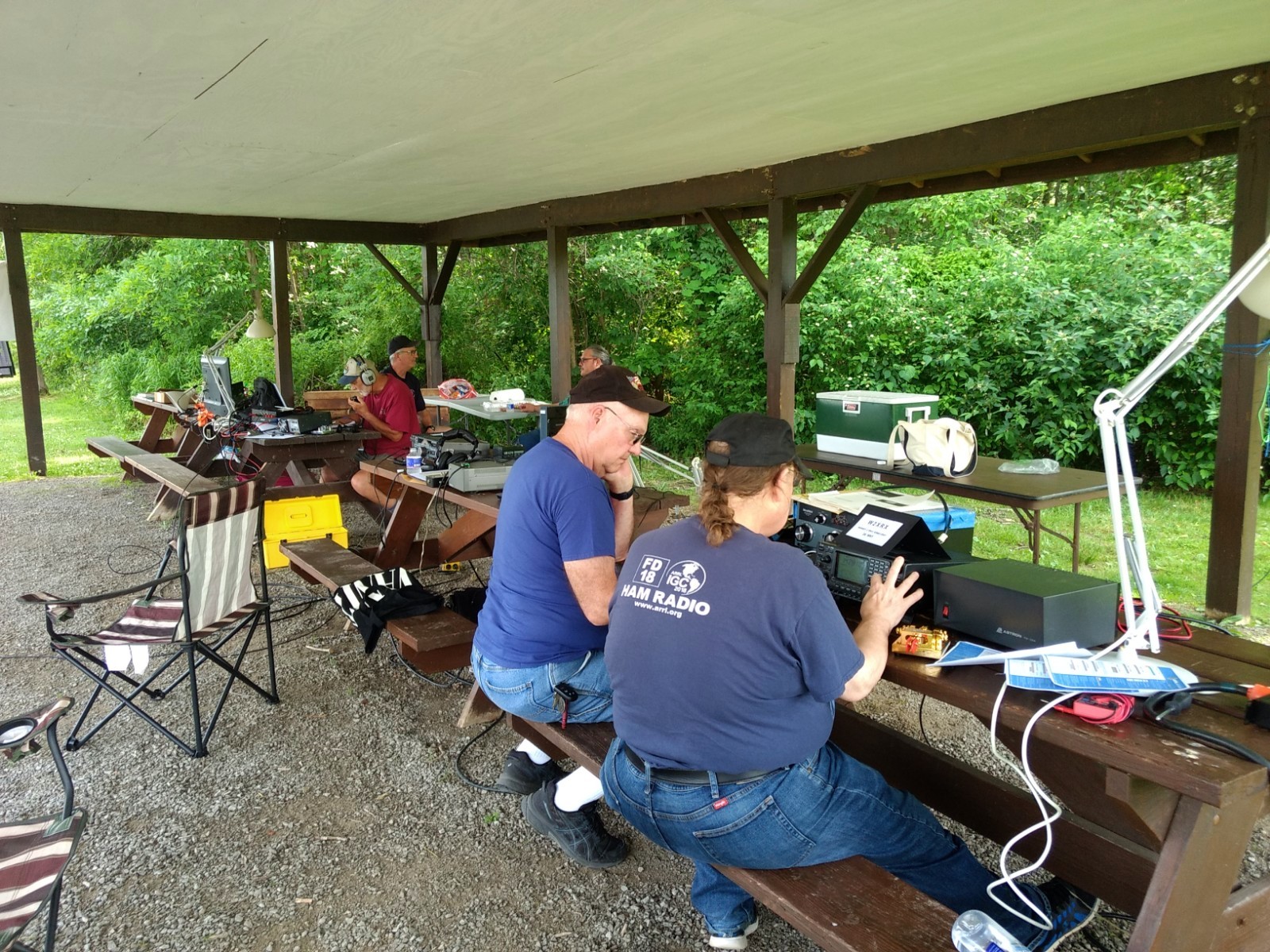
Field Day operations use generators, batteries, or solar cells for power along with temporary antennas to simulate emergency conditions. Locally the XRX Amateur Radio Club, Monroe County Amateur Radio Services, and the Rochester Amateur Radio Association joined forces to set up a Field Day site at the lower soccer fields in Webster’s Kent Park. Thirty-five amateurs took part from 2 p.m. Saturday to 2 p.m. Sunday. We made 900 contacts with other stations in every state except Alaska, and most Canadian provinces as well as Italy, France, England, Wales, Jersey (the island, not the state), and Russia. Contacts were made using voice, Morse code (yes, Morse is still used) and a computer mode called FT8. All contacts were made completely independent of the power grid and internet just as in an actual emergency.

Our site included three transmitting stations operating simultaneously using the call sign W2XRX, and a fourth station (called a “GOTA” or Get on the Air station) using the call sign WB2EOC specifically reserved for beginners. The GOTA had a full time “coach” helping the newcomers through their first contacts and kept a map showing the states they had contacted. By the end of the event, the GOTA operators had made 59 contacts with 21 states.

Field Day is also an opportunity try new things. This year our GOTA station was powered by banks of solar cells rather than the generators. GOTA also made a contact using an antenna held aloft by a kite. For the first time, we put up antenna for the main station, W2XRX, on the 160-meter band, a set of frequencies near the AM broadcast band, and made three contacts.

Amateur radio has kept up with the times more than many people realize. This year, some of us brought along SDRs (software defined radios) where most of the electrical parts are replaced by a computer. I also brought a Morse keyer (a device to send Morse code more easily than with a conventional key) which “understood” Morse. That is, the speed and other adjustments are controlled not by switches and knobs, but by sending it Morse code.

This year we also had a tutorial on a new computer mode called JS8Call. This mode allows for more informal conversations than the older FT8 which is limited to reports of signal strength and location.

Field Day is also food, conversation, and getting together with old friends. In a genuine emergency, our skills and equipment from Field Day will enable us to get on the air, sending out health and welfare messages when other methods of communication fail.

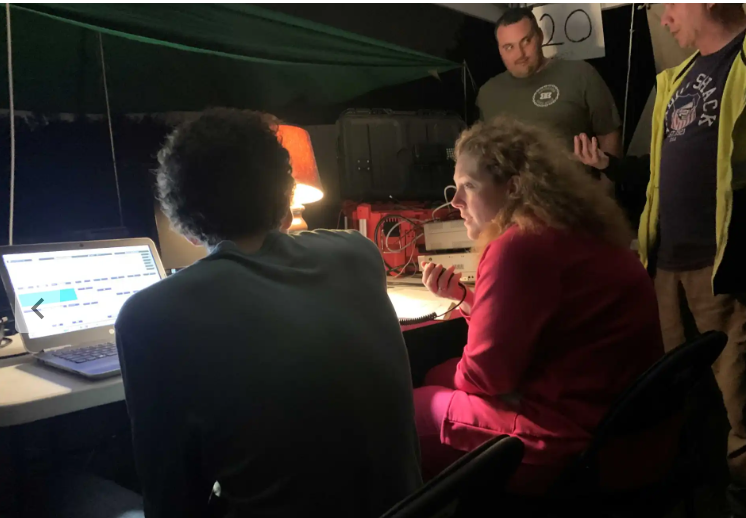
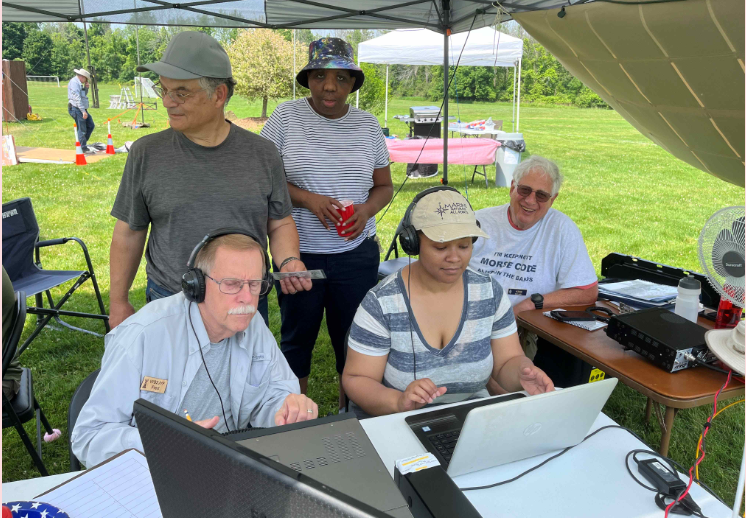
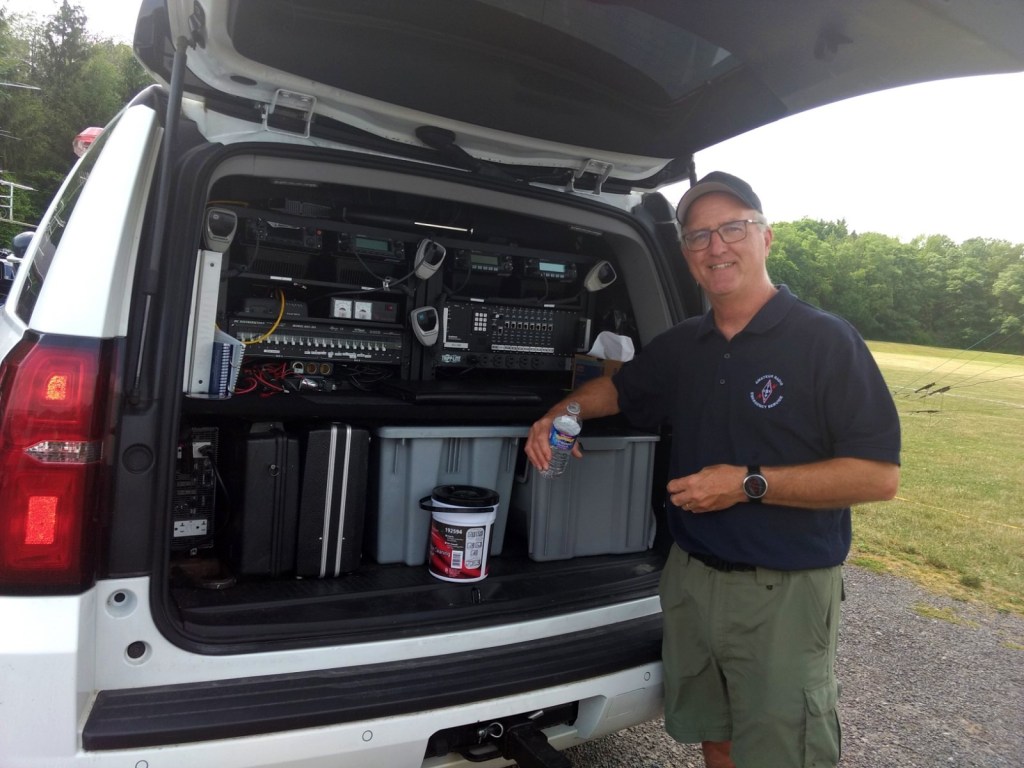
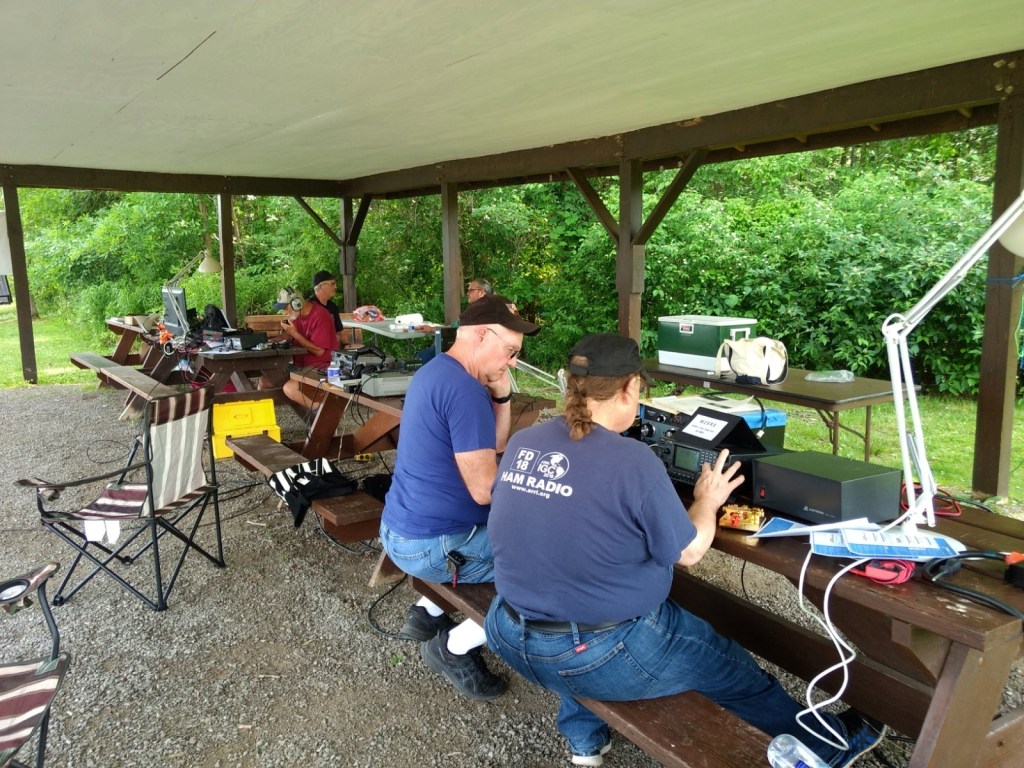
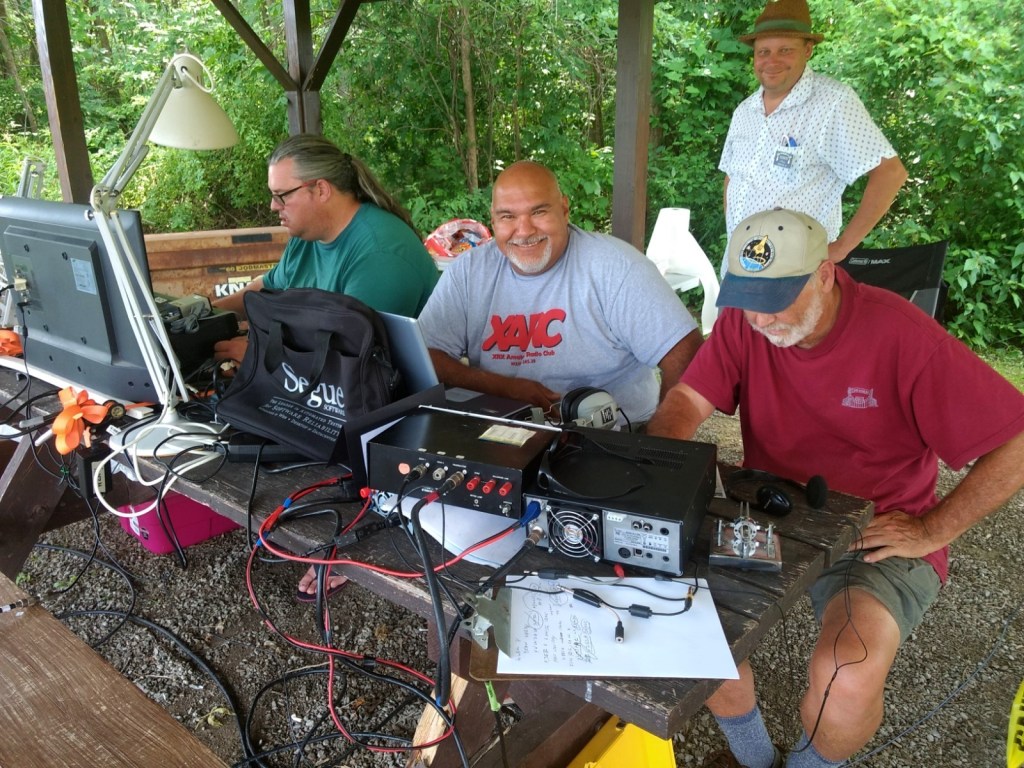
Here are some more pictures from the day (Bob took most of them):

Next year’s Field Day is scheduled on June 27 and 28, again at Kent Park. So mark it on your calendar now and plan to stop by; they’d love to see you, tell you all about their hobby, and maybe even get you on the air.

* * *

email me  at missyblog@gmail.com“Like” this blog on Facebook and follow me on Instagram and Threads (@missyblog)

You can also get email notifications every time I post a new blog by using the “Subscribe” link on the right side of this page (or all the way at the bottom of the page if you’re on your phone).

(posted 7/6/2025)
Radio Club Field Day will broadcast again from Kent Park

19 Jun

If you’re interested in amateur radio even a little bit, you’ll want to head out to Kent Park next weekend, June 28 to 29, to check out the annual XRX Amateur Radio Club Field Day. It’s a day when radio operators from all over the area come together to practice their skills totally “off the grid.”

Held on the fourth weekend in June every year, Field Day is an nationwide event, held simultaneously with 1000 similar stations across the US and Canada over a 24-hour period and involving more than 30,000 radio amateurs. Operators communicate via voice, Morse code and computers connected to transmitters.

On Field Day, operators are challenged to transport their equipment away from their homes, set up in a park or remote area, rebuild their stations, put up antennas and broadcast in quasi-emergency conditions, without drawing electricity from RG&E or using the internet or cell phones. The ARRL, the National Association for Amateur Radio, describes Field Day as “a picnic, a camp out, practice for emergencies, an informal contest and, most of all, FUN!”

The challenge is simply to contact as many other stations as possible during a 24-hour window, overcoming any challenges thrown by weather or technical problems along the way.

After last year’s very successful effort, Field Day Chair Bob Karz is excited about this year’s possibilities.

He wrote,

Last year was quite spectacular for us. We made contacts in all 50 US states and every Canadian province plus several foreign countries to boot. We also had a record number of visitors which we hope to repeat this year.

Conditions for radio communications should again be excellent this year. We’ll continue using voice and Morse code of course but will have increased emphasis on computer based communications which accounted for nearly half our contacts last year.

The XRX Radio Club will be operating from the lower soccer fields of Kent Park on Schlegel Rd. The club typically sets up several broadcast stations, complete with generators, computers, transmitters, and all manner of antennas. (Click here to check out the blog I wrote last year’s Field Day.) Set-up will begin at 10:30 a.m. on Saturday, June 28 and the exercise starts at 2 p.m. It continues through 2 p.m. on Sunday, and visitors can stop by anytime.

And visitors are more than welcome to stop by. These radio amateurs are always happy to share their passion with interested onlookers, and you may even get the chance to make an “on-the-air” contact yourself.

* * *

email me  at missyblog@gmail.com“Like” this blog on Facebook and follow me on Instagram and Threads (@missyblog)

You can also get email notifications every time I post a new blog by using the “Subscribe” link on the right side of this page (or all the way at the bottom of the page if you’re on your phone).

(posted 6/19/2025)

This year’s Field Day was a great success

2 Jul

I got a nice email the other day from Bob Karz (K2OID), chairman of the XRX Amatuer Radio Field Day held June 22-23 at Kent Park. You may remember the blog I posted a few weeks ago previewing this annual event, which is part contest, part open house for ham radio operators, the challenge being to set up in a remote location, and over a period of 24 hours make as many radio contacts as possible.

Bob filled me in on everything that happened (and didn’t happen) and remarked on how successful this year’s event was. He was excited to report that they welcomed 20 visitors from the community (“which is high for us”), who’d come by to see what the event was all about and maybe even try their hand at making a contact. He also reported that the “space weather” was

about the same as last year — good, but not spectacular. We were hoping for better, but like the weather outside, it’s variable.  Nevertheless, we made over 1100 contacts (more than last year) with stations in every US state and every Canadian province. That’s something we’ve never done before.

“Perhaps most significantly,” Bob added, “five newly licensed hams made their very first radio contacts at this year’s Field Day.”

In a follow-up email, Bob added even more details about the day:

We had a nice “fox hunt” that went on while we were making our contacts.  Several of us (but not me) found the “fox.” …  This year for the first time we had a station run off solar power alone rather than using our generators.   

Like many clubs we posted our location on the “Field Day Locator” website (Field Day Station Locator (arrl.org) so hams visiting our area might join us. Sure enough, Rick Rogers, K7RCR who was visiting relatives down the road in Lincoln stopped by and joined us. We now have a friend in Tucson.  

We also had a surprise visit from Scott Bauer, W2LC. Scott drove from Syracuse. He is the Western New York Section Manager for the national amateur radio organization and was visiting as many Field Day sites as possible. By the rules, he could only operate from one of them…ours. He is the most amazing Morse Code operator we’ve ever seen. He has trained himself to send Morse with one hand and simultaneously take notes with the other!

Bob concluded, “We had a great Field Day … The results will be released in January, and we expect to have an even better showing than the top 13% of our classification we achieved last year.”

I hope that anyone who wanted to, had the chance to stop by. But if not, no worries. Field Day will return next June, so stay tuned.

73

* * *

email me  at missyblog@gmail.com“Like” this blog on Facebook and follow me on Instagram and Threads (@missyblog)

You can also get email notifications every time I post a new blog by using the “Subscribe” link on the right side of this page (or all the way at the bottom of the page if you’re on your phone).

(posted 7/1/2024)

Radio Club Field Day will broadcast again from Kent Park

16 Jun

If you’re interested in amateur radio even a little bit, you’ll want to head out to Kent Park this weekend, June 22 to 23, to check out the annual XRX Amateur Radio Club Field Day. It’s a day when radio operators from all over the area come together to practice their skills totally “off the grid.”

Held on the fourth weekend in June every year, Field Day is an nationwide event, held simultaneously with 1000 similar stations across the US and Canada over a 24-hour period and involving more than 30,000 radio amateurs. Operators communicate via voice, Morse code and computers connected to transmitters.

On Field Day, operators are challenged to transport their equipment away from their homes, set up in a park or remote area, rebuild their stations, put up antennas and broadcast in quasi-emergency conditions, without drawing electricity from RG&E or using the internet or cell phones.

ARRL, the National Association for Amateur Radio, describes Field Day as the “single most popular on-the-air event held annually in the US and Canada.”

They add,

Field Day is a picnic, a camp out, practice for emergencies, an informal contest and, most of all, FUN! It is a time where many aspects of Amateur Radio come together to highlight our many roles. While some will treat it as a contest, other groups use the opportunity to practice their emergency response capabilities.

The challenge is simply to contact as many other stations as possible during the 24-hour window, which begins Saturday at 2 p.m. and continues overnight through Sunday at 2 p.m., overcoming any challenges thrown by weather or technical problems along the way.

This year’s Field Day will feature a brand new twist, called a “fox hunt.”  In this case, the “fox” is a hidden miniature radio transmitter, and the object is to use radio-location to find it. Field Day Chair Bob Karz explains that “the skills we develop (in the fox hunt) help us identify and track down interference, deliberate or otherwise, with our communications. Indeed, we used our fox hunting skills this past year to track down deliberate interference with some of our equipment.”  

Bob also said that, surprisingly, the intense solar activity that led to the spectacular auroras last month and temporarily disrupted radio communications world-wide actually improves radio communications the rest of the time. So they’re expecting make even more contacts this year than usual.

The XRX Radio Club will be operating from the lower soccer fields of Kent Park on Schlegel Rd. The club typically sets up several broadcast stations, complete with generators, computers, transmitters, and all manner of antennas. (Click here to check out the blog I wrote about 2021’s Field Day.)

Visitors are more than welcome to stop by. Equipment set-up will begin at 10 a.m. on Saturday and the exercise begins at 2 p.m., running through 2 p.m. Sunday. These radio amateurs are always happy to share their passion with interested onlookers, and you may even get the chance to make an “on-the-air” contact yourself.

* * *

email me  at missyblog@gmail.com“Like” this blog on Facebook and follow me on Instagram and Threads (@missyblog)

You can also get email notifications every time I post a new blog by using the “Subscribe” link on the right side of this page (or all the way at the bottom of the page if you’re on your phone).

(posted 6/16/2024)

38th annual Field Day a great success

1 Jul

The XRX Amateur Radio Club held their annual Field Day last weekend, and from all reports, it was a great success. The event’s chairman, Bob Karz, wrote that the club made more contacts than ever, meaning more points than ever, and they hope to finish in the top 11% of their class, which is a pretty big deal.

If little of what I just said made sense to you, keep reading. Bob sent along this very good description about what this interesting exercise is all about.


Amateur Radio Emergency Services and the XRX Amateur Radio Club held their 38th annual emergency preparedness Field Day June 24 to 25 at Kent Park in Webster. It’s not a field day in the usual sense, but rather an opportunity to try out our radios and hone our skills needed to provide communications to the outside world in the event of a real emergency.

Field Day involves over 30,000 amateur radio operators (or hams) in the US and Canada as well as a few from other parts of the world. This year we made over 1,000 contacts with stations in every state except Alaska, most Canadian provinces, Chile, France, and Puerto Rico all totally “off the grid” using power from generators and batteries with no internet or cell phones.

These days amateur radio is more than dots and dashes, although we did make several contacts using Morse Code. We also made contacts with voice and a computer mode called FT8 which is a little like the internet except over radio. FT8 is becoming increasingly popular for Field Day. This year for the first time we actually made more contacts using FT8 (420) than with any other method.

Field Day is an opportunity to try out new equipment and techniques. It’s also a chance showcase Amateur Radio to the public. We encourage visitors and even give kids (and their parents) a chance to make radio contacts. This year we had more than 30 people drop by including 12 kids who each made a radio contact with help from a radio “coach.”

Field Day is always the 4th full weekend in June. The next Field Day will be June 22 to 23, 2024. We will again be at the lower soccer fields in Kent Park. You are invited to drop by and see for yourself what some of your friends and neighbors are doing to help keep us safe in the event of a natural disaster. More information about the local amateur radio community can be found at www.rochesterham.org.


If you’d like to read more about Field Day, click here to read the blog I wrote about the one I attended in 2021.

* * *

email me  at missyblog@gmail.com“Like” this blog on Facebook and follow me on Instagram (@missyblog)

You can also get email notifications every time I post a new blog by using the “Follow Me” link on the right side of this page.

(posted 7/1/2023)

Radio Club Field Day will broadcast again from Kent Park

21 Jun

If you’re interested in amateur radio even a little bit, you’ll want to head out to Kent Park this weekend to check out the annual XRX Amateur Radio Club Field Day. It’s a day when radio operators from all over the area come together to practice their skills totally “off the grid.”

Held on the fourth weekend in June every year, Field Day is an nationwide event, held simultaneously with 1000 similar stations across the US and Canada over a 24-hour period and involving more than 30,000 radio amateurs. Operators communicate via voice, Morse code and computers connected to transmitters.

On Field Day, operators are challenged to transport their equipment away from their homes, set up in a park or remote area, rebuild their stations, put up antennaes and broadcast in quasi-emergency conditions, without drawing electricity from RG&E, or using the internet or cell phones.

ARRL, the National Association for Amateur Radio, describes Field Day as the “single most popular on-the-air event held annually in the US and Canada.”

Field Day is a picnic, a campout, practice for emergencies, an informal contest and, most of all, FUN! It is a time where many aspects of Amateur Radio come together to highlight our many roles. While some will treat it as a contest, other groups use the opportunity to practice their emergency response capabilities.

The contest part of the weekend is simply to contact as many other stations as possible during the 24-hour window, which begins Saturday and continues overnight through Sunday, overcoming any challenges thrown by weather or technical problems along the way.

The XRX Radio Club will set up again this year in the parking lot past the playing fields at the very north end of Kent Park on Schlegel Rd. Last year the club had five separate broadcast stations, complete with generators, computers, transmitters, and all manner of antennas. (Click here to check out the blog I wrote about last year’s Field Day.)

Visitors are more than welcome to stop by. These guys are always happy to share their passion with interested onlookers.

* * *

email me  at missyblog@gmail.com“Like” this blog on Facebook and follow me on Twitter and Instagram.

You can also get email notifications every time I post a new blog by using the “Follow Me” link on the right side of this page.

(posted 6/21/2022)

*****

A “field day” like no other

27 Jun

From the time I was a child, I’ve known “field days” to be those extra special days at the end of the school year when classwork was put on the back burner and the entire school headed outside all day to play games, eat snacks and just have some fun.

But the field day I went to Saturday at Kent Park was something entirely different.

The event was the XRX Radio Club Field Day, a chance for amateur radio (ham) operators to practice their skills totally “off the grid,” meaning no electricity from RG&E, no internet and no cell phones. The Field Day challenge for radio operators is to transport their equipment away their homes, set up in a park or other remote area, rebuild their stations, put up antennaes and operate in quasi-emergency conditions.

Held annually, Field Day is an nationwide event, held simultaneously with 1000 similar stations across the US and Canada over a 24-hour period and involving more than 30,000 radio amateurs. Operators communicate via voice, Morse code and computers connected to transmitters.

This year’s Field Day was set up in the parking lot past the playing fields at the very north end of Kent Park on Schlegel Rd. When I stopped in about an hour after the event began, five separate broadcast stations were in operation, complete with generators, computers, transmitters, and all manner of antennas.

I immediately connected with Field Day Chairman Bob Karz (K2OID), who in no time recognized that I had less than zero knowledge about all that I was seeing. He was kind enough to give me a tour of the entire operation, taking me from station to station, very patiently explaining the several different ways communications (“exchanges”) were being made (UHF/VHF, digitally, with antennas, and by satellite).

Despite Bob’s best efforts to simplify things, I still felt like I’d been dropped into the middle of a foreign country. (Bob called the language everyone was speaking “hamspeak,” adding that there are even subsets of the language.)

But I did learn some interesting things, like how sunspots and atmospheric conditions can be the difference between hearing someone in Batavia and someone in California, what “CQ” means, how you can bounce an exchange off the moon, why UHF/VHF exchanges are harder to make, and why “80 meters” bands only come alive at night.

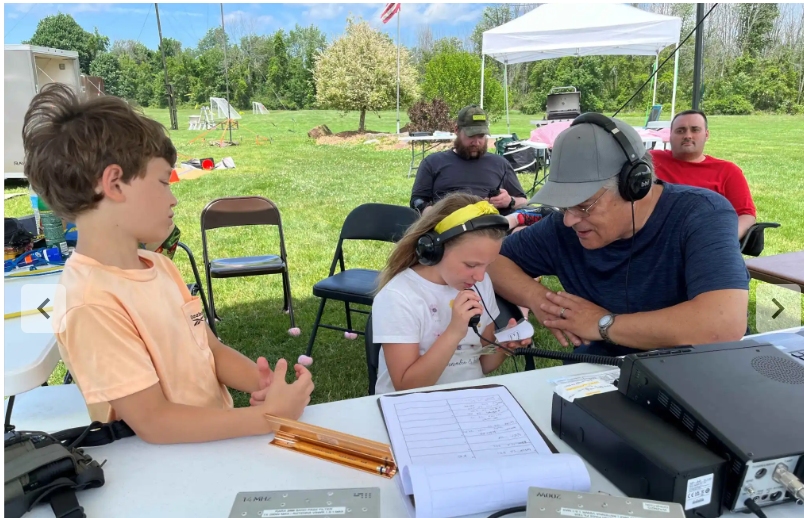
Ben works the radio at his first Field Day under the watchful eye of Tim Brown (WB2PAY)

For most of the participants, the weekend’s activities were a kind of contest. The goal was to make contact with as many ham operators across the country as possible in the allotted time. (Some years they’ve contacted all 50 states, and once even chatted with the astronauts aboard the International Space Station.) There are even bonus points awarded for things like if the operator is under 18 or new to the hobby, and using Morse code. And UHF/VHF contacts count double because they’re harder to make. But if you make an exchange with an operator you’ve contacted before? That’s a demerit.

One station, however, set apart from the others, wasn’t part of the contest. It was the “get on the air” station, dedicated for the use of newbies or inexperienced hams, or those who haven’t been on the air for a long time and wouldn’t be comfortable being part of the competition.

This is where I watched 11-year old Ben Kennerknecht (W2BMK) take his turn on the radio during his first Field Day. Hesitant at first, it took him little time getting the hang of the proper exchange protocols. You could see his confidence and pride grow with every new contact.

Ham operator Don Dunn (AB2MN) explained that the weekend also serves another important purpose.

The FCC allocates a good deal of radio spectrum (that is radio frequencies) for hams’ use. We are thus expected to have the knowledge and skill to establish impromptu radio communication’s ability in the event of an emergency, be it natural, or man-made, local or regional. This is part of what we do, and Field Day is a way we practice, learn and maintain our skills, improve, and teach others.

Hams are often the first voices from disaster areas such as tsunamis, floods, hurricanes, and tornadoes. When cell phone and land line circuits were overloaded during the 9-11 attacks, amateur radio operators carried critical information from both attack sites.

Mostly, though, it’s about ham operators getting together to enjoy their hobby. Or, as Bob explained,

Field Day is two days of junk food, very little (or no) sleep, generators, solar panels, and solving unforeseen problems. Field Day is more often than not rain and mud. Field Day (believe it or not) is FUN.

Hmmm. Fun, snacks, friends, even a little bit of learning. Maybe this field day isn’t so different after all.

Find out more about this fascinating hobby at the Rochester Amateur Radio Association website.

Post-event update: Bob Karz emailed me on Monday to tell me that more than 1000 contacts were made with stations in every state except Alaska, and several Canadian provinces. More than 50 hams participated, which was a record for the Webster event.

He also added that “we had a bit of an unplanned ‘adventure’ when our computers logging our contacts crashed at midnight Saturday by deciding not to talk to each other. It took an hour and a half to find a work around. Obstacles like this are fairly typical for Field Day as well as for real emergencies.”

* * *

email me  at missyblog@gmail.com“Like” this blog on Facebook and follow me on Twitter.

You can also get email notifications every time I post a new blog by using the “Follow Me” link on the right side of this page.