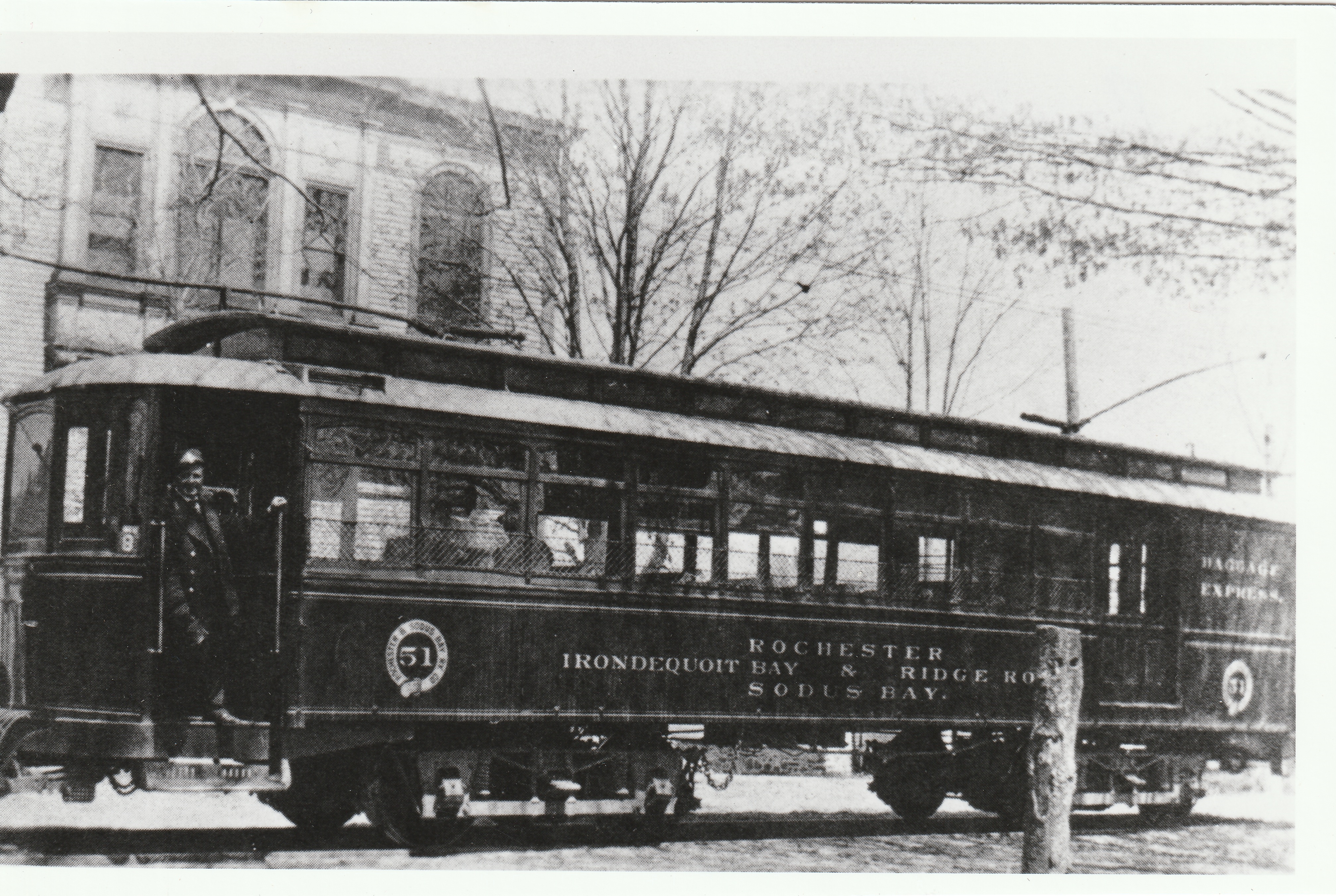
In the early 1900s, before automobiles became commonplace and horse-drawn wagons just weren’t considered fast enough anymore to travel long distances, Webster residents had another option: the “Blue Line” trolley.
The trolley was part of the Rochester and Sodus Bay Railroad Company, which was incorporated in August, 1898. It was nicknamed the “Blue Line” because the cars were all painted a deep, distinctive royal blue. The section that ran through Webster was built in 1900, taking passengers on a rather circuitous route through the town, especially where it climbed the east bank of Irondequoit Bay. When it reached the top of the hill, along what is now Rt. 104, it crossed the highway south of Dayton’s Corners and Plank Rd., continued to Creek St. and Bay Rd., then to Glen Edith. From there, the line headed east through West Webster, the Village of Webster, Union Hill, Fruitland, Ontario Center and beyond.
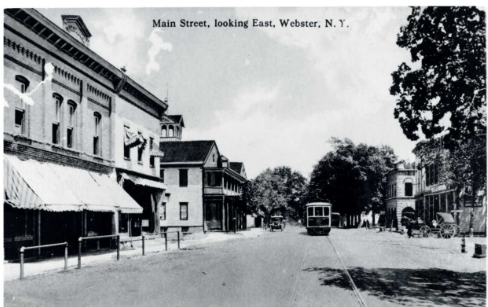
In the villages along the route, tracks were laid through the main streets; in the Village of Webster, the trolley stopped at 28 East Main St., where Root Rituals Salon is now. At smaller stations, the trolley would only stop if there were passengers to embark or disembark. In pleasant weather, riders could wait along the tracks and watch for the trolley to approach, but in inclement weather, catching the trolley was a bit more challenging. Then, passengers would have to wait inside a small ticket booth and watch for it to arrive. If they didn’t get outside quickly enough, the trolley would pass by without picking them up.
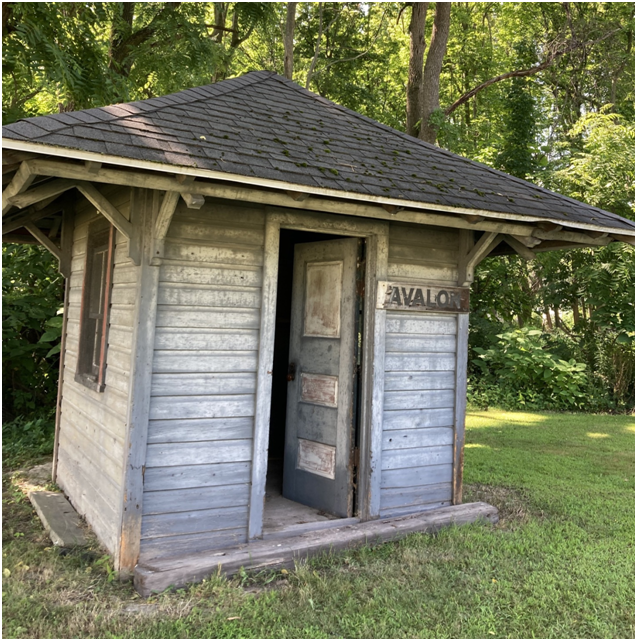
One of these original ticket booths still stands on Bay Rd. near Avalon Trail. It’s believed that the Avalon Trolley Stop could be one of the line’s historic “porthole” stops. Passengers peeked out through a window and were instructed to light a “torch” made of rolled-up newspaper to signal the approaching trolley. Unsurprisingly, this method was eventually deemed a fire hazard for both the passengers and the wooden shelters, and eventually an electric light was installed on the building to signal the trolley driver.
When the line first operated, trolleys ran on an hourly schedule from Rochester to Sodus Point and back between 6 a.m and 9 p.m., along 47 miles of track. A normal run took two hours and 19 minutes, and tickets cost $1.32. During the spring months, the Blue Line was often referred to as the Apple Blossom Special; for a reduced rate — just 75 cents — passengers could take a ride along Ridge Road to see and smell the apple blossoms.
In 1920 the automobile began taking business away from the trolley, and business fell off considerably through the later part of the decade. The Blue Line made its last run on June 27, 1929. Esther Dunn described that run in her book Webster … Through the Years: “On that day, William ‘Yank’ Gloor, Sodus Bay line’s most popular motorman who ran the first regular car to Sodus Point from Rochester, had the distinction of piloting the last car to leave the Point for Rochester. On this last trip, car number 111 carried a banner on front which read, ‘My Last Run — Goodbye Folks.'”
You can read more about the Blue Line Trolley at the Webster Museum, where the volunteers there have created a very informative display right inside the front door. So stop by and check it out for yourself. The museum is located at 18 Lapham Park in the Village of Webster, and is open from 2 to 4:30 p.m. every Tuesday, Thursday and Saturday.
Thank you to Webster Town Historian Lynn Barton and several other museum volunteers for helping me pull together this information.
* * *
(posted 2/14/2026)
email me at missyblog@gmail.com. “Like” this blog on Facebook and follow me on Instagram and Threads (@missyblog)
You can also get email notifications every time I post a new blog by using the “Subscribe” link on the right side of this page (or all the way at the bottom of the page if you’re on your phone).


 webster on the web
Thanks for the interesting history lesson.
Great story!
Oh, thank you! I’m so glad you enjoyed it!