Sometimes, historical surprises can show up in unexpected places.
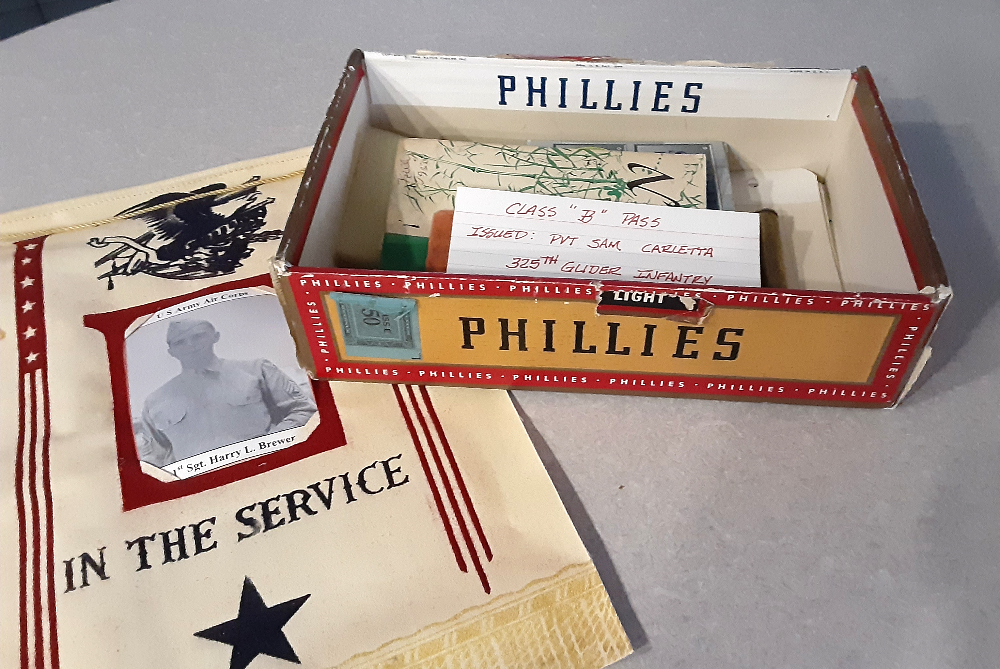
About two years ago, hidden away in the recesses of a storage room at the American Legion Post 942, one of the Legion members discovered a dusty old Phillies cigar box. Among the treasures tucked inside, stacked in a neat pile, were more than 150 small pages, about 3″ x 6″ each, apparently taken from a spiral-bound notebook. Each of the pages is covered with neat, hand-written notes about an individual soldier — a Webster veteran. It indicates in which cemetery the soldier is buried, and in most cases provides a half dozen or more details about the soldier’s life and service.
The Legion member knew he had stumbled upon something important, so he handed the pages over to Post Historian Herb Gauch for safekeeping.
“As I started looking at them,” Gauch said, “I realized what a treasure trove of Webster we had discovered.” Not sure what to do with them, he kept them safe for a long time. But “finally, I realized that our very own Webster (Union Cemetery) Historian, and driving force behind Wreaths Across America, Cherie Wood, would know best.”
Wood was thrilled to receive the pages and become their new caretaker, and immediately started poring through them to see what new details she could discover about our town’s veterans.
Every veteran in each of our Webster area cemeteries — Webster Union, West Webster, Webster Rural, Holy Trinity and Union Hill — has a page. Someone clearly spent countless hours researching each one (not an easy job in the days before Ancestry.com) and painstakingly recording what he found out. The information encompasses each one of our nation’s wars, from the Revolutionary War through the War of 1812, the Civil War, the Indian Wars, the Spanish-American War and WWI. They even include the Tripolitan War in the early 1800s, America’s first foreign war.
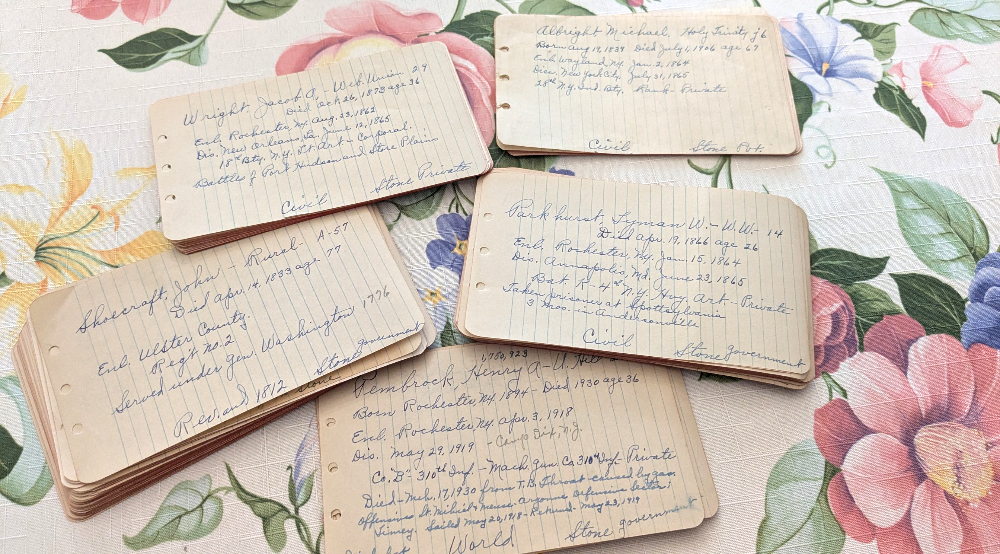
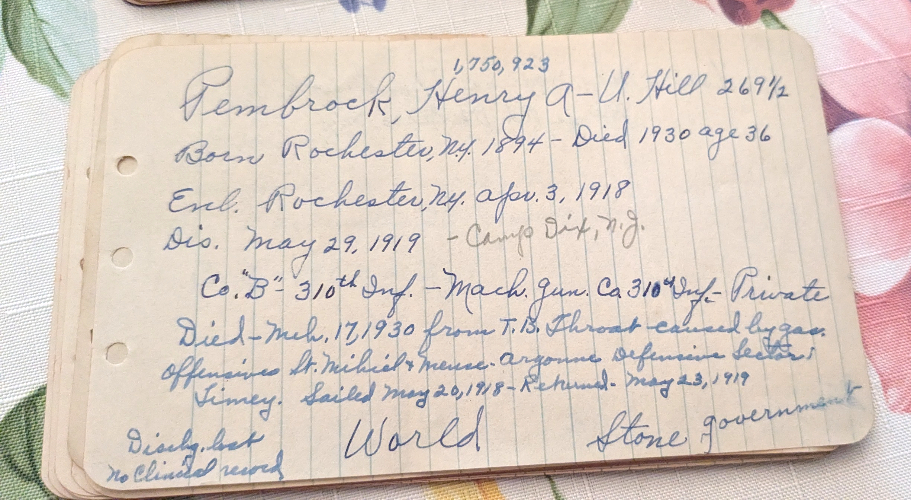
The pages don’t include any WWII veterans, which seems to indicate that whoever was doing the research didn’t or couldn’t continue the project at that point, or started to record the information in a different manner. (It’s interesting to note that the WWI pages only indicate “World War,” because at that point there was only one World War, the “war to end all wars.”)
The details include where the veteran’s grave is located in each cemetery, which led Gauch and Wood to theorize that the pages were used by the American Legion to place flags on the veterans’ graves every Memorial Day. But there’s a lot more information than would be necessary to simply locate the markers to place a flag. In addition to the standard details you might commonly find on a gravestone — birth and death dates, rank, and unit in which they served — the pages often also include other personal details, like when and where a soldier enlisted and was discharged, the battles he fought in, his commanding officer, how he died and where he died, sometimes even noting the hospital’s name.
Reading through the papers is a fascinating exercise. There are many familiar Webster names, including Jonas Whiting, Robert Woodhull and John Schlegel. The pages include 14 Revolutionary War veterans; John Shoecraft’s page even notes that he served under General George Washington. James Adams fought in two wars, the Spanish-American War and WWI, and several of the soldiers died at Antietam. One noted that the veteran was taken prisoner at Spotsylvania during the Civil War and spent three months in Andersonville prison. Another recorded that WWI veteran Henry Pembrock died from tuberculosis of the throat “caused by gas.”
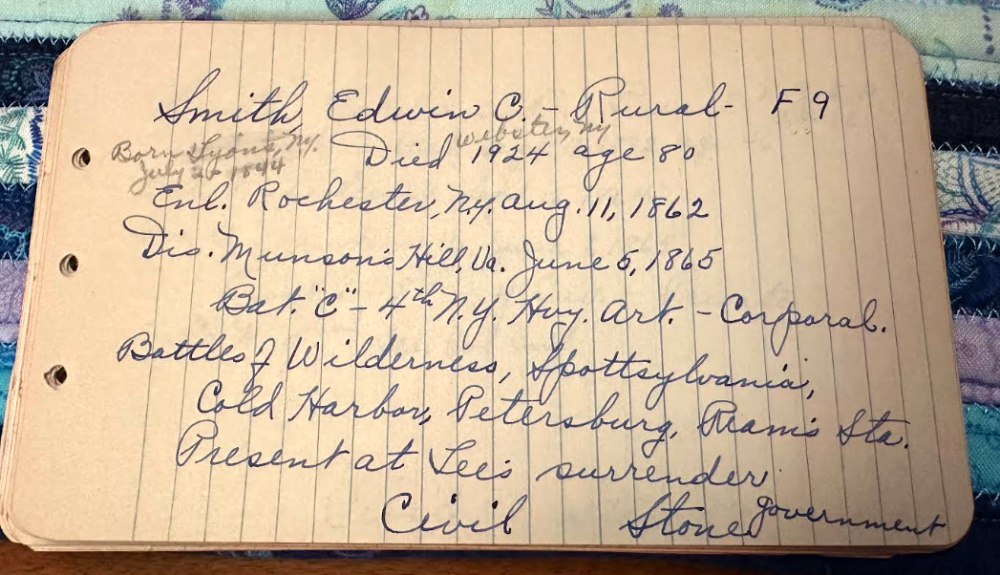
Perhaps the most interesting of them all is the record for Cpl. Edwin C. Smith, a Civil War veteran who fought in the battles of Wilderness, Spotsylvania, Cold Harbor, Petersburg and Ream’s Station, and was present at Lee’s surrender at the Appomattox Court House.
Eventually, Wood will hand the pages over to Webster Town Historian Lynn Barton for safekeeping. But in the meantime they’re providing some valuable information about the veterans buried in our local cemeteries. And more importantly, every time one of them is read, a veteran is remembered.
“These are our people,” Wood said. “They lived here, they died here or on the battlefield. They belong to our town. I don’t want them forgotten. “
* * *
(posted 6/9/2026)
email me at missyblog@gmail.com. “Like” this blog on Facebook and follow me on Instagram and Threads (@missyblog)
You can also get email notifications every time I post a new blog by using the “Subscribe” link on the right side of this page (or all the way at the bottom of the page if you’re on your phone).


