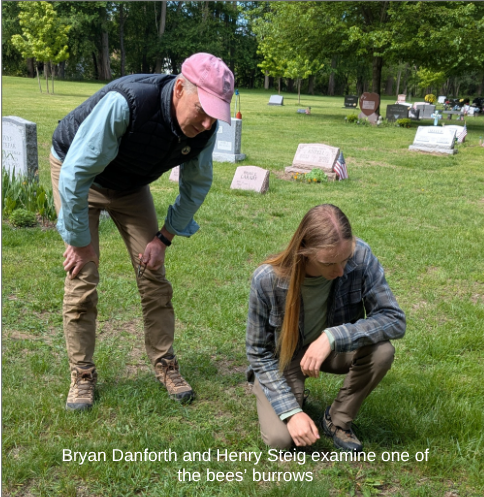
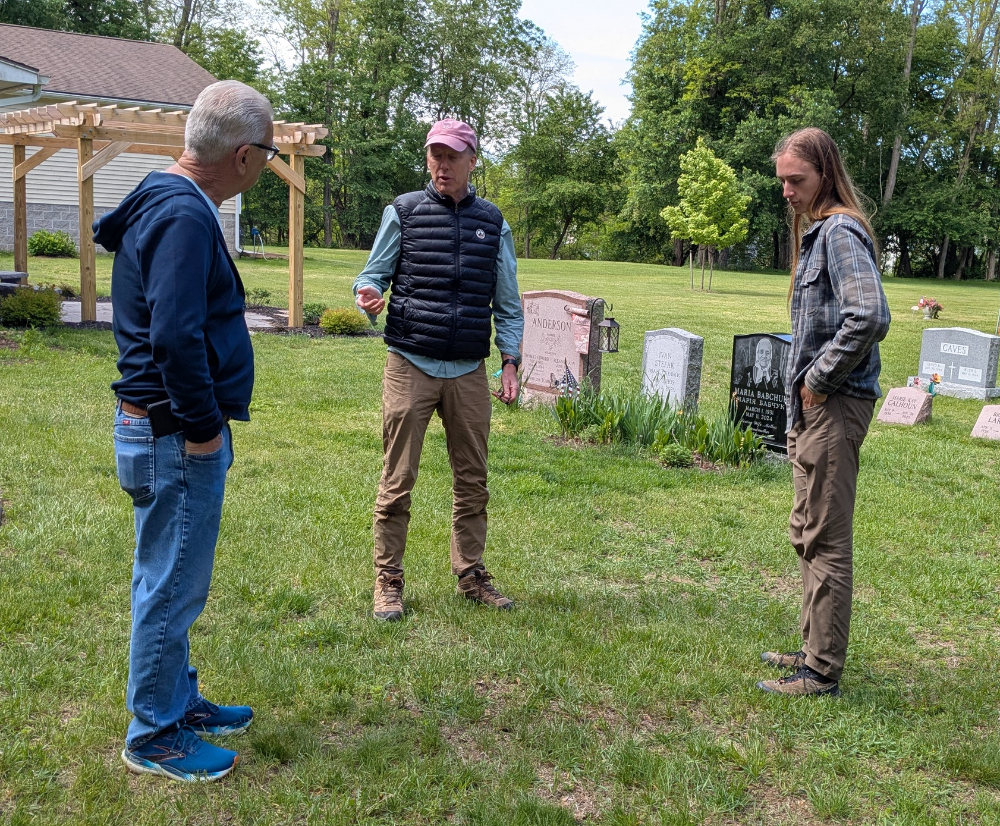
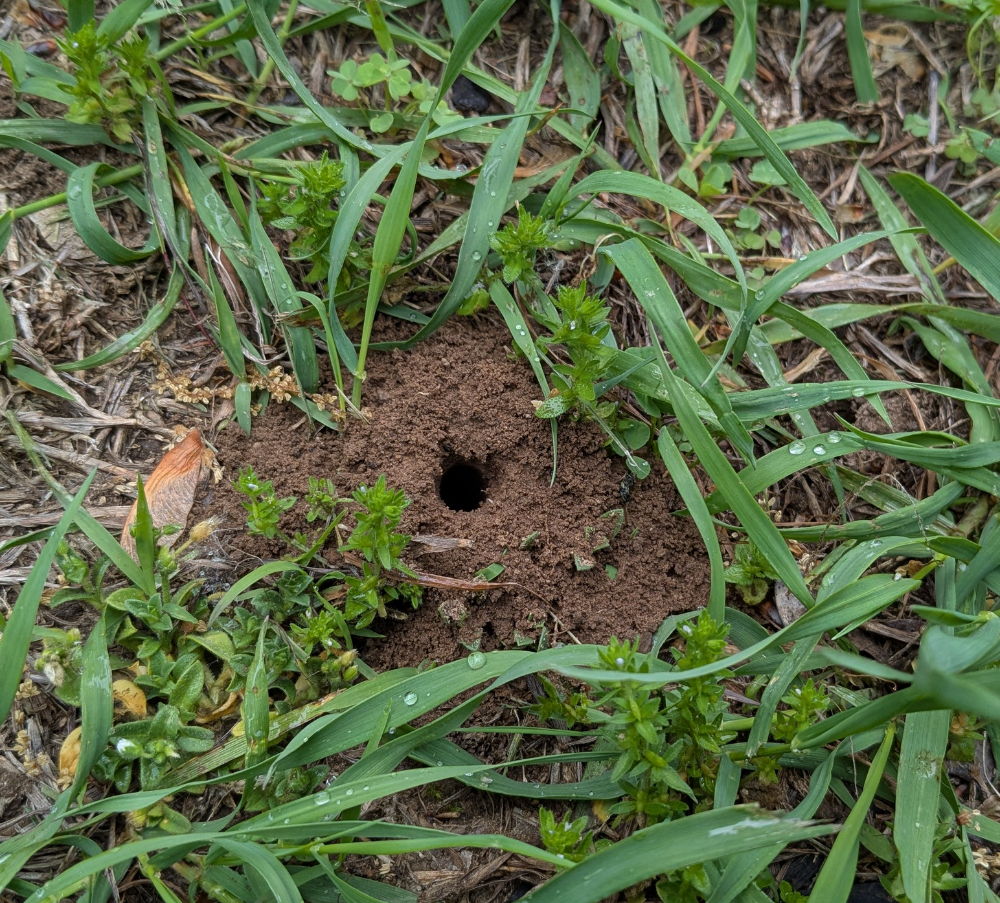
Under a cool, cloudy Thursday sky earlier this week, a small group gathered in the westernmost section of Webster Union Cemetery. Among them were cemetery president George Baker, a Cornell University professor, and a graduate student, all peering intently at a series of small holes bored into the soil. They weren’t there to discuss gravestones or burial plots, however. Instead, they were investigating a completely different, yet equally important, cemetery concern: bees.
Every spring for the past several years, hundreds of thousands of bees have emerged from the ground at Webster Union Cemetery, especially in the cemetery’s western section. The phenomenon begins in April and lasts several weeks, and the bees arrive in such large numbers they often form what looks like an undulating carpet, hovering just a few inches off of the ground. It’s an issue that concerns cemetery staff members and visitors alike; naturally, the sight of so many bees amassed near their loved ones’ graves makes family members apprehensive.
These particular bees, Baker knew, were called “miner bees.” But he didn’t know much about them or how big a problem they actually presented. So he reached out to Cornell entomologist Dr. Bryan Danforth, who came out to the cemetery that Thursday morning, accompanied by grad student Henry Steig, to check out the situation first-hand.
Danforth, a professor of entomology at Cornell’s College and Agriculture and Life Sciences, is an expert in bees, and is especially interested in promoting their peaceful co-existence with humans. He’s discovered that cemeteries in particular are an ideal habitat for many bee species, in part because of the lack of pesticides and the fact the ground is rarely disturbed.
Danforth confirmed that the Webster Union bees were indeed Andrena regularis (the “regular mining bee”), and a second, closely related species, Colletes inaequalis, both solitary, ground-nesting bees. They’re also known as “digger bees,” reflecting how the female will use her legs, mandible and abdomen to bulldoze out her nest, a hole reaching more than a foot deep, which branches out underground into individual tunnels and chambers in which she deposits each of her eggs. The larvae continue to develop and hibernate through the summer, fall and winter, until the adults are ready to emerge in a cloud of buzzing insecthood on the first warm day of spring. The males emerge first, poised for prime mating opportunities when the females emerge a day or so later. Once mating is complete, the males fly off and the females work on their nests.
Danforth added that miner bees are important pollinators. They’re one of the best apple pollinators in New York State, because they come out of the ground early in the spring, right when the apple blossoms are blooming.
But the most important thing — which he reiterated several times — should set peoples’ minds at ease: miner bees are NOT aggressive and DO NOT sting. They don’t want to bother people. They just want to enjoy the solitude, make some babies, dig their nests, then leave it to the next generation to continue the cycle the following spring.
Most of the miner bees at Webster Union Cemetery have already hatched, mated and moved on. But, in the next week or two, if you’re at the cemetery visiting your loved ones and see a rippling mass of bees near their grave, just ignore them. And the next time you bite into a crisp apple, perhaps you can say a silent thank-you to A. regularis.
* * *
(posted 5/29/2026)
email me at missyblog@gmail.com. “Like” this blog on Facebook and follow me on Instagram and Threads (@missyblog)
You can also get email notifications every time I post a new blog by using the “Subscribe” link on the right side of this page (or all the way at the bottom of the page if you’re on your phone).


Being a person that is highly allergic to bees this is not good news to me. They may not sting but if irritated I would imagine that they will sting.
Actually, they don’t. You can wade right through them and they will not sting! (the males don’t even have stingers )