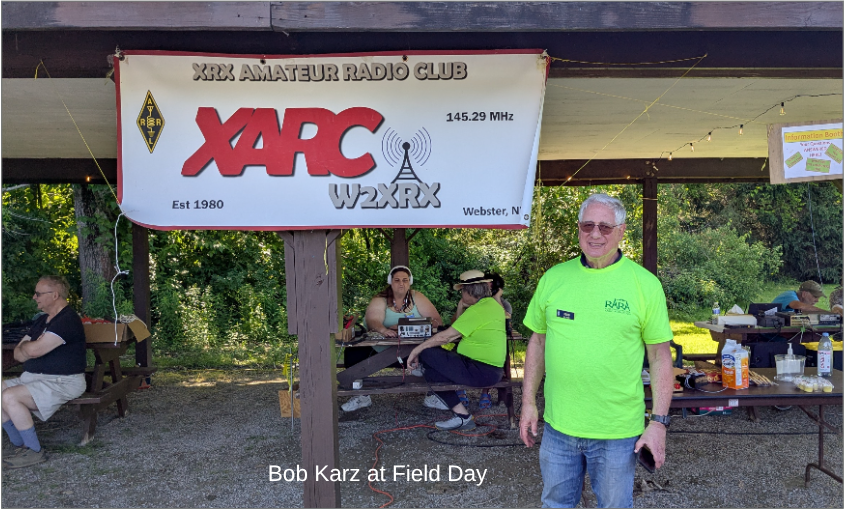
I had the great opportunity once again this year to attend the annual XRX Amateur Radio Club Field Day, held Saturday through Sunday, June 27 to 28. This is basically a ham radio marathon event, designed to replicate setting up communications in emergency conditions.
I took a lot of notes and many photos, but instead of trying to sum up the event from my less-than-knowledgeable perspective, I will once again this year share with you the follow-up report prepared by Field Day Chair Bob Karz:
* * *
For amateur radio, the most important time of the year is the fourth full weekend in June. Over 30,000 of us across the US and Canada set up more than 1,000 temporary stations completely off the grid, typically in parks and other public spaces, making contact with each other as well as international stations. The event is called “Field Day,” and an important objective is to test our readiness to provide radio communication in the event of a natural disaster or other emergency.
Last weekend marked the sixth year that the Rochester Amateur Radio Association (RARA), Monroe County Amateur Radio Emergency Services (MCARES), and the XRX Radio Club have sponsored an amateur radio Field Day at the north end of Webster’s Kent Park. Thirty-nine local amateurs participated this year in perfect weather — not too hot, not too cold, and no rain.
The disastrous Venezuelan twin earthquakes just three days earlier remind us about why emergency communications are essential during a natural disaster. Venezuelan radio amateurs are continuing to work to deliver health and welfare messages throughout the earthquake area. To facilitate their work, certain radio frequencies were declared off limits for this year’s Field Day so Venezuelan communications could continue unimpeded.
We began our Field Day set up on Friday morning stringing our wire antennas high in the trees. Rather than climbing them (difficult and dangerous), we use a homemade “air cannon” to launch a shuttle trailing fishing line into the canopy. The fishing line is replaced with string and then rope which supports our antennas.
We set up five separate stations Saturday morning. Three used voice, Morse code, or a computer mode called FT8. The fourth station used voice only, and was exclusively for beginners. A fifth station was for very high frequency (VHF) relatively short-range communications (about 50 miles). We also set up two generators and various solar cell arrays for power and a computer network to log our contacts.
We began operations promptly at 2:00 pm, and over the next 24 hours made contact with 1,065 stations (165 more than last year) in every state except Wyoming, Nevada, and Alaska, most Canadian provinces, and the countries of Lithuania, New Zealand, Spain, Italy, England, Russia, Germany, Finland, France, and Indonesia. All contacts were completely off the grid as if there were a real emergency. We estimate that we will finish in the top 10 to 15% of about 320 Field Day stations our category.
This year we welcomed visits by Webster Town Supervisor Alex Scialdone, Section Manager Scott Bauer (an officer in the Amateur Radio national organization), and Missy Rosenberry from Webster on the Web and her husband Jack. Field Day is always a good time to showcase our hobby, so we were pleased to welcome visitors from the nearby baseball tournament as well as others in the area who stop by.
Field Day is more than radio contacts. It is also for showing off new equipment, like a measurement tool called a Vector Network Analyzer that tells how well our antennas are working, a small transceiver about the size of a paperback book with about the power of a nightlight that we used to make more than 30 contacts as far away as Missouri, and a keyer that generates Morse code without controls. Rather, you talk to it using (you guessed it) Morse code. We also heard a presentation about homemade “go boxes” with everything needed to get on the air (antenna, transceiver, computer, batteries, microphone, keyer, and all the connecting wiring) are together and ready to go for any emergency. Field Day is also food, lots of it, including a mobile kitchen to prepare real meals but also lots of snack food as well.
Field Day is just a sampling of what amateur radio is about. If you’d like to learn more visit arrl.org or rochesterham.org.
Here’s a whole slideshow of images from the day. Thank you to Bob for many of these:
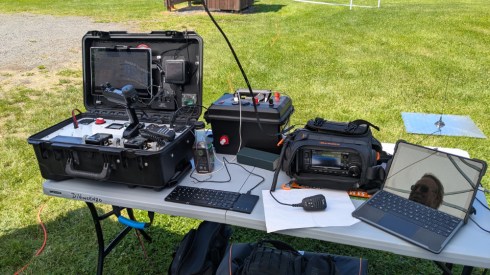
The “go box” on display 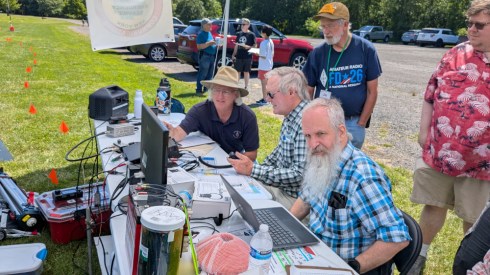
Manning the “GOTA” station (“get on the air”) for newbies 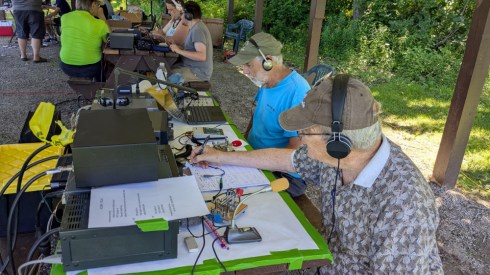
Working the Morse code station 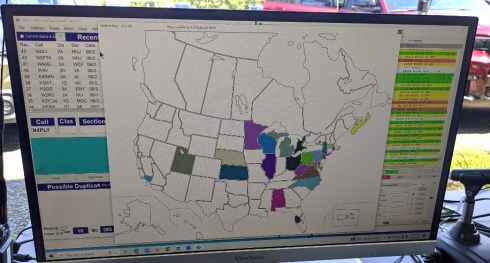
After just an hour, they’d contacted all these states 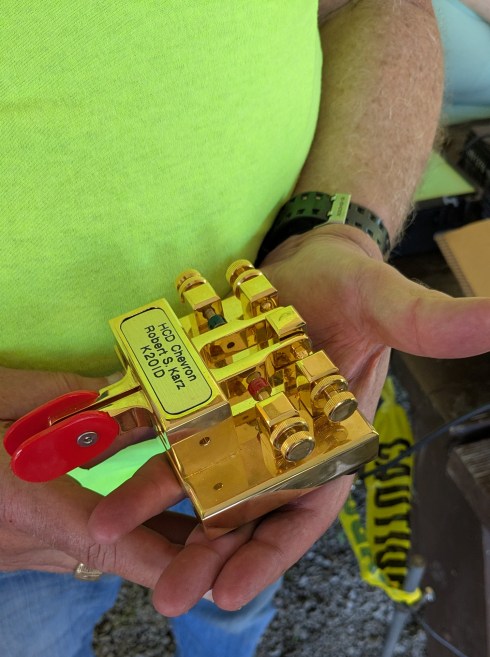
Bob Karz’s gold-plated keyer 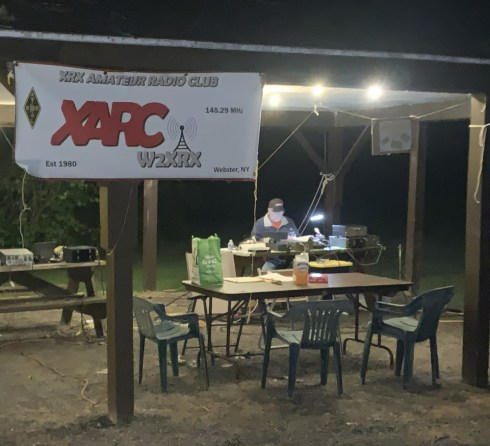
Operating a station into the night 
Joe Delorenzo shows Webster Town Supervisor Alex Scialdone the GOTA station 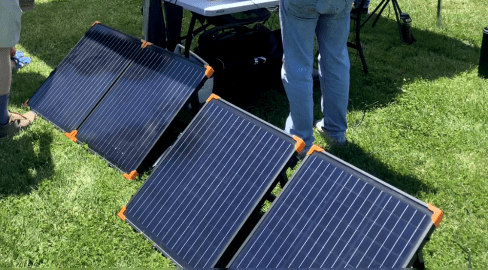
solar arrays 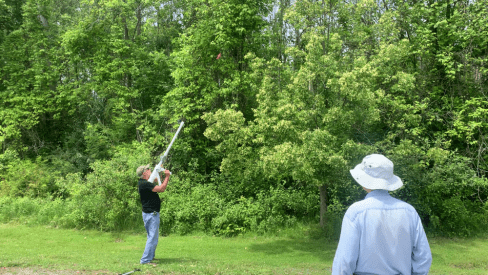
Peter Fournia using an air cannon 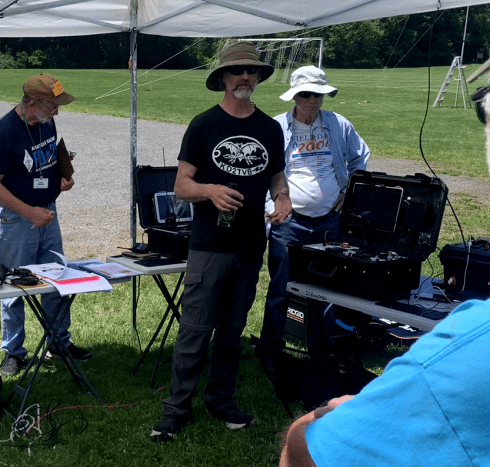
Sam Hartley demonstrates his Go Box
* * *
email me at missyblog@gmail.com. “Like” this blog on Facebook and follow me on Instagram and Threads (@missyblog)
You can also get email notifications every time I post a new blog by using the “Subscribe” link on the right side of this page (or all the way at the bottom of the page if you’re on your phone).
(posted 7/2/2026)


Glad you got out for a visit. Bob’s crew always does a great job. Radio signal propagation was quite good this year – BUT, I’m curious: Did you (and Jack?) Get On The Air? Did you visit the GOTA station? Who(m?) did you talk to? Did you have fun? And finally, what were your thoughts and impressions?
Demonstrating this hobby / service to the public is important. Looks like they had many visitors to the annual FD event, due in part to your recurring coverage; thank you.
No, we didn’t stay very long. I was glad that Jack had a chance to see the operation. He’s not a radio nerd like you guys but is a nerd in his own right and really was interested in everything. Bob is such a nice guy; always appreciates my interest and efforts.