Tag Archives: History Bit

August History Bit: The Forest Lawn train accident

15 Aug

On a quiet summer morning 136 years ago this week, the peaceful community of Forest Lawn was jarred by a horrifying crash. A deadly train accident shattered the town’s calm, leaving twisted tracks, splintered cars, and a tragic story that would be remembered for generations.

August 10, 1889 was a normal day for the Rome, Watertown & Ogdensburg Railroad “stub train,” which ran from Windsor Beach to Forest Lawn every morning. It had pulled into the station at 7:50 a.m., as expected, and passengers were boarding. 

Unfortunately, it was not a normal morning for the “Thousand Island” express train, which was running almost two hours late. It normally barreled through the station at high speed at 6 a.m. But on this morning, as it thundered around the curve, the stub train blocked its path, and the engineer could do little to avoid the collision. 

The resulting crash telescoped the stub train’s coach cars, two of which were lifted off the tracks and shoved against the station house. The express train’s engine ran off into the sand and blew up. Three people lost their lives, including a young girl, and six were severely injured. 

Newspaper accounts from the time didn’t explicitly assign blame, but investigators questioned why no one anticipated that the late-arriving express train would reach Forest Lawn at about the same time as the stub train from Windsor Beach. A man should have been sent down the track to flag the train, the reports argued. Sometimes in such situations, orders are telegraphed ahead to stop at a siding, but the conductor insisted he never received any such order.

A Democrat and Chronicle article published the day following the crash noted that,

The place itself is a most favorable one for accidents. Forest Lawn is … situated on a sharp promontory. The Rome, Watertown & Ogdensburg track curves sharply on each side of the station so that standing on the platform, scarcely twenty rods of track (330 feet) are visible to the west and the stretch of track between the station and the curve to the east is considerably less than that. … A flag was displayed at the rear of the stub train but to expect protection from that means would be worse than foolishness for it would give the engineer of the approaching train no time whatever in which to avert the disaster.

The Rome, Watertown & Ogdensburg Railroad (better known in our area as the Hojack) has been out of business for many years, and the train station is long gone. But while trains no longer run through the Forest Lawn neighborhood, the memory of that tragic day will endure for many years. 

(photo above provided by Webster Town Historian Lynn Barton)

* * *

email me  at missyblog@gmail.com“Like” this blog on Facebook and follow me on Instagram and Threads (@missyblog)

You can also get email notifications every time I post a new blog by using the “Subscribe” link on the right side of this page (or all the way at the bottom of the page if you’re on your phone).

(posted 8/15/2025)

June History Bit: Webster’s kit houses

10 Jun

In today’s wacky and overpriced housing market, it’s fun to remember a time back in the early to mid-1900s when you could purchase your new home from the Sears Catalog. 

They were called “kit houses,” also known as pre-cut houses, ready-cut houses, mail order homes or catalog homes. Basically, they were delivered in pieces, which the homeowner would assemble. They came in many different styles ranging from simple bungalows to imposing colonials, and buyers were encouraged to personalize their order; walls, windows and doors could be moved, added or eliminated. Prices ranged from $3,000 to $10,000 depending on the style, which was a reasonable price even back then. 

Several other companies also offered kit homes, including Montgomery Ward, Aladdin Homes, Wardway Homes, and Bennett Homes. Almost all the materials needed to complete the home were provided, including pre-measured and pre-cut lumber, and hardware. Brick, concrete or masonry were not included, and plumbing, electricity, labor and land would, of course, add to the final cost. But ultimately, a kit home was an economical option for a lot of families. 

Several kit houses still exist in Webster. One in on Shoemaker Rd. Its owner remembers that the ranch-house model was called the Fairmount and it was ordered from Liberty Ready-Cut Homes. It featured a 1330-foot floor plan, with covered porch, three bedrooms, kitchen, living room and dining room.   

She added,

The “kit” was brought in on the Hojack, then the parts were trucked to the building site on Shoemaker. The owners (Irving and Helen Simmons) did much of the assembly themselves and hired contractors for a few things. I can verify that the quality of the construction is superior to the two previous homes I’ve owned, contractor-built, around the same time, and of similar styles. 

These beautiful little (and big) homes were the perfect answer for families looking for an affordable home-buying option, and their quality has survived the test of time. 

You can read more about Webster’s kit houses and more at the Webster Museum, 18 Lapham Park in the Village of Webster. It’s open Tuesdays, Thursdays and Saturdays from 2 to 4:30 p.m. Visit the website at webstermuseum.org

* * *

email me  at missyblog@gmail.com“Like” this blog on Facebook and follow me on Instagram and Threads (@missyblog)

You can also get email notifications every time I post a new blog by using the “Subscribe” link on the right side of this page (or all the way at the bottom of the page if you’re on your phone).

(posted 6/10/2025)

May History Bit: Meet the Webster Museum (Part 3)

10 May

The next stop in our History Bits Tour of the Webster Museum’s permanent exhibits is the office of W. Roy “Bob” Hawley. 

W.R. Hawley was born in 1881 to George Nelson Hawley and Mae Hawley, who owned a prosperous general store. He could have chosen to take that over when he grew up, but instead, in 1910 he opened Hawley’s Hardware Store at 17 West Main St., and later moved it to the corner of Lapham Park. When it closed more than 50 years later in 1965, it was the oldest retail business in the village or town of Webster.

In addition to running his store, W.R. was also actively involved in the Village of Webster’s political and social scenes. In 1931 he was elected village mayor, a position he would hold for the next 34 years.

Among the original items you’ll see when you visit Mayor Hawley’s office at the museum are the roll-top desk which sat in his office at the back of the store, and the store’s ornate cash register.

Adjacent to Mayor Hawley’s office is the museum’s tribute to the many apothecaries and their pharmacists who have served our town. 

Next to a recreated drugstore, complete with an apothecary cabinet, apothecary bottles and mortar and pestle, are biographies highlighting some of Webster’s best-known pharmacists. They include George Mason, who in 1884 built the block at 5 East Main St. and opened a combination drug and grocery store on the first floor; and Milton Case, who owned the Webster Drug Store in the 1930s and served as village mayor for several years. You can also read about Walter Weiner, who bought the Webster Drug Store from Milton Case, and Frank Lucas, who ran the Lucas Rexall Drug Store for 43 years. 

Stay tuned for the next stop on our museum tour of Webster in July when we take a closer look at our town’s dairy industry. In the meantime, you can find out more about the Webster Museum on the website, webstermuseum.org. Or stop by for a personal tour. 

The Webster Museum is located at 18 Lapham Park in the village, and is open every Tuesday, Thursday and Saturday from 2 to 4:30 p.m. There’s no admission charge.  

* * *

email me  at missyblog@gmail.com“Like” this blog on Facebook and follow me on Instagram and Threads (@missyblog)

You can also get email notifications every time I post a new blog by using the “Subscribe” link on the right side of this page (or all the way at the bottom of the page if you’re on your phone).

(posted 5/10/2025)

April History Bit: Willow Point Park

15 Apr

We all know Seabreeze Amusement Park in Irondequoit. It’s been around for almost 150 years, making happy summer memories for generations. Fewer, however, will remember Willow Point Park, Webster’s very own amusement park. It was in business for only three decades, but to this day it evokes very fond memories.

Willow Point Park was located on Bay Road (where Willow Point Rd. is now), a little more than a half mile north of the Empire/Bay Rd. intersection. It was a small, rather quaint amusement park, quite different from the sprawling parks that today’s kids know today. But its more intimate atmosphere was one of Willow Point’s biggest draws, especially for young families. It was also popular because, despite its moderate size, it featured many unusual attractions which were – and are – hard to find at the bigger amusement parks.

Everett DeNeve opened the first incarnation of Willow Point Park in the early 1930s. It began as just a miniature golf course, but every year DeNeve expanded it with new attractions. By 1939, he sold Willow Point to Jack Garliner, who would direct its expansion well into the early 1960s. 

In many respects, Willow Point seemed more like a summer camp than an amusement park. Throughout its almost 30-year history, its various attractions included an archery range, trampoline, batting cages, tennis, volleyball, badminton and small boats. But of course there were also plenty of traditional amusements and rides, including an arcade, a roller coaster, carousel, tilt-a-whirl, kiddie rides (which by today’s standards were especially quaint), and several other rides for young thrill-seekers.

As Garliner added and swapped out features through the years, Willow Point became a favorite gathering place for all ages. Teens and young adults would crowd into the roller rink/dance hall to see nationally-known bands, and a bingo hall added in the 1950s attracted older adults. 

Garlinger even made sure that disadvantaged children could enjoy his park. In the 1950s, he started offering “free days” for blind children one day a year and provided free lunches. Those events were followed later by similar days for children with multiple sclerosis and cerebral palsy.

In 1964, a year before he died, Garliner offered to sell Willow Point Park to the Town of Webster, with no success. After Garliner’s death, Joseph Schuler bought Willow Point in 1966, and kept it open until Labor Day, 1968. The land sat vacant for years before it was redeveloped as the Waterview Townhouse Apartments complex.

* * *

email me  at missyblog@gmail.com“Like” this blog on Facebook and follow me on Instagram and Threads (@missyblog)

You can also get email notifications every time I post a new blog by using the “Subscribe” link on the right side of this page (or all the way at the bottom of the page if you’re on your phone).

(posted 4/15/2025)

February History Bit: Happy birthday Village Hall

8 Feb

Today’s Bit of Webster History celebrates a notable birthday. Last week, the current Webster Village Hall turned 60 years old

The current Village Hall, located at 28 West Main St., was constructed in 1964 on the former site of Klem Chevrolet. In 1921, Walter Klem and his brother Frank took over the Johanson blacksmith shop, and eventually started selling Chevrolets. In 1963 the property was sold to the Village and Klem Chevrolet later moved to 740 Ridge Road.

The Klem building was demolished and construction of the new Village Hall began in 1964. Officials moved into the new building in the middle of January, 1965 and the first official function held there was a meeting of the Village Board. 

On January 27, 1965, the Village hosted a grand community celebration and open house. The event was advertised in the Webster Herald as an opportunity for village residents to “view and inspect the new village hall and its facilities, which include Customer Counter, Billing Machines, Vault, Mayor’s Office, Meeting Room and DPW Office and Garage.” Vice-Mayor Donald King was on hand to show off the facility, assisted by Trustees Milton Case and James Hall and several staff members. Mayor Hawley couldn’t be there because he was ill. 

Prior to 1965, the Village Hall was located next door in the area which is now an entrance to the back parking lot behind Village Hall. The two-story building was constructed in 1912. The first floor housed the Fire Department’s equipment, along with three steel cells used as the village and town jail. Two big front rooms on the second floor were used for village and town offices. A large assembly room in the back was used for elections, trials, and various meetings. The basement served as a warehouse for the public works department.

Thank you to the folks at the Village Hall and the Village’s Historic Preservation Committee for pulling all this information together.   

Want to learn more about Webster history? Visit the Webster Museum, located at 18 Lapham Park in the village. It’s open every Tuesday, Thursday and Saturday from 2 to 4:30 p.m. There’s no admission charge. Or log onto webstermuseum.org. And if you’re especially interested in historic village properties, visit the Historic Preservation Commission website at websterhpc.com.

* * *

email me  at missyblog@gmail.com“Like” this blog on Facebook and follow me on Instagram and Threads (@missyblog)

You can also get email notifications every time I post a new blog by using the “Subscribe” link on the right side of this page (or all the way at the bottom of the page if you’re on your phone).

(posted 2/8/2025)

October History Bit: the Burning Ship of Nine Mile Point

19 Oct

From the shores of Lake Ontario, I bring you a ghost story. It’s the legend of a long-lost ship whose spectral image (some say) can still occasionally be seen sailing under a blue moon. 

The story hails from 1835, the heyday of lake-sailing cargo schooners. Nine-Mile Point was a natural stopping point for local shippers; the large sand bluff poked out into the lake and had a tree at the point’s end, making it easy to identify.  

Angus McClone and Dirk VanWesterly were two tight-fisted farmers who had large farms near Nine Mile Point. Ship captains who docked there knew both farmers well, especially their penchant for haggling over shipping rates. Successful ship captains refused to deal with them, but there were always others who needed the money and had no choice but to agree to a bad deal. 

One such captain was Hugh Bowe. His ship was called the Nilfred, and it was in very bad condition. McClone was on shore when it pulled into harbor, and – sensing that the ship’s captain would be desperate for funds – McClure negotiated a very unfair rate to have his goods shipped to Charlotte.

Adding insult to injury, McClone and VanWesterly demanded free passage to Charlotte, where they made a good profit selling the cargo. Then they demanded a free ride home. Since he’d not yet been fully paid, Bowe agreed, setting sail under a blue moon back to Nine Mile Point, furious about how these country farmers had gotten the better of him. 

On the way back to Nine Mile Point, McClone and VanWesterly tucked into a bottle of whiskey to celebrate their good fortune, and soon started talking too much about how much money they’d made. Hearing this, Bowe and his crew hatched a plan. Why not kill the farmers, take their money, set the Nilfred on fire and row away in a lifeboat? The people on shore would see the fire and assume that all on board had died.   

The plan went off without a hitch. The crew dispatched the farmers, found the money, and when the ship arrived back at the mouth of Four Mile Creek, the sailors set it afire, boarded a lifeboat and started paddling to shore. The schooner sailed away slowly toward the middle of the lake. 

But the winds at Nine Mile Point can be capricious. They turned the schooner completely around and it started sailing back to shore, heading straight towards the lifeboat. Unable to get out of the way in time, the Nilfred crashed into the lifeboat, killing Bowe and his crew. 

Then the winds changed again, turning the Nilfred completely around once more. It was last seen sailing away over the horizon, a blazing torch under a blue moon. 

It’s said that sometimes, on nights of a blue moon, a ghostly apparition of a burning ship appears far out on the lake off Nine Mile Point. It moves towards the shore, and then suddenly turns around and disappears over the horizon.

Perhaps the farmers’ ghosts are trying to get back to reclaim their lands.      

This story, and the image above, were pulled from The Burning Ship and other Legends: Tales and Lore of Western New York (1994) by C. Benn Forsyth, still available on Amazon.com.

Discover more fascinating Webster history at the Webster Museum, 18 Lapham Park. It’s open Tuesdays, Thursdays and Saturdays from 2 to 4:30 p.m. Find out more at webstermuseum.org.

* * *

email me  at missyblog@gmail.com“Like” this blog on Facebook and follow me on Instagram and Threads (@missyblog)

You can also get email notifications every time I post a new blog by using the “Subscribe” link on the right side of this page (or all the way at the bottom of the page if you’re on your phone).

(posted 10/19/2024)

September History Bit: Going to school at the Webster Museum

18 Sep

Have you ever visited the recreated one-room schoolhouse at the Webster Museum? Even if you haven’t, there’s a good chance your children have toured this charming piece of Webster history, and maybe even got to wear the dunce cap.

For this month’s History Bit, in honor of the beginning of the new school year, I bring you back to a time before buses and backpacks.

A bit of Webster History: The Webster Museum’s one-room school 

This month’s History Bit takes a closer look at a piece of Webster schoolhouse history, faithfully recreated at the Webster Museum. 

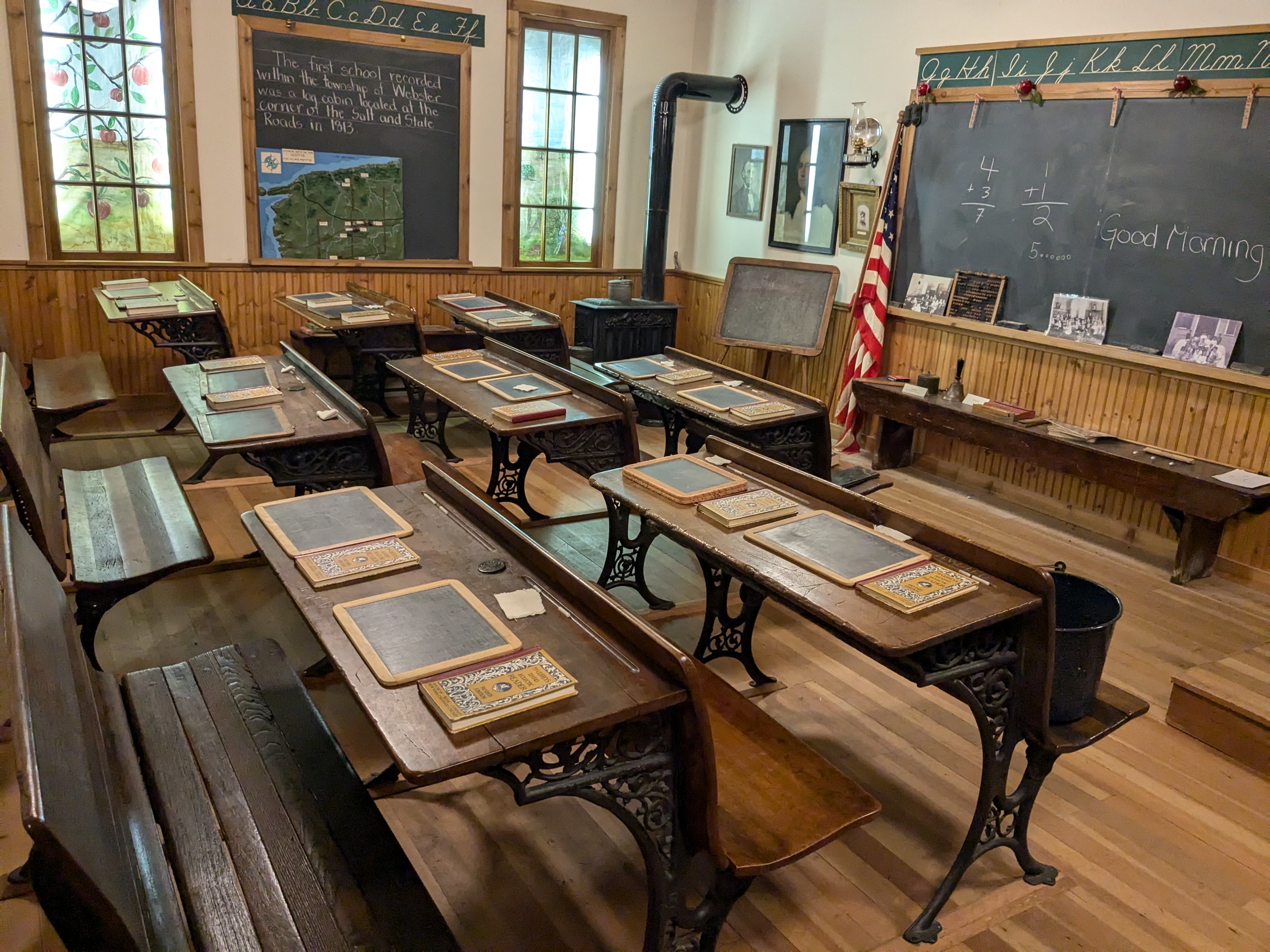
It’s the museum’s very own one-room schoolhouse. Tucked at the far southern end of the museum’s exhibit space, the room represents a typical early-1900’s schoolroom. It seats 24 students at double desks and includes a schoolmaster’s desk, a collection of early textbooks, and early teaching aids.   

The schoolroom is a very popular tour stop for the elementary school classes who visit the Webster Museum every year. As part their 75-minute tour through all of the museum’s exhibits, students take a 15 to 20-minute detour into the classroom and step back into a time when a wood stove provided the heat, lessons were completed on slates, and your older brother or sister might be sitting in a row behind you.

The lessons are designed to be as interactive, entertaining and humorous as possible, while illustrating what a typical school day would look like 120 years ago. The teacher rings a school bell to begin the day, students complete a math lesson on the slates, and are required to raise their hand and stand when called upon. They hear about how students had to walk to school because there were no school buses, how the wood stove in the corner of the room provided all the heat, and when you looked out the window you would very likely see fields and orchards, not a playground and parking lot. 

More than a dozen volunteers, many of them retired teachers themselves, take turns leading the museum tours and presenting the classroom lesson. Most of the students who come through are Webster Central School District second graders; the curriculum that year focuses on community, and a big part of that is comparing “then and now.”  

Our children already know all about “now.” And thanks to our dedicated Webster Museum volunteers, they’re also learning about “then,” when Webster was an agricultural community and the schools – and school day – looked a whole lot different.  

Stop by the Webster Museum and visit the schoolroom for yourself. The museum is located at 18 Lapham Park in the Village of Webster, and is open Tuesdays, Thursdays and Saturdays from 2 to 4:30 p.m. Read more about the classroom and all of the museum’s exhibits at webstermuseum.org.

* * *

email me  at missyblog@gmail.com“Like” this blog on Facebook and follow me on Instagram and Threads (@missyblog)

You can also get email notifications every time I post a new blog by using the “Subscribe” link on the right side of this page (or all the way at the bottom of the page if you’re on your phone).

(posted 9/18/2024)

August History Bit: Webster Union Cemetery

14 Aug

Webster Union Cemetery, located at the corner of Rt. 250 and Woodhull Rd., is one of the richest historical sites in Webster. 

Farmland was donated for the first known burial in 1817, when a Webster child needed a place to rest. It was originally called The Burial Ground, Lakeside, Union Cemetery of Webster. Since this caused some confusion between other areas near Webster, especially Union Hill Cemetery, the name was officially changed to Webster Union Cemetery in April 1954.

In 1859, Webster’s first settler, Abram Foster, was buried there at the age of 90. He was the first of many prominent families to come, including the Burnetts, Curtices, Fosters, Pelletts, Woodhulls, Whitings, and Wrights. Veterans from the Revolutionary War, War of 1812, Civil War, World Wars I and II, the Korean War and the Vietnam War are buried there as well.

The cemetery is also stunningly beautiful. In 2008 it was awarded the Historic Landscape Award from the Landmark Society of Western New York, and was listed on the National List of Historic Places in 2022.

This month, Webster Union Cemetery celebrates 200 years as an active burial ground, and community members are invited to the party. 

On Saturday Aug. 17 from 11 a.m. to 3 p.m., visitors are invited to stroll Webster Union Cemetery’s beautiful grounds and “meet” some of Webster’s earliest settlers. Talk to a suffragette fighting for women’s right to vote, a 1918 Spanish flu victim, Civil War soldiers, shopkeepers, boardinghouse owners, and even a Revolutionary War spy. You’ll also have a chance to learn headstone cleaning and preservation. Admission is free. 

Webster Union Cemetery is located at 345 Webster Rd. (corner of Rt. 250 and Woodhull). Find out more about all of Webster’s historic cemeteries at the Webster Museum, 18 Lapham Park in the Village of Webster. It’s open Tuesdays, Thursdays and Saturdays from 2 to 4:30 p.m. Visit the website at webstermuseum.org.

* * *

email me  at missyblog@gmail.com“Like” this blog on Facebook and follow me on Instagram and Threads (@missyblog)

You can also get email notifications every time I post a new blog by using the “Subscribe” link on the right side of this page (or all the way at the bottom of the page if you’re on your phone).

(posted 8/14/2024)

July History Bit: the Webster Fireman’s Carnival

11 Jul

If you’ve seen this week’s edition of the Webster Herald, you’ve already seen this month’s History Bit, which you’ll see in its entirety below.

To research that article, I drew heavily from the Webster Volunteer Fire Department’s 1906-2006 100th anniversary volume, and historical editions of the Herald. I discovered all sorts of interesting facts about the carnival, but had to leave many of them out in the interest of newspaper space. Since I have no space concern in a blog, I’ve posted much of that additional information here, following the original Bit.


Some Webster Fireman’s Carnival history

With the return of the Webster Fireman’s Carnival this week, it seems an appropriate time to take a look back at the history of this very popular and long-running summer event.  

According to the Webster Volunteer Fire Department’s 100th anniversary history book, the Fireman’s Carnival turns 87 years old this year. The first carnival was held July 23 and 24, 1937 on Ridge Rd. just west of Corning Park, where Pierce St. is now. The first chairman, Russell B. Mason, reported a net profit of $514.63. 

Not much is known about that first year, but we do know that the carnival was held at the same location the following year. The July 15, 1938 edition of the Webster Herald reported that carnival-goers would enjoy four thrilling rides, plus free dancing and entertainment. They could also enter to win cash door prizes, a radio from Hawley’s Hardware and a refrigerator from Netzman’s Appliances. 

The 1938 carnival was even more successful than the first, netting about $1100 despite some challenges. It rained buckets Friday night, and on Saturday the Ferris wheel broke down. Fortunately, though, carnival-goers had other entertainment options, including a hoop-rolling contest and a “Dutch bowlers” (cricket) demonstration game, which attracted an audience of 700. 

Even before the 1938 carnival, the Webster Fire Department was well into the planning stages of purchasing its own property for use as carnival grounds. That September, they finalized the sale of a 24-acre tract of land owned by William Partridge near their current festival location west of Corning Park, purchased for $2500. The firemen have held their carnival on that property, now known as Fireman’s Field, every year since. 


Now, here are some other interesting things I read:

  • In 1939, just two years after the first carnival, stands were built on the new property and a water line installed.
  • In 1940, wooden toilets were installed.
  • Several improvements were made between 1946 and 1950, including constructing two bridges across the stream, and building a storehouse and a building with flush toilets.
  • In the early 1950s there was talk of building a community pool, with an awning, on the site. But those plans never got off the ground.
  • In 1956 the Webster School Board asked for a right-of-way across the Fireman’s Field to Ridgecrest School. At the time, the board was granted permission to allow children to walk across the field to school, In June of 1957, a road was built across the field from Ebner Rd. (which at the time ended at the village line) to the Ridgecrest property line.
  • The “clubhouse,” now known better as the Firemen’s Exempt building, was erected in 1960.
  • In the early 1970s, restrooms were enlarged and remodeled, hot water and sinks were added to the food booths, and several stands were rebuilt after suffering damage in a windstorm.
  • Carnival organizers applied for their first Game of Chance license in 1982.
  • In 1983, McDonald’s inquired about purchasing a parcel of the property along Ridge Rd. The motion was voted down. Three more offers were made in 1986 for “the front piece of the carnival grounds” for $100,000, $200,000 and $270,000, which were all turned down. (It appears that the decision to sell the property was finally made in late 1987.)
  • In 1985 (and for several years in the late 80s and early 90s) the carnival was opened up Friday night to local homes for the handicapped so they could enjoy the festivities without the crowds.
  • In 1986, 2.765 acres adjacent to the carnival field were purchased from the school district for parking.
  • The beer stand ticket booth was built in 1988.
  • In 1999, a few buildings were removed to make room for more rides.

* * *

email me  at missyblog@gmail.com“Like” this blog on Facebook and follow me on Instagram and Threads (@missyblog)

You can also get email notifications every time I post a new blog by using the “Subscribe” link on the right side of this page (or all the way at the bottom of the page if you’re on your phone).
(posted 7/11/2024)

March History Bit: Happy Birthday Bay Bridge!

14 Mar

The Irondequoit Bay Bridge celebrated a birthday last month.

On Feb. 3, 2024, the Bay Bridge turned 54 years old. Stretching almost a half mile long, the bridge was christened on a snowy day in 1970, which was reportedly so cold that the celebratory wine froze in the glasses before it could be raised. 

Seven months later, on a much sunnier and warmer late August day, the bridge was officially dedicated with not one, but three ribbon cutting ceremonies; one held at the Irondequoit end, a second in the middle and a third at the Webster end.

The project took about two years to build, and apparently much of the discussion during the process centered around what to name the new span. Many ideas were suggested, including naming it after Donald Holleder or even calling it the Hiawatha Bridge. But state regulations didn’t allow any project using state money to be named after a person, so ultimately it became known only as the Irondequoit Bay Bridge.  

Interestingly, the plows waiting on that icy February morning to spread some salt across the newly opened bridge were not the first vehicles to cross. 

As reported Sept. 9, 1970 in the Webster Herald

The first “man” across the bridge made it on Feb. 3 at 4:28 a.m. via Union Hill Ambulance. He was then one-year old Kevin Lohse of Greensboro Drive who had stopped breathing. The ambulance was conducted by a police car driven by Sgt. Gil Kunzer whose idea it was to remove the bridge barriers, thus saving needed time and perhaps the youngster’s life. 

Young Kevin, healthy and happy, attended the ribbon cutting ceremonies in August.

Discover more fascinating bits of local history at the Webster Museum, 18 Lapham Park in the Village of Webster. It’s open Tuesdays, Thursdays and Saturdays from 2 to 4:30 p.m. Visit the website at webstermuseum.org.

* * *

email me  at missyblog@gmail.com“Like” this blog on Facebook and follow me on Instagram and Threads (@missyblog)

You can also get email notifications every time I post a new blog by using the “Subscribe” link on the right side of this page (or all the way at the bottom of the page if you’re on your phone).

(posted 3/14/2024)