Tag Archives: History Bit

February History Bit: Webster’s camera, the Winpro

18 Feb

Most longtime Webster residents are already pretty familiar with the industries our town is best known for, like baskets, apple growing, and fruit evaporating. But how many realize that Webster also had a thriving camera-making business? 

From 1948 to about 1954, Webster Industries, Inc. produced the only camera ever made in Webster. It was called the Winpro, and was the first point-and-shoot 35 mm camera made entirely of molded plastic. The factory was at 36-38 Commercial St., near where Response Care, Inc. is now located.

Local camera aficionado Frank Calandra owns several Winpro cameras. In an article he wrote for the Webster Museum website, he says they were made from lightweight Tenite plastic (which, ironically, was invented by Kodak). He notes, however, that “the grade Winpro chose gave them a strong, stable, attractive product. Cameras were made in either gray or black Tenite and proved to be quite rugged.”

They were so sturdy, Frank said, “As a publicity stunt, Winpro cameras were dropped from tall buildings and survived intact and in working order. None of their competitors, which included Argus, Kodak and Ansco dared attempt such a feat. “

The Winpro proved to be a very popular camera, especially for novice photographers. At the attractive price of just $10.95, more than 150,000 were sold in the first two years. This despite stiff competition from several manufacturers of the day, including the photographic powerhouse operating just ten miles to the west in Rochester.  

The camera was produced in Webster until about 1954, when the company fell on hard times and was sold to Zenith Film in Horseheads, NY.

Frank still owns several Winpro cameras, which he says were so well made that they’re still in working order, and still take nice photos. You can check out his collection, on display now at the Webster Museum. You can also read Frank’s article about Webster’s own Winpro camera on the Webster Museum website, webstermuseum.org, under the “History” tab. 

The Webster Museum is located at 18 Lapham Park in the Village of Webster, and is open every Tuesday, Thursday and Saturday from 2 to 4:30 p.m.

* * *

email me  at missyblog@gmail.com“Like” this blog on Facebook and follow me on Instagram and Threads (@missyblog)

You can also get email notifications every time I post a new blog by using the “Subscribe” link on the right side of this page (or all the way at the bottom of the page if you’re on your phone).

(posted 2/18/2024)

September History Bit: the Town of Webster’s official tree

17 Sep

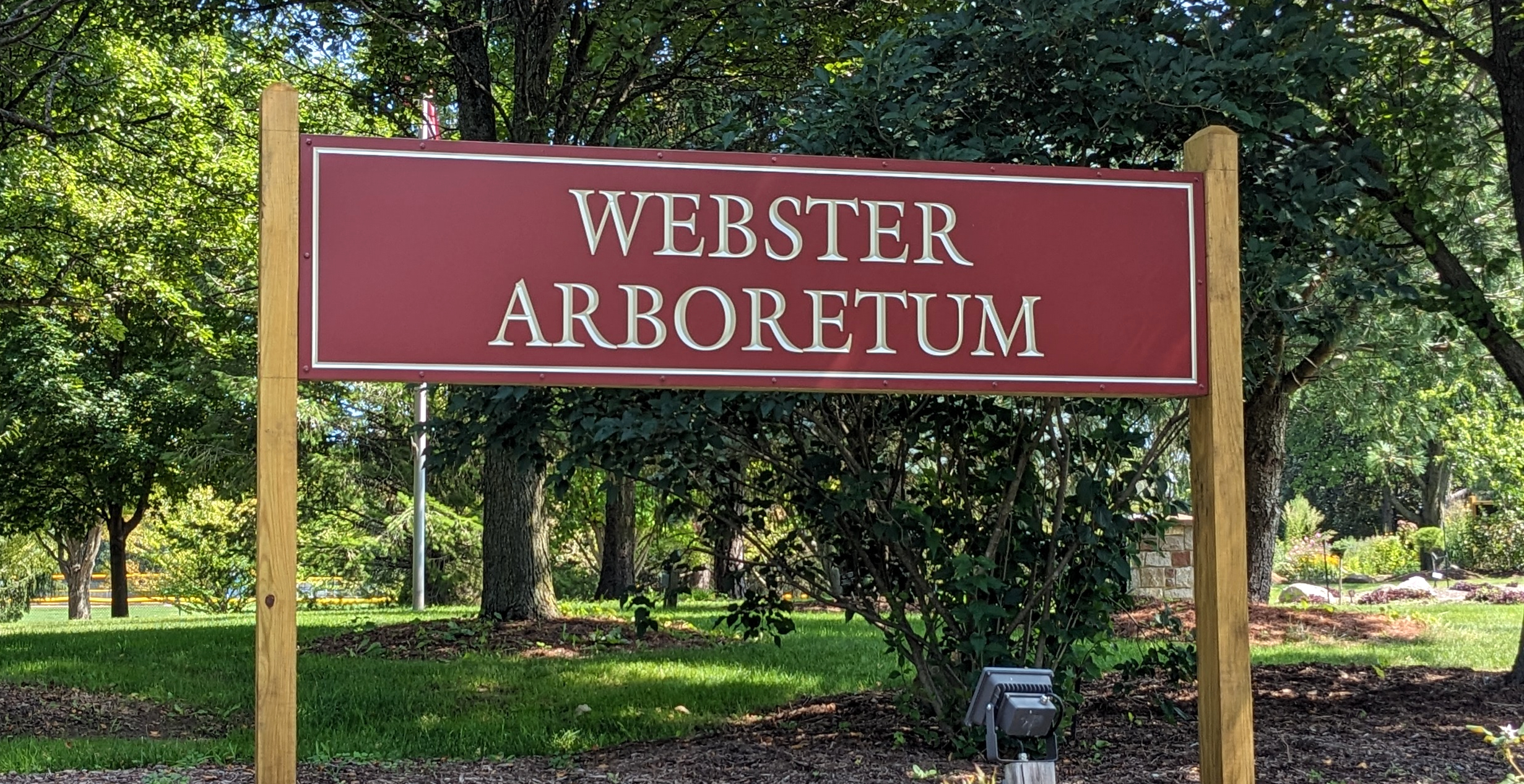
In this month’s History Bit, we shine a spotlight on the Webster Arboretum, and a beautiful little tree with the peevish name, the crabapple. 

Most people probably don’t realize that the flowering crabapple is the Town of Webster’s official tree. According to the Webster Arboretum website, that designation can be traced back to Elizabeth Sykes, a member of the Webster Country Gardeners Garden Club. Back around 1970, she urged the Town to adopt the tree as the Town Tree. (No one seems to know why she chose the crabapple).

Sykes then asked Jean Thompson and Carole Huther to approach the Town about establishing a crabapple arboretum. The perfect location seemed to be a parcel of land the Town had purchased several years earlier, two family farms on Schlegel Rd. owned by Herman Rieflin and Walter Wright. On June 21, 1971 the Town accepted the proposal and set aside 20 of the 80 acres for the arboretum. 

Of course the first plantings were crabapple trees.

In the years since it was established, the Webster Arboretum – officially known as the Webster Sesquicentennial Arboretum at Irving Kent Park, and now about 40 acres – has seen many improvements and expansions, especially in anticipation of the Town’s sesquicentennial celebration in 1990. The beautiful results of those efforts and continuing support from the Town of Webster, Webster community members and a dedicated team of volunteers can be seen today in its bountiful gardens and along its flower-filled paths.  

The Webster Arboretum is located at 1700 Schlegel Rd. To read more about this beautiful park, visit the Arboretum website.

Discover more interesting bits of local history at the Webster Museum, 18 Lapham Park in the Village of Webster. It’s open Tuesdays, Thursdays and Saturdays from 2 to 4:30 p.m. Visit the website to learn more.  

P.S. If you’re enjoying these History Bit features and would like to read more of them, check out the link on the right of the blog home page, where I’ve posted all of the History Bits since September 2022.

* * *

email me  at missyblog@gmail.com“Like” this blog on Facebook and follow me on Instagram and Threads (@missyblog)

You can also get email notifications every time I post a new blog by using the “Follow Me” link on the right side of this page.

(posted 9/4/2023)

July History Bit: The Village of Webster’s very own pioneer cemetery

24 Jul

The Town of Webster has several beautiful cemeteries, most very familiar to us. But the smallest of our town’s cemeteries is often forgotten, even though many of us pass by it almost every day.  

Robb Cemetery is an 8700-square foot parcel of land on East Main Street in the village of Webster, just west of Phillips Road. It is a true pioneer burial ground, with at least eight known burial sites dating back to 1823. 

The land was originally set aside from the farm of Andrew Robb as a family burial ground – the only one in Webster – but other friends and relatives were also buried there.  

For many years there was no indication the land held a cemetery – no signage, not even any gravestones. At one point, interestingly, one of the neighboring homeowners decided to just lay claim to it and paved it over for a parking lot.

In 2013, though, the Village of Webster officially took possession of the property, cleaned it up, and erected a handsome sign naming all of the pioneers known to have been buried there.  

A fascinating little piece of that cemetery’s history now resides at the Webster Museum. It’s the headstone for Nelly Wood, who died in 1838 at age 84. It was found many years ago in the basement of the house just west of the cemetery. No one really knows how long it was there, or Nelly’s connection with the Robb Family. But it is a nice reminder of the significance of Webster’s very own pioneer cemetery. 

Stop by the museum to see it for yourself any Tuesday, Thursday or Saturday from 2 to 4:30 p.m. The Webster Museum is located at 18 Lapham Park in the Village of Webster. 

* * *

email me  at missyblog@gmail.com“Like” this blog on Facebook and follow me on Instagram (@missyblog)

You can also get email notifications every time I post a new blog by using the “Follow Me” link on the right side of this page.

(posted 7/24/2023)

Webster History Bit: a little respect for the proud Irish potato

1 Mar

In honor of the month of March, when we celebrate all things Irish, here’s an amusing – and historical – look back at a vegetable that’s central to Irish heritage: the potato. 

Back in the days when Webster was more a farming community than anything else, the Webster Herald would commonly publish reports on the bounty of the year’s harvest. But the following two items, pulled from a column called “Who Can Beat This?”, published on Oct. 23, 1942 at the height of WWII, focused specifically on two very unusual potatoes. 

The author began, “We are told that food will win the war. And it will. When you get a combination of fighting Irish and Irish potatoes, you just can’t beat it. … Of course we all know that there are no fighting men like the Irish… Now about the potatoes….” 

The article continued, “In the fall of 1941, Martin Hosenfeld, who farms over on the State Road, harvested several acres of potatoes. In sorting them he came across one that weighed 3 pounds and 4 ounces, which goes to prove that you can’t beat the Irish potatoes.” 

Apparently the potato had some even more unusual qualities.

This particular potato was not going to be caught napping, so it was born with eighteen eyes. In the spring of 1942 Mr. Hosenfeld cut the potato into eighteen pieces, one eye in a piece, and planted them one in a hill. From that nineteen forty-one potato that weighed a little more than three pounds, he this year harvested twenty-three pounds of potatoes, practically all of them being of marketable size.

These reports typically also included specifics about the farmer’s methods, perhaps in case others might want to try to grow an even bigger potato. In Farmer Hosenfeld’s case, the author wrote, 

“The soil in which he planted was a heavy loam. He fertilized with twenty ton manure to the acre and half a ton of fertilizer.”

Later in the column, the author reported on yet another monstrous potato, which he theorized might actually help the war effort. 

He wrote, “Fruits and vegetables are certainly going to town this year in size. They realize we are in the war all right and they sure are producing. The latest on the list is a potato that grew in a patch on Ovid Fry’s farm on the Nine Mile Point Road. This little Irish potato weighed three pounds. Not a bad weight for a small potato.” 

“We are going to have this potato baked and while it is good and hot come in and pick it up and you will better realize what Hitler has got a hold of.” 

And in case you’re wondering, “Ovid had four and one-half acres of Katahdins and they produced three hundred bushels to the acre. The soil is a sandy loam and he used 1100 pounds of fertilizer to the acre.”

The Webster Museum has an entire exhibit highlighting Webster’s rich farming history. Stop by for a visit and learn more about, well, maybe not potatoes, but certainly all sorts of fruits and vegetables, cereal grains and more. The Museum is located at 18 Lapham Park in the Village of Webster. It’s open Tuesdays, Thursdays and Saturdays from 2 to 4:30 p.m. Visit the website at webstermuseum.org to learn more.    

P.S., I get a lot of amusing historical tidbits from this great website: https://nyshistoricnewspapers.org. It’s digitized newspapers from all over New York State, and the search function is easy to use. I use it for the Webster Herald, but I’ve also reviewed Buffalo and Binghamton newspapers for family names. Check it out sometime.

* * *

email me  at missyblog@gmail.com“Like” this blog on Facebook and follow me on Instagram.

You can also get email notifications every time I post a new blog by using the “Follow Me” link on the right side of this page.

(posted 3/1/2023)

Meet “Nipper,” the Webster Museum’s mascot

7 Feb

For this month’s Webster History Bit, I want to introduce you to one of the Webster Museum’s best friends.

Just steps inside the front door of the Webster Museum sits one of the museum’s most faithful greeters, a life-sized white dog made from papier-mache. His head cocked slightly to one side, he seems to be patiently and carefully listening for when the front door opens and he can welcome the museum’s next visitor. 

His name is “Nipper,” and if you’re of a certain age, you’ll recognize him as the mascot of RCA Victor, one of the most famous trademarks of the 20th century. 

Nipper has been part of the museum’s collection – and presumably welcoming museum patrons – for almost 40 years. But he had some interesting travels before then.  

When exactly Nipper came to Webster has been lost to history but it’s believed that around the late 40s and early 50s, he was a feature on East Main St. in the village, where he sat in the front window of Mayor Roy Hawley’s hardware store, watching the world go by. After many years he was removed from the shop and relegated to Mayor Hawley’s garage. 

Sometime after the death of the Mayor, his widow gave Nipper to her neighbor Dick Batzing, who at the time was a teacher at Bay Rd. Elementary School, and Town Historian. For a few years, Nipper resided in the school’s music room. When the room had to be converted to classroom use, Nipper was moved into a hallway, where he became a beloved landmark, helping students locate their rooms and receiving regular pats on the head as classes passed. 

Nipper did have a very scary experience during his school days, however. In September 1974, vandals broke into the school and chopped him to pieces. Fortunately, a generous benefactor came to his aid several weeks later. Roberta Kappel, an art teacher and mother of a former Bay Rd. student, successfully reconstructed Nipper, and he was returned to the school, to the delight of students and staff members alike.

When Bay Rd. Elementary closed in 1983, Batzing brought Nipper to the Webster Museum, where he continues to delight visitors, both young and old. 

Meet Nipper yourself at the Webster Museum, 18 Lapham Park in the Village of Webster. It’s open Tuesdays, Thursdays and Saturdays from 2 to 4:30 p.m. Visit the website at webstermuseum.org to learn more.  

* * *

email me  at missyblog@gmail.com“Like” this blog on Facebook and follow me on Instagram.

You can also get email notifications every time I post a new blog by using the “Follow Me” link on the right side of this page.

(posted 2/7/2023)

History Bit: Rules for teachers, circa 1872

4 Sep

So I got a new job recently.

Beginning this month, I’ve taken over the job of writing the monthly “Bit of Webster History,” a short feature produced by the Webster Museum highlighting interesting historical tidbits from around our town.

For the last six years, these “Bits” have been researched and written by Webster Museum volunteer Kathy Taddeo. She’s a great writer and I always enjoyed seeing what gems she came up with every month. Needless to say, I have some big shoes to fill.

Here’s my first stab at it:

A Bit of Webster History — Rules for Teachers

In honor of the first week of school and our hard-working teachers, this month’s History Bit takes us back to a time when school was held for all grades in one room heated by a wood stove, writing was done on slates, and the drinking fountain was a metal pail and cup. 

The first school recorded within the township of Webster was a log cabin at the corner of Salt and State roads in 1813. In those days the school year was typically divided into summer and winter terms. Usually a woman would teach girls and young children in the summer, and a man would teach the older boys in the winter after they were released from farm work. 

It was a tough job with some pretty strict rules – and not just with regards to classroom management. Consider this list of Rules for Teachers from 1872:  

  1. Teachers each day will fill lamps, clean chimneys
  2. Each teacher will bring a bucket of water and a scuttle of coal for the day’s session
  3. Make your pens carefully. You may whittle nibs to the individual taste of the pupils. 
  4. Men teachers may take one evening each week for courting purposes, or two evenings a week if they go to church regularly. 
  5. After ten hours in school, the teachers may spend the remaining time reading the Bible or other good books. 
  6. Women teachers who marry or engage in unseemly conduct will be dismissed. 
  7. Every teacher should lay aside from his pay a goodly sum of his earnings for his benefit during his declining years so that he will not become a burden on society. 
  8. Any teacher who smokes, uses liquor in any form, frequents pool or public halls, or gets shaved in a barber shop will give good reason to suspect his worth, intention, integrity and honesty.
  9. The teacher who performs his labor faithfully and without fault for five years will be given an increase of 25 cents per week in his pay, providing the Board of Education approves. 

See the list for yourself at the Webster Museum, where it’s posted just outside the museum’s classroom, which emulates how an actual one-room schoolhouse might have looked in the early 1900s.

The museum, located at 18 Lapham Park, is open Tuesdays, Thursdays and Saturdays from 2 to 4:30 p.m. Visit the website for more historical tidbits about our town’s schools and teachers.

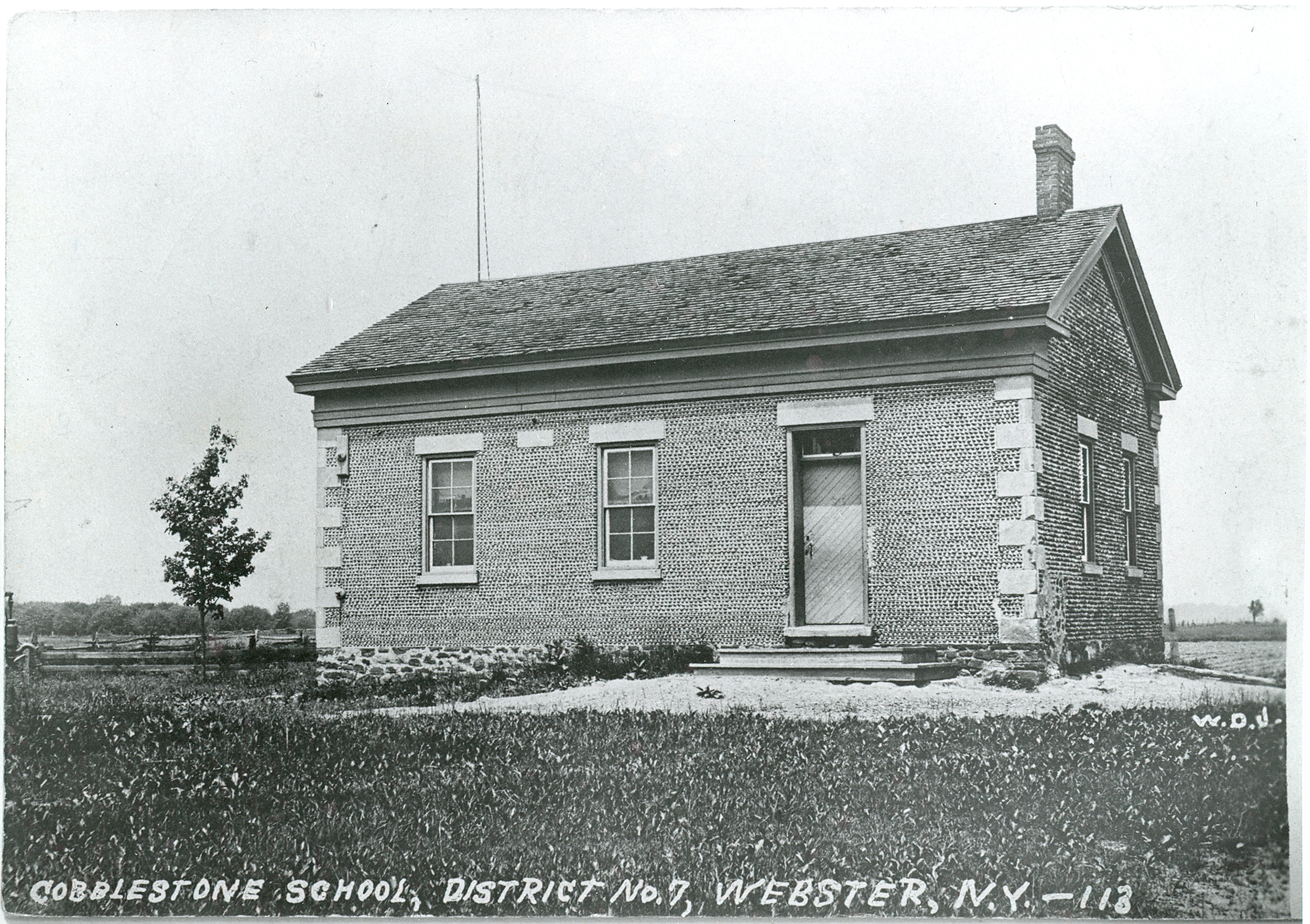
(P.S. The photo above pictures one of the district’s earliest schools, the District No. 7 school on Schlegel Rd., circa 1846.)

* * *

email me  at missyblog@gmail.com“Like” this blog on Facebook and follow me on Twitter and Instagram.

You can also get email notifications every time I post a new blog by using the “Follow Me” link on the right side of this page.

(posted 9/4/2022)